
Compositing Artist Salary Guide: What You Can Really Earn
Did you know that two compositing artists at different studios can earn nearly $90,000 apart, doing essentially the same job? It sounds like a glitch in the data, but it is the reality of one of VFX's most technically demanding roles. If you are trying to understand your worth, plan your next career move, or benchmark your hiring budget, this Compositing Artist Salary Guide cuts through the noise.
These are ArtBlast's own numbers, from the real compositing artist job postings we track across 600+ studio job boards. You will not find them anywhere else.
- 168 compositing artist openings tracked across 89 studios
- 13% of those roles were remote
- Only 6% of postings disclosed a salary range, the rest hid the number
- Top hiring studios: Framestore, Rodeo FX, DNEG, Reel FX Animation, Blue Zoo Animation Studio
- Most active markets: Canada, United Kingdom, United States
Source: ArtBlast game art job tracking, 2026. Using these figures? Please cite ArtBlast and link to this page.
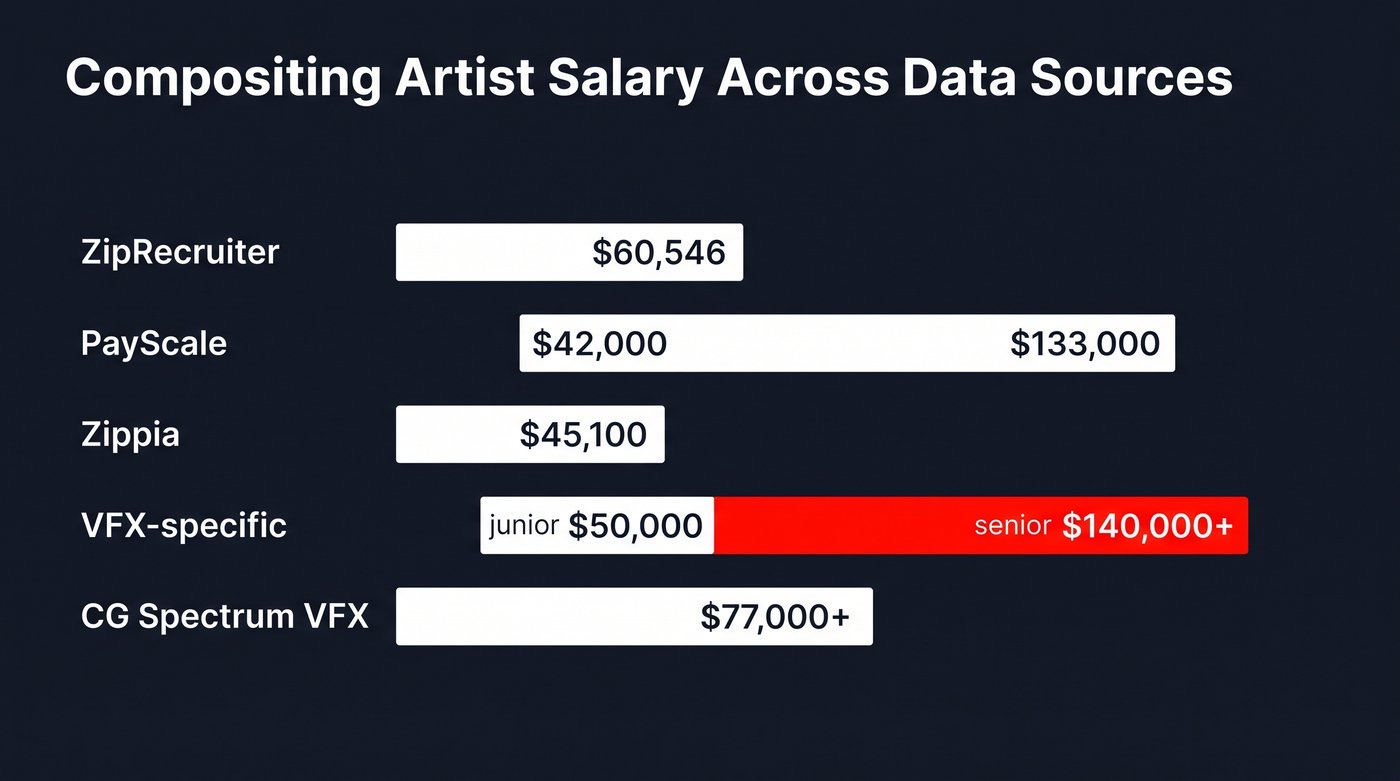
Quick answer: Compositing artist salaries in the US range from roughly $50,000 at the junior level to $140,000 or more for senior and lead roles. The average annual pay sits near $60,546, with hourly rates between $24 and $33 for most working artists, according to ZipRecruiter's June 2025 data.
The wide spread is not a data error. It reflects experience level, location, studio tier, and whether a job title says "compositor" in a generic editing house or at a major film VFX studio. This guide untangles all of it so you can make smarter career and hiring decisions.
Key Findings: Compositing Artist Salary
- US compositing artists average $60,546 ($29.11 per hour) per ZipRecruiter.
- PayScale reports a full range of $42,000 to $133,000.
- VFX-specific compositors run $50,000 junior to $140,000+ senior.
- Film and episodic VFX pay more than general post-production work.
- Nuke mastery and complex shot experience push compositors into the top band.
What Does a Compositing Artist Actually Do?
Before the numbers make sense, the role needs to be clear. A compositing artist, also called a VFX compositor, is the specialist who stitches together 3D renders, live-action footage, matte paintings, and digital effects into a single, seamless shot. They work at the very end of the post-production pipeline, which means their work is what audiences literally see on screen.
Daily responsibilities include keying, rotoscoping, color matching, plate stitching, and paint cleanup. Senior compositors often supervise the final look of entire sequences before delivery. That late-pipeline, high-stakes positioning is a key reason why skilled compositors command strong pay compared to many other 2D VFX roles.
This distinction also explains why salary databases disagree so sharply. Generic "compositor" data often includes video editors and broadcast artists, pulling averages down. When you filter for VFX compositing at film, TV, and games studios, the numbers climb significantly. For those considering this career path, understanding what a VFX artist actually does provides crucial context for the specialized skills that drive these higher salaries.
Compositing Artist Salary by Experience Level
Experience is the single biggest driver of compositing pay. Here is how the ranges break down in major US markets, based on data from ESMA, CG Spectrum, PayScale, and ZipRecruiter.
Junior Compositor (0 to 2 Years)
Junior compositors typically handle supporting tasks such as rotoscoping, cleanup, and simple key work under supervision. Pay in major markets starts around $50,000 to $70,000 per year. PayScale's entry-level hourly data shows rates near $20.63 per hour for those with less than one year of experience, climbing to $23.56 per hour with one to four years on the job.
Mid-Level Compositor (3 to 5 Years)
At this stage, artists own full sequences independently, troubleshoot pipeline issues, and begin mentoring juniors. Annual salaries typically land between $75,000 and $100,000. ZipRecruiter's 75th percentile sits at $68,500 annually, though VFX-specific roles at established studios routinely push into this tier and beyond.
Senior Compositor and Lead (5 or More Years)
Senior compositors and compositing leads oversee teams, drive look development, and often interact directly with directors and VFX supervisors. This is where earning potential accelerates sharply, reaching $110,000 to $140,000 or more per year. PayScale's top hourly rate reaches $77.74 per hour at senior levels, which annualizes well above $130,000 with consistent project work.
Compositing Artist Salary: Full Data Comparison Table
Different platforms measure compensation differently. The table below consolidates the most current data into a single view so you can see exactly where each source sits and why the numbers vary.
| Source | Average Annual Pay | Average Hourly Rate | Range (Low to High) | Data Date |
|---|---|---|---|---|
| ZipRecruiter (US) | $60,546 | $29.11 | $51,500 (25th pct) to $76,000 (top) | June 2025 |
| PayScale (US) | $42,000 to $133,000 | $35.86 avg | $19.97 to $77.74/hr | 2026 (rolling) |
| Zippia (US, trend) | $45,100 | Approx. $21.68 | Historical trend 2022 to 2025 | January 2025 |
| ESMA (VFX-specific) | $75,000 to $140,000+ | N/A | Junior $50k to Senior $140k+ | Industry guidance |
| CG Spectrum (VFX-specific) | $77,000 to $138,000 | N/A | Based on Glassdoor, senior-weighted | Industry guidance |
| Glassdoor India | Approx. $3,200 to $8,640/yr USD | N/A | INR 22k to 60k/month | 2025 (rolling) |
The Zippia and generic PayScale averages skew lower because they include non-VFX compositor roles. The ESMA and CG Spectrum figures reflect film and TV studio benchmarks specifically, which is the relevant range for most readers of this guide.
Regional Salary Differences: US, India, and Beyond
Where you work matters almost as much as how long you have worked. Geography is one of the most powerful levers in your compositing salary negotiation.
- Los Angeles, Vancouver, London, and New York: These are the global VFX hubs. Senior compositors in these markets align with the upper bands, often $110,000 to $140,000 or more annually. NYC day rates of $650 to $750 per day for experienced artists, plus overtime, are credibly reported by working professionals.
- Mid-tier US cities and regional studios: Expect salaries closer to the Zippia and ZipRecruiter midpoints, roughly $50,000 to $75,000 for most experience levels.
- India: Glassdoor India data shows composite artist salaries averaging around INR 42,000 per month (roughly $500 USD), with a range of INR 22,000 to 60,000 per month. This reflects a different cost of living and studio tier structure, not lesser skill.
- Remote hiring: The growth of remote VFX work is beginning to compress some geographic gaps, though top-tier studios still pay location premiums for on-site talent in major production cities.
Skills That Push Your Salary Into the Upper Bands
Technical skill depth is the clearest path to higher pay in compositing. Employers at premium studios are not just hiring someone who knows a compositing application. They want artists who can solve the hard problems that land at the end of the pipeline.
Software Mastery
Nuke is the industry standard at film and high-end TV studios, and fluency in it is effectively a baseline requirement for any role above junior level. Artists who also understand Fusion and Adobe After Effects add flexibility, which is useful in smaller studios or advertising pipelines.
Color Science and Image Literacy
Understanding color spaces, ACES pipelines, gamma curves, and look development separates mid-level compositors from senior ones. Artists who can match a CG render to a plate photochemically, rather than by eye alone, are significantly more valuable. This knowledge directly correlates with the jump from $75,000 to $110,000 and above.
Photography and Optical Knowledge
Compositing is fundamentally about making synthetic elements behave like real light. Artists who understand lens artifacts, depth of field, film grain, and camera data bring that realism naturally. CG Spectrum and ESMA both list photographic literacy as a core differentiator for higher-paid roles.
Pipeline and On-Set Knowledge
Compositors who understand how data moves from camera to final delivery, including VFX pulls, LUT management, and working with on-set VFX supervisors, can troubleshoot upstream problems. That capability is what gets artists promoted to lead roles and the $110,000 to $140,000 salary band.
How to Negotiate a Higher Compositing Artist Salary
Knowing the ranges is only half the equation. Here is a practical, step-by-step approach to getting paid what the data says you are worth.
- Quantify your shot complexity. Before any salary conversation, document the most technically demanding shots you have completed. Stereo compositing, complex keywork in difficult lighting, or invisible cleanup on hero shots all signal senior-level value. Bring specific examples to the table.
- Benchmark against multiple sources. Use ZipRecruiter, PayScale, and industry-specific data from training providers to build a range, not a single number. Knowing that PayScale shows $77.74 per hour at the senior level gives you a credible ceiling to reference.
- Factor in contract and day rates. If you freelance or work on short-term contracts, your day rate needs to account for gaps between projects, no benefits, and self-employment taxes. A $650 per day rate sounds strong, but it equates to roughly $130,000 annually only if you are fully booked. Build your rate accordingly.
- Leverage remote offers strategically. If a remote studio in a lower-cost city offers you work, you can use that offer as a benchmark against a local studio paying less. Conversely, if you live outside a VFX hub, remote roles with major studios can unlock hub-level pay without relocation.
- Demonstrate mentorship and ownership. Studios pay senior rates for artists who reduce the workload of supervisors. If you can show that you have trained juniors, caught upstream CG issues, or owned a sequence from brief to delivery, you are arguing for the top of the band, not the middle.
Salary Growth Trends: Is Compositing Pay Rising?
Zippia's historical data shows US compositor salaries rising from $42,600 in 2022 to $45,100 in January 2025, with annual growth rates between 0.6% and 2.6%. That is modest compared to the rising complexity and volume of VFX work driven by streaming demand, but it reflects a base average that includes lower-paying non-VFX roles.
For VFX-specific compositing roles, the trajectory is more promising. Growing demand from episodic streaming content, cinematic advertising, and video games is expanding the number of compositor positions at all levels. Remote hiring is broadening the talent pool but also the opportunity pool for skilled artists outside traditional hubs.
To put the journey in perspective: a compositor starting at $15 per hour on a night shift in 2011 (a real reported experience) now has a pathway to $650 to $750 per day in a major market with a decade of experience. That is the real story of compositing salary growth: slow at the bottom, steep at the top.
Conclusion: Know Your Value as a Compositing Artist
This Compositing Artist Salary Guide covers the full picture, from entry-level pay around $50,000 to senior-lead compensation above $140,000. Here are the key takeaways to carry forward:
- Generic compositor salary averages ($42,000 to $45,000) undercount VFX-specific roles; the real range for film and TV compositors is $50,000 to $140,000 or more depending on experience.
- Location and studio tier are major multipliers; LA, NYC, Vancouver, and London consistently deliver the upper salary bands.
- Nuke fluency, color science knowledge, and pipeline understanding are the three skill areas most directly tied to moving from mid-level to senior pay.
- Negotiation works best when you quantify shot complexity, use multiple salary benchmarks, and demonstrate mentorship or sequence ownership.
Whether you are a junior compositor mapping your five-year plan or a studio trying to stay competitive in a tight talent market, the data is clear: specialized skill and demonstrated ownership drive this salary, not just tenure. For those looking to maximize their earning potential, exploring the broader VFX artist career path can reveal additional advancement opportunities beyond traditional compositing roles.
New to the role? Read what a compositor does day to day.
Frequently Asked Questions
What is the average salary for a compositing artist in the US?
The average compositing artist salary in the US is approximately $60,546 per year based on ZipRecruiter's June 2025 data, with an average hourly rate of $29.11. However, VFX-specific roles at film and TV studios typically range higher, from $75,000 to $140,000 depending on experience level and studio tier.
How much does a junior VFX compositor make?
A junior VFX compositor in a major US market can expect to earn between $50,000 and $70,000 per year. Entry-level hourly rates start around $20 to $23 per hour according to PayScale data. Pay varies based on studio size, location, and the specific demands of the role, such as working on film versus broadcast or advertising projects.
What skills increase a compositing artist's salary the most?
Mastery of Nuke, deep knowledge of color science and color space pipelines (such as ACES), and the ability to understand and troubleshoot the full VFX pipeline are the strongest salary drivers. Artists who combine these technical skills with photographic literacy and the ability to mentor juniors typically access the $100,000 to $140,000 salary range at senior and lead levels.
How does compositing artist pay differ between the US and India?
The difference is significant and reflects cost of living as much as skill level. US compositors average around $60,546 per year, while Glassdoor India data shows composite artist salaries averaging INR 42,000 per month, roughly $3,800 to $5,000 USD annually. High-end Indian studios and international remote roles can push local pay higher, but the gap remains substantial.
Is compositing a well-paid VFX career compared to other roles?
Yes. Compositing sits at the high-value end of the 2D VFX pipeline. Because compositors work at the final stage of production and are responsible for the quality of what audiences see on screen, they generally earn more than many entry-level generalist VFX roles. Senior compositors and compositing supervisors are among the better-compensated specialists in the broader VFX workforce.
What is the difference between a compositor salary and a VFX compositor salary?
The title matters more than it should. Generic "compositor" salary data often includes broadcast editors, motion graphics artists, and non-VFX roles, pulling averages down to around $42,000 to $45,000 per year. VFX compositor roles at film, streaming, and games studios are filtered for specialized pipeline skills and consistently report salaries between $75,000 and $140,000 for mid to senior levels.
How do freelance day rates compare to full-time compositing salaries?
Experienced freelance compositors in major markets like New York report day rates of $650 to $750 per day, plus overtime. Fully booked, that can exceed $130,000 per year, but freelancers must account for project gaps, no employer benefits, and self-employment taxes. Full-time roles offer stability and benefits, while freelance rates can be higher if you maintain consistent bookings.