Picture this: your passion for sketching fantastical creatures and imaginative worlds could earn you over $136,000 annually in the right market. As creative industries explode with demand in 2026, concept artists are commanding salaries that reflect their crucial role in bringing ideas to life across gaming, film, and digital media.
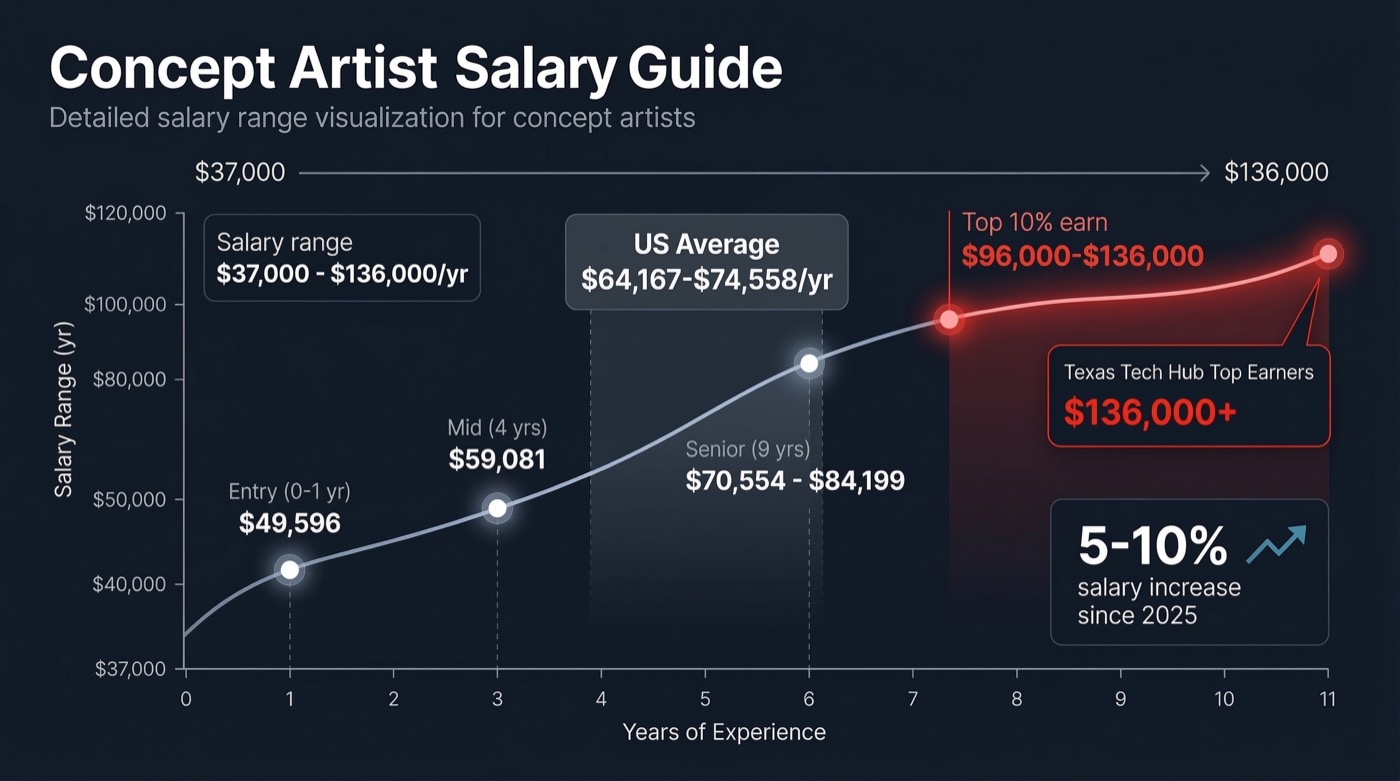
The Concept Artist Salary Guide 2026 reveals an average U.S. salary ranging from $64,167 to $74,558, with specialized markets like Texas tech hubs pushing top earners past $136,000. This represents a significant 5-10% increase from 2025 levels, driven by AI integration, expanding digital campaigns, and growing demand for visual storytelling expertise.
Whether you’re considering a career switch, negotiating your next contract, or simply curious about earning potential in creative fields, understanding these salary benchmarks matters now more than ever. The talent shortage in visual design roles has created unprecedented opportunities for skilled artists to command premium compensation.
Understanding Concept Artist Compensation in 2026
Concept artists serve as visual architects, translating abstract ideas into tangible designs that guide entire production teams. From character designs in blockbuster video games to environmental sketches for architectural firms, these professionals shape the visual language of modern media.
According to Salary.com’s February 2026 data, the average concept artist earns $70,554 annually, up from $68,691 in January 2025. This growth trajectory aligns with broader creative industry trends showing sustained demand for digital visualization expertise.
The role requires mastery of digital illustration tools, understanding of composition and lighting, and the ability to iterate rapidly based on client feedback. These specialized skills justify the competitive compensation packages available in today’s market.
2026 Salary Benchmarks: What the Data Reveals
Multiple authoritative sources paint a consistent picture of concept artist earning potential, though ranges vary based on methodology and regional focus. Understanding these variations helps you benchmark your own compensation accurately.
National Salary Averages
Current 2026 salary data from leading compensation platforms shows:
- Salary.com: $70,554 average (range: $51,607-$98,318; typical positions: $59,749-$84,199)
- PayScale: $64,167 average with documented ranges from $37,000 to $96,000
- Comparably: $74,558 average, though their broader range ($33,403-$309,752) includes outliers and freelance premium rates
This consistency across platforms confirms that most concept artists earn between $60,000-$75,000 annually. The variations largely reflect differences in experience levels, employment types, and geographic markets.
Experience-Based Salary Progression
Your earning potential grows substantially as you build your portfolio and industry reputation. PayScale’s 2026 experience breakdowns reveal clear advancement pathways:
| Experience Level | Years | Average Salary |
|---|---|---|
| Entry-Level | Less than 1 year | $49,596 |
| Early Career | 1-4 years | $59,081 |
| Mid-Career | 5-9 years | $65,000-$75,000 |
| Experienced | 10+ years | $80,000-$96,000 |
This progression demonstrates nearly 50% salary growth potential from entry to experienced levels. Strategic career moves, including employer switches and specialization in high-demand niches, can accelerate this trajectory significantly.
Regional Hotspots: Where Concept Artists Earn the Most
Location dramatically impacts earning potential in creative fields. Tech-heavy markets with concentrated gaming, film, and digital media industries offer substantial premiums over national averages.
Texas: The Unexpected Leader
ZipRecruiter’s January 2026 data reveals Texas as a concept artist salary powerhouse, with an average of $123,748 annually ($59.49 per hour). This represents nearly 75% above the national average, driven by expanding tech hubs and lower cost of living attracting major studios.
Top Texas cities for concept artist compensation include:
- Manor: $143,204 average annual salary
- Austin: $131,659, fueled by gaming and tech startup growth
- Dallas-Fort Worth: $128,000-$136,000 range for experienced artists
The Texas market shows 22% of positions clustered at $64.50-$65.62 per hour, with the 75th percentile reaching $136,000 annually. This concentration suggests robust demand across multiple experience levels.
California and Tech Corridor Premiums
San Jose, California leads national markets with average salaries hitting $147,206, representing 97% above the U.S. baseline. The Bay Area’s concentration of major gaming studios, animation houses, and tech companies creates intense competition for visualization talent.
Other high-paying markets include Los Angeles (entertainment industry demand), Seattle (gaming studios), and New York City (advertising and digital agencies). However, cost of living considerations often make Texas markets more attractive for net income.
Industry Trends Driving Salary Growth in 2026
The creative sector is experiencing transformative changes that directly impact concept artist compensation. Understanding these trends helps you position yourself for maximum earning potential.
AI Integration and Productivity Gains
Robert Half’s 2026 Salary Guide forecasts 5-10% average increases across marketing and creative roles, with specialized positions seeing 10%+ growth. Concept artists who master AI-assisted design tools command premium rates by delivering faster iteration cycles without sacrificing quality.
Rather than replacing artists, AI tools like generative design assistants and rapid prototyping software amplify creative output. Studios increasingly value artists who blend traditional skills with technological fluency, often paying 15-20% premiums for this hybrid expertise.
Cross-Platform Design Demand
The expansion of gaming across mobile, console, VR, and cloud platforms creates unprecedented demand for versatile concept artists. Projects now require designs that translate seamlessly across multiple formats and screen sizes.
This complexity drives salary growth, particularly for artists experienced in UX-informed design principles. The 2026 creative hiring landscape prioritizes candidates who understand both aesthetic excellence and functional user experience.
Personalized Content and Marketing Evolution
Digital marketing’s shift toward ROI-focused, personalized campaigns increases demand for concept artists in advertising and brand development. Companies now budget for custom visual content rather than stock imagery, creating steady work for freelance and in-house artists alike.
This trend particularly benefits artists with strong commercial sensibilities who can translate brand strategies into compelling visual narratives. Marketing-focused concept artists often earn 10-15% above entertainment industry peers.
How to Maximize Your Concept Artist Salary
Strategic career decisions compound over time to dramatically impact lifetime earnings. These proven approaches help concept artists optimize their compensation trajectory.
Step 1: Build a Specialized Portfolio
Generalist portfolios compete in crowded markets, while specialists command premium rates. Identify high-demand niches like character design for mobile games, environmental concepts for architectural visualization, or vehicle design for sci-fi productions.
Your game art portfolio should demonstrate mastery within your chosen specialty while showing enough versatility to handle varied projects. Aim for 15-20 polished pieces that tell a cohesive story about your unique strengths.
Step 2: Master In-Demand Tools and Workflows
Technical proficiency directly correlates with earning potential. Priority skills for 2026 include:
- Advanced Adobe Photoshop and Procreate techniques for digital painting
- 3D blockout skills in Blender or Maya for dimensional accuracy
- AI-assisted design tools for rapid iteration and exploration
- Unity Pro or Unreal engine skills for interactive presentations
Artists fluent in multiple software ecosystems navigate project requirements more flexibly, making them valuable across diverse client needs.
Step 3: Leverage Strategic Job Transitions
PayScale data confirms that employer switches often deliver larger salary increases than internal promotions. Plan career moves every 2-3 years during your early and mid-career phases to capture market-rate adjustments.
When transitioning, negotiate based on demonstrated value rather than previous salary. Use concrete portfolio examples showing how your work contributed to successful projects, quantifying impact wherever possible.
Step 4: Consider Geographic Arbitrage
Remote work normalization creates opportunities to earn high-market salaries while living in lower-cost areas. A concept artist earning the Texas average of $123,748 while living in a mid-sized city enjoys substantially higher purchasing power than Bay Area counterparts.
Research companies with established remote work cultures and location-agnostic pay scales. Many studios now hire nationally while paying rates competitive with their headquarters markets.
Step 5: Develop Business and Communication Skills
Technical excellence opens doors, but professional skills accelerate advancement. Artists who clearly articulate design rationale, manage client expectations effectively, and mentor junior team members naturally progress into lead and supervisory roles.
These positions typically command 30-50% premiums over individual contributor roles while offering greater creative influence over project direction.
Freelance vs. Full-Time Employment Considerations
Employment structure significantly impacts both earning potential and career stability. Each path offers distinct advantages depending on your risk tolerance and lifestyle preferences.
Full-Time Studio Positions
Salaried positions provide predictable income, benefits packages, and collaborative environments that accelerate skill development. Junior artists particularly benefit from mentorship and structured feedback available in studio settings.
However, salary growth follows more predictable curves, with typical annual increases of 3-5% absent promotions or job changes. Geographic limitations also apply, though remote positions are expanding options.
Freelance and Contract Work
Independent artists command higher hourly rates, often 50-100% above equivalent full-time salaries when accounting for benefits and overhead. Comparably’s upper range ($309,752) primarily reflects successful freelancers with established client bases and premium positioning.
This path demands strong business acumen, self-motivation, and financial discipline to manage irregular income. Building a sustainable freelance practice typically requires 2-3 years of industry experience and portfolio development.
Hybrid Approaches
Many concept artists optimize earnings through hybrid models: maintaining stable day jobs while accepting evening and weekend freelance projects. This approach builds client relationships and supplemental income while preserving financial security.
After establishing reliable freelance revenue streams, artists can transition to full independence with reduced risk and proven market demand.
Navigating Salary Negotiations as a Concept Artist
The wide salary ranges in concept art reflect both market variability and negotiation outcomes. Equipped with current data, you can confidently advocate for fair compensation aligned with your skills and market position.
Research specific company ranges using platforms like Glassdoor and Levels.fyi before negotiations. Entry-level artists should target the $49,000-$59,000 range, while experienced professionals with strong portfolios justify $80,000-$96,000 or higher in major markets.
Present your case using concrete examples: projects completed, skills acquired, and measurable contributions to team success. Avoid discussing personal financial needs; instead, frame negotiations around market value and the specific value you bring to their projects.
Consider total compensation beyond base salary, including bonuses, profit sharing, professional development budgets, and equipment allowances. Some studios offer royalty participation on successful titles, creating significant upside potential.
Future Outlook: What’s Next for Concept Artist Careers
The convergence of technological advancement and expanding digital media consumption creates a robust long-term outlook for concept artist careers. Industry projections through 2028 suggest sustained growth in creative roles, particularly those combining artistic vision with technical fluency.
Emerging opportunities include virtual production for film and television, metaverse environment design, and AI training data creation. Artists who position themselves at the intersection of traditional artistry and emerging technologies will command the highest premiums.
The talent shortage identified in the 2026 Salary Guide from Robert Half suggests continued upward pressure on salaries, particularly for mid-career and senior artists. Companies competing for limited talent increasingly offer signing bonuses, retention packages, and accelerated advancement opportunities.
Key Takeaways from the Concept Artist Salary Guide 2026
Understanding compensation benchmarks empowers better career decisions and more effective negotiations. The current market offers substantial opportunities for concept artists at all experience levels.
Core insights include average salaries ranging from $64,167 to $74,558 nationally, with premium markets like Texas and San Jose offering $123,748 to $147,206 for the same roles. Experience-based progression shows clear pathways from $49,596 entry-level to $96,000+ for seasoned professionals.
Industry trends point toward 5-10% salary growth continuing through 2026 and beyond, driven by AI integration, cross-platform design needs, and personalized content demand. Strategic specialization, tool mastery, and smart career transitions maximize earning potential.
Whether you’re just starting your journey or optimizing an established career, the Concept Artist Salary Guide 2026 data confirms strong market fundamentals and growing recognition of visualization expertise as essential to modern creative production. Position yourself strategically, negotiate confidently, and continue developing skills that align with industry evolution.
Frequently Asked Questions
What is the average concept artist salary in 2026?
The average concept artist salary in 2026 ranges from $64,167 to $74,558 annually depending on the data source, with Salary.com reporting $70,554 as the current national average. Entry-level positions start around $49,596, while experienced artists with 10+ years earn $80,000-$96,000 or more. Geographic location, industry sector, and employment type (freelance vs. full-time) significantly impact these figures.
Which cities pay concept artists the highest salaries?
San Jose, California leads with average salaries of $147,206, followed by Texas cities including Manor ($143,204), Austin ($131,659), and Dallas ($128,000-$136,000). These markets offer 75-97% premiums over national averages due to concentrated gaming, tech, and entertainment industries. However, when adjusting for cost of living, Texas markets often provide superior net income compared to coastal cities.
How does experience level affect concept artist pay?
Experience creates substantial salary progression in concept art careers. Entry-level artists with less than one year earn approximately $49,596, while early career professionals (1-4 years) average $59,081. Mid-career artists (5-9 years) typically earn $65,000-$75,000, and experienced professionals with 10+ years command $80,000-$96,000 or higher. Strategic job transitions and specialization can accelerate this natural progression.
Do freelance concept artists earn more than full-time employees?
Freelance concept artists often command higher effective hourly rates, sometimes 50-100% above equivalent full-time salaries when accounting for benefits and overhead costs. However, this comes with income variability, lack of benefits, and additional business responsibilities. Successful freelancers with established client bases can reach the upper salary ranges ($150,000-$300,000+), though this typically requires several years of industry experience and business development.
What skills increase concept artist earning potential?
High-value skills for 2026 include mastery of industry-standard software (Photoshop, Procreate, Blender), AI-assisted design tool fluency, 3D blockout capabilities, and real-time rendering knowledge. Specialization in high-demand niches like character design, environmental concepts, or vehicle design commands premium rates. Soft skills including clear communication, project management, and mentorship abilities enable progression into lead roles with 30-50% salary increases.
Are concept artist salaries expected to grow in the next few years?
Yes, Robert Half’s 2026 Salary Guide projects 5-10% average increases across creative roles, with specialized positions seeing 10%+ growth. Factors driving this growth include AI integration creating productivity gains, expanding cross-platform design needs, personalized content demand, and ongoing talent shortages in creative fields. Concept artists who adapt to emerging technologies and develop versatile skill sets are positioned for sustained salary growth through 2028 and beyond.
How do concept artist salaries compare to related creative roles?
Concept artists earn competitively within the creative sector. Related roles show similar ranges: storyboard artists average $67,544, while digital artists command approximately $93,237 due to broader technical requirements. Content strategists and digital project managers, benefiting from 10%+ projected increases, earn comparable or higher salaries. UX designers with visual skills often exceed concept artist averages due to direct business impact, though concept artists in entertainment industries may earn premiums through royalty participation.
Looking for work? Browse open concept artist jobs on ArtBlast, updated daily.