Ever wondered why top game developers flock to certain studios? The answer often comes down to one thing: compensation. In 2026, the gaming industry’s elite studios are paying senior developers up to $176,000 annually, with top earners reaching an impressive $411,000 per year.
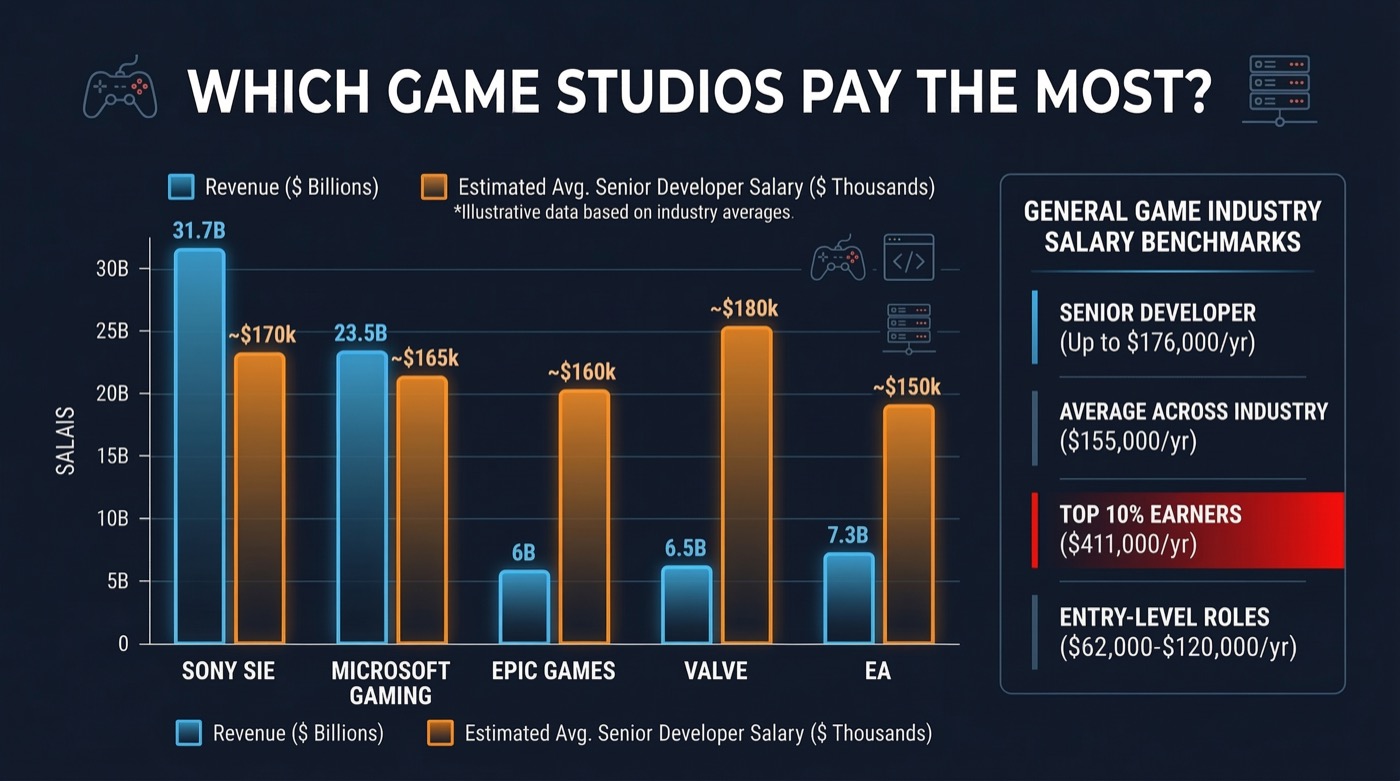
Which game studios pay the most? Studios under major publishers like Sony Interactive Entertainment, Microsoft Gaming, Epic Games, and Valve typically offer the highest salaries, driven by massive revenues exceeding $6 billion annually. These industry giants leverage their financial power to attract elite talent with competitive base salaries, equity packages, and comprehensive benefits.
The correlation between studio revenue and employee compensation has never been stronger. As gaming revenues surge past $200 billion globally, studios are locked in fierce talent wars. According to ZipRecruiter’s latest data, game development professionals now average $155,000 annually, reflecting the industry’s premium on specialized skills in AI-driven gameplay, cross-platform development, and live operations.
Revenue Giants Leading the Compensation Race
The highest-paying game studios share one common trait: exceptional revenue generation. Financial power directly translates to competitive salaries, benefits, and growth opportunities.
Sony Interactive Entertainment dominates the landscape with $31.7 billion in revenue, followed closely by Tencent at $27.1 billion and Microsoft Gaming at $23.5 billion. These powerhouses own multiple successful studios and franchises that generate consistent revenue streams.
US-based publishers like Electronic Arts ($7.3 billion), Valve (estimated $6.5 billion), and Epic Games (estimated $6.0 billion) round out the top tier. Their success stories include blockbuster titles generating billions in lifetime revenue, from Fortnite’s $12 billion to Hearthstone’s $1 billion-plus in mobile earnings alone.
The Revenue-to-Salary Pipeline
Studios with higher revenues consistently offer better compensation packages. This relationship exists because successful titles require ongoing investment in top talent to maintain player engagement and develop new content.
Take-Two Interactive’s Capital Games studio exemplifies this model. Star Wars: Galaxy of Heroes has generated over $1.5 billion, enabling the studio to offer premium salaries for roles ranging from game designers to live operations specialists.
Similarly, Double Down Interactive’s Vegas Slots portfolio exceeded $2 billion in lifetime revenue since 2012, with $181 million earned in 2025 alone. This sustained success creates stable, high-paying career opportunities.
Top-Paying Studios by Region and Specialty
Location significantly impacts which game studios pay the most. US-based companies currently lead the compensation rankings, particularly those specializing in mobile gaming and live service titles.
| Studio/Publisher | Annual Revenue | Notable Titles | Primary Location |
|---|---|---|---|
| Sony Interactive Entertainment | $31.7B | God of War, Spider-Man | California, USA |
| Microsoft Gaming | $23.5B | Halo, Forza, Call of Duty | Washington, USA |
| Epic Games | $6.0B (est.) | Fortnite, Unreal Engine | North Carolina, USA |
| Valve Corporation | $6.5B (est.) | Steam, Dota 2, Counter-Strike | Washington, USA |
| Electronic Arts | $7.3B | FIFA, Apex Legends, Madden | California, USA |
| Activision Blizzard | Part of Microsoft | Hearthstone, Diablo, Warcraft | California, USA |
US Mobile Studios Surge Ahead
The 2026 mobile gaming boom has positioned US studios as compensation leaders. Activision Blizzard’s Hearthstone continues generating over $1 billion in mobile lifetime revenue, while Jam City’s Harry Potter: Hogwarts Mystery and Disney Emoji Blitz earn millions monthly.
Zynga, now under Take-Two Interactive, maintains its position with evergreen titles like Zynga Poker and newer hits like Match Factory. This portfolio approach ensures consistent revenue that supports competitive salaries across development teams.
The strategic use of major intellectual properties—from Star Wars to Disney franchises—creates sustainable revenue models. Studios leveraging these IPs typically offer 20-30% higher salaries than independent developers.
Game Development Salary Benchmarks for 2026
Understanding salary ranges helps developers identify which game studios pay the most for specific roles. For those considering whether game art is a viable career path, current data reveals significant variation based on experience, specialization, and studio size.
Key salary benchmarks include: For a deeper breakdown specific to art roles, see the game artist salary guide.
- Senior Game Developer/Engineer: Up to $176,000 annually at top studios
- Game Development Professionals (Average): $155,000 across all experience levels
- Top 10% of Game Developers: $411,000, typically at major publishers with profit-sharing or equity
- Entry to Mid-Level Developers: $62,000 to $120,000 depending on location and studio size
What Drives Higher Compensation?
Several factors separate the highest-paying studios from average employers. Specialization in high-revenue game genres tops the list, with live service games, mobile free-to-play titles, and competitive multiplayer games commanding premium salaries.
Studios under major publishers benefit from financial stability and comprehensive benefits packages. Microsoft Gaming studios, for example, offer not just competitive base salaries but also stock options, performance bonuses, and extensive healthcare coverage.
Geographic location remains crucial. California and Washington state studios typically pay 15-25% more than equivalent positions in other regions due to higher living costs and intense competition for talent.
Best Game Companies for Total Compensation
Salary represents just one component of total compensation. The truly highest-paying studios distinguish themselves through comprehensive packages that include equity, bonuses, and quality of life benefits.
Industry experts highlight these studios for exceptional compensation and work culture:
- Valve Corporation: Known for flat organizational structure, profit-sharing, and premium base salaries in Kirkland, Washington
- Epic Games: Offers competitive salaries plus Unreal Engine royalty sharing opportunities for qualifying projects
- Unity Technologies: Recognized for work-life balance alongside strong compensation packages
- Amazon Game Studios: Leverages Amazon’s comprehensive benefits and stock options
- Sony Interactive Entertainment Studios: Combines high base pay with performance bonuses tied to game success
The Role of Equity and Bonuses
Base salary tells only part of the compensation story. Studios like Epic Games and Valve offer profit-sharing arrangements that can double or triple total compensation for developers on successful projects.
Activision Blizzard developers working on titles like Hearthstone often receive performance bonuses based on game revenue milestones. When a game surpasses $1 billion in lifetime revenue, these bonuses can represent 25-50% of annual compensation.
Playstudios and similar mobile-focused companies integrate rewards and equity packages that vest over multiple years, incentivizing long-term commitment while boosting total compensation above industry averages.
How to Land High-Paying Game Studio Positions
Targeting which game studios pay the most requires strategic career planning. The path to six-figure game development salaries involves specific skills, networking, and geographic considerations.
Step-by-Step Strategy for Maximum Earnings
Step 1: Develop In-Demand Specializations
Focus on skills commanding premium salaries: live operations development, AI/machine learning integration, cross-platform architecture, and monetization systems. Studios like Epic Games and Microsoft actively recruit specialists in these areas.
Step 2: Target High-Revenue Game Categories
Specialize in mobile free-to-play, live service multiplayer, or established franchise games. These categories generate the highest revenues, directly funding better salaries.
Step 3: Consider Geographic Relocation
US studios, particularly in California, Washington, and North Carolina, consistently outpay international counterparts. While Tencent and NetEase generate massive revenues, location-adjusted salaries favor US positions.
Step 4: Build a Portfolio Showcasing Revenue Impact
Demonstrate previous work on successful monetization, player retention, or engagement systems. Studios paying top dollar want proof you can contribute to their bottom line. Creating a compelling portfolio is crucial for landing these coveted positions.
Step 5: Leverage Industry Connections
Networking within studios like Valve or Epic often provides access to unadvertised positions with better compensation. Industry events and online communities facilitate these connections.
Skills That Command Premium Salaries
Certain technical competencies consistently correlate with higher pay at top studios. Unreal Engine 5 expertise remains highly valuable, especially for positions at Epic Games or studios developing AAA titles.
Live operations experience—managing ongoing content updates, events, and monetization—commands premiums at mobile-focused studios like Zynga and Jam City. These roles often exceed $150,000 annually for experienced professionals.
Cross-platform development skills are increasingly critical as studios like Activision Blizzard expand mobile versions of PC/console franchises. Developers bridging these platforms often negotiate salaries 20-30% above average, leveraging tools like Unity Pro for seamless multi-platform deployment.
Industry Trends Shaping Future Compensation
The gaming industry’s evolution directly impacts which game studios pay the most. Three major trends are reshaping compensation landscapes in 2026 and beyond.
Mobile revenue continues its explosive growth, with US studios leading the charge. This shift elevates salaries at mobile-focused companies like Zynga and Jam City, which now compete directly with traditional console developers for talent.
The integration of AI and machine learning into game development creates new high-paying roles. Studios investing heavily in AI-driven NPCs, procedural content generation, and personalized player experiences offer premium compensation for these emerging skill sets.
Challenges and Opportunities
Industry volatility presents both risks and opportunities. Recent layoffs, including Jam City’s Ludia studio separation in 2025, remind developers that even high-revenue companies face restructuring.
However, evergreen mobile titles and live service games provide unusual stability. Studios maintaining successful long-term games like Star Wars: Galaxy of Heroes or Zynga Poker offer more secure high-paying positions than project-based development teams.
Remote work opportunities are expanding access to top-paying positions. Some studios now offer location-flexible roles at adjusted salary rates, enabling developers worldwide to access US-level compensation without relocation.
Global Perspective on Studio Compensation
While US studios currently dominate salary rankings, global publishers like Tencent ($27.1 billion revenue) and NetEase ($11.5 billion) deserve consideration. These Chinese gaming giants generate enormous revenues but offer different compensation structures.
Location-adjusted salaries reveal that US studios typically pay 30-50% more than equivalent Chinese positions when accounting for cost of living and purchasing power. However, rapid growth at Asian studios creates advancement opportunities that can offset lower base salaries.
European studios generally fall between US and Asian compensation levels. Companies like Ubisoft and CD Projekt Red offer competitive regional salaries but typically cannot match US tech hub compensation for equivalent roles.
Conclusion: Maximizing Your Game Development Earnings
Which game studios pay the most? The answer centers on revenue-generating powerhouses like Sony Interactive Entertainment, Microsoft Gaming, Epic Games, and Valve. These studios leverage billions in annual revenue to offer salaries reaching $176,000 for senior roles and up to $411,000 for top performers.
Success in landing these positions requires strategic specialization in high-revenue game categories, particularly mobile free-to-play and live service titles. Geographic considerations matter significantly, with US-based studios consistently outpaying international counterparts.
The 2026 gaming landscape favors developers with expertise in AI integration, cross-platform development, and live operations. As mobile gaming revenues surge and talent wars intensify, compensation across the industry continues rising.
Focus on studios with proven revenue success, develop in-demand specializations, and consider geographic relocation to maximize your earning potential in this dynamic, lucrative industry.
Looking for a game art job? ArtBlast curates 10-60+ game art jobs daily from studios like the ones above. Subscribe at artblast.co/subscribe and apply while the role is still fresh.
Frequently Asked Questions
Which game studio pays developers the highest salary?
While specific studio salary data isn’t publicly disclosed, studios under Sony Interactive Entertainment, Microsoft Gaming, Valve, and Epic Games consistently offer the highest compensation. Senior game developers at these companies earn up to $176,000 annually, with top performers reaching $411,000 through base salary, equity, and profit-sharing arrangements. These studios’ multi-billion dollar revenues enable premium compensation packages that smaller developers cannot match.
How much do game developers make at top studios in 2026?
Game development professionals at top studios average $155,000 annually in 2026, according to industry salary data. Entry-level positions start around $62,000, while senior developers and engineers earn up to $176,000. The top 10% of game developers, typically working at major publishers on successful franchises, make $411,000 or more when including bonuses, equity, and profit-sharing. Location significantly impacts these figures, with California and Washington state studios paying 15-25% above national averages.
Do mobile game studios pay as well as console game studios?
Yes, top mobile game studios now match or exceed console studio salaries in 2026. US mobile-focused companies like Zynga, Jam City, and Activision Blizzard’s mobile divisions offer competitive compensation driven by massive revenues. Mobile hits like Star Wars: Galaxy of Heroes ($1.5 billion lifetime) and Hearthstone ($1 billion-plus mobile) generate revenue comparable to console titles. Senior developers at successful mobile studios typically earn $140,000 to $170,000, competing directly with traditional game development salaries.
What benefits do high-paying game studios offer besides salary?
Top-paying game studios provide comprehensive packages beyond base salary. Common benefits include equity or stock options (particularly at publicly-traded companies like Electronic Arts and Take-Two), performance bonuses tied to game revenue milestones (often 15-30% of base salary), profit-sharing arrangements at studios like Valve, comprehensive healthcare and retirement plans, flexible work arrangements including remote options, professional development budgets for conferences and training, and relocation assistance. These benefits can increase total compensation by 30-60% above base salary.
Are game development salaries higher in the US or internationally?
US game studios currently pay 30-50% more than international counterparts when adjusted for cost of living and purchasing power. While Chinese publishers like Tencent ($27.1 billion revenue) and NetEase ($11.5 billion) generate massive revenues, their developer salaries typically range $80,000 to $120,000 compared to $120,000 to $176,000 at equivalent US positions. European studios fall between these ranges. However, international studios may offer faster advancement opportunities and unique projects that compensate for lower base salaries.
What skills increase salary potential at game studios?
Skills commanding premium salaries in 2026 include Unreal Engine 5 expertise (increasing compensation 15-25%), live operations and monetization systems experience (particularly for mobile games), AI and machine learning integration for gameplay systems, cross-platform development bridging mobile, console, and PC, multiplayer and networked game architecture, and proven experience shipping high-revenue titles. Developers combining technical skills with business understanding of player retention and monetization consistently negotiate the highest salaries at revenue-focused studios.
How do game studio salaries compare to other tech industry jobs?
Game development salaries at top studios now compete with broader tech industry compensation. Senior developers earning $155,000 to $176,000 match software engineering salaries at major tech companies, though top-tier FAANG positions may still offer 10-20% premiums. However, game studios increasingly offer comparable equity packages and benefits. The gap has narrowed significantly since 2020 as gaming revenues surged past $200 billion globally. Passion for gaming, creative fulfillment, and seeing millions enjoy your work remain unique advantages that complement competitive financial compensation.