
Lighting Artist Salary Guide: What You Can Really Earn in 2026
Did you know that two reputable job platforms can show lighting artist salaries that differ by more than $70,000 for the same job title? That kind of gap leaves digital artists guessing whether they are underpaid, overpaid, or simply comparing apples to oranges. This Lighting Artist Salary Guide cuts through the noise and gives you a clear, segmented breakdown of what lighters actually earn in 2026.
These are ArtBlast's own numbers, from the real lighting artist job postings we track across 600+ studio job boards. You will not find them anywhere else.
- 151 lighting artist openings tracked across 74 studios
- 29% of those roles were remote
- Only 10% of postings disclosed a salary range, the rest hid the number
- Top hiring studios: Cloud Imperium Games, Keywords Studios, People Can Fly Studio, Lighthouse Games, Bardel Entertainment
- Most active markets: Canada, United States, United Kingdom
Source: ArtBlast game art job tracking, 2026. Using these figures? Please cite ArtBlast and link to this page.
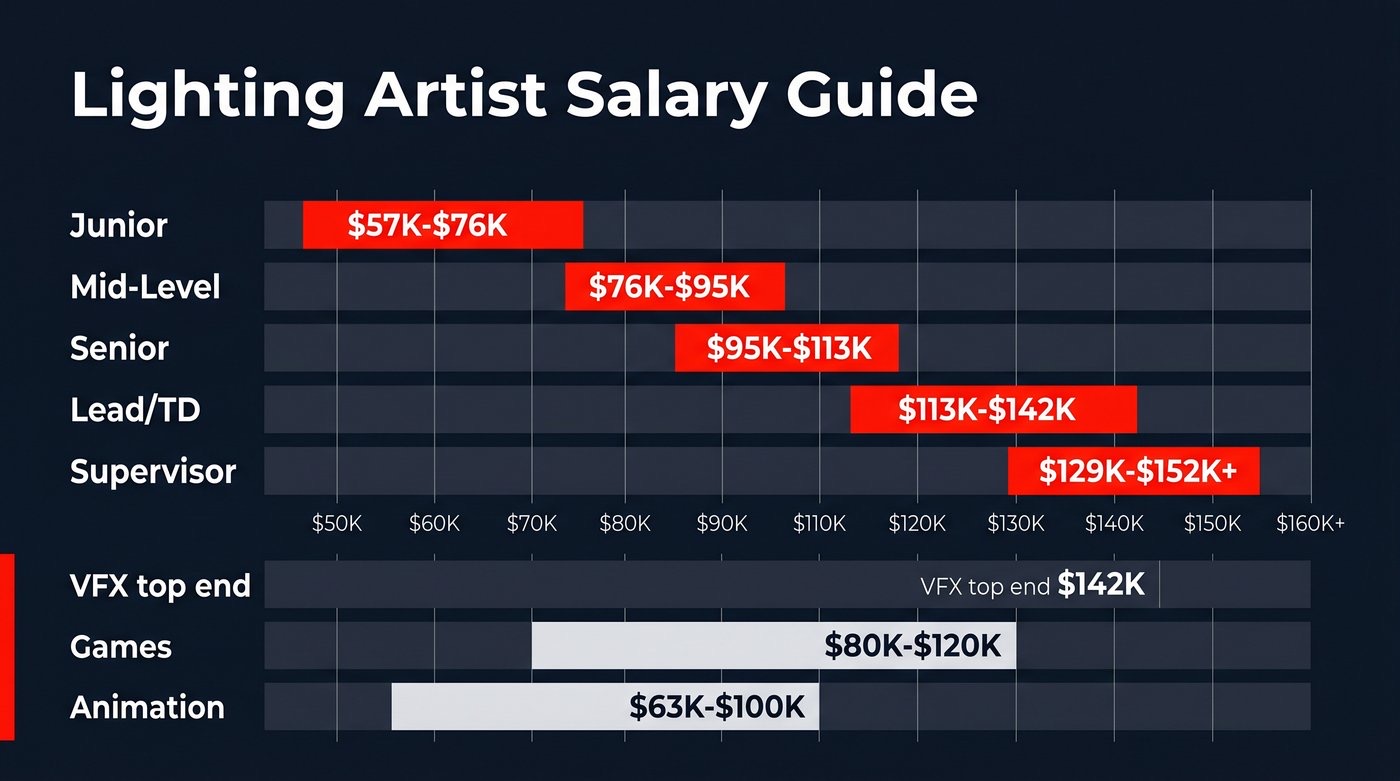
Here is the quick answer: Lighting artist salaries in the US typically range from $57,000 to $142,000 per year, depending on seniority, specialization (VFX, games, animation, or real-time), and location. In India, the range runs from roughly ₹1L to ₹15L annually, with senior artists in top studios sitting at the higher end.
The reason salary data looks so inconsistent is that the label "Lighting Artist" covers vastly different roles, from a junior 3D lighter on their first feature to a senior Lighting TD managing a render farm for a streaming giant. Keep reading to find out exactly where you fall and how to move up.
What Does a Lighting Artist Actually Do?
Think of a lighting artist as the virtual Director of Photography on a 3D production. Their job is to place and adjust light sources inside a scene, control mood and atmosphere, manage reflections and volumetrics, and ensure visual consistency across every shot in a sequence.
According to CG Spectrum, VFX lighting artists also compile upstream CG elements, build light rigs, optimize render farm usage, and match CG lighting to live-action plates. That blend of artistic instinct and technical pipeline knowledge is precisely what makes the role so well-compensated at the senior level.
Core tools include Maya, Adobe Photoshop, and After Effects, alongside deep knowledge of physically based rendering (PBR), path tracing, color theory, shading, and HDRI capture. Artists who also pick up Python or MEL scripting, or who specialize in Unreal Engine for real-time and virtual production, consistently earn toward the top of the pay range.
Lighting Artist Salary by Seniority Level (US)
Seniority is the single biggest driver of pay. The table below consolidates data from Salary.com, ZipRecruiter, ESMA, SalaryExpert, and CG Spectrum to give you a realistic 2026 snapshot for the US market.
| Role / Level | Annual Salary Range (USD) | Notes |
|---|---|---|
| Junior Lighting Artist | $57,000 - $76,000 | Entry level; Salary.com baseline |
| Mid-Level Lighting Artist | $76,000 - $95,000 | ESMA median ~$84,300 |
| Senior Lighting Artist | $95,000 - $113,000 | ESMA upper range ~$112,700 |
| Lighting TD (Technical Director) | $113,000 - $142,000+ | CG Spectrum / Glassdoor top end |
| Lead / Supervisor | $129,000 - $152,000+ | ZipRecruiter 2025 senior band |
Notice how the numbers shift dramatically once you move from a generalist "Lighting Artist" title into a Lighting TD or supervisory role. This is why ZipRecruiter's 2025 average of $129,541 looks so much higher than Salary.com's $57,427 to $87,695 range. Each platform captures a different slice of the market.
Lighting Artist Salary by Specialization and Industry
Your industry vertical matters almost as much as your seniority. Here is how pay compares across the main sectors where lighting artists work.
VFX Film and Television
This is the highest-paying vertical at the top end. Senior VFX Lighting TDs at major studios can command $113,000 to $142,000 or more. The explosion of streaming content has driven heavy demand for artists who can handle complex CG-heavy scenes and photo-real integration at speed. If you're considering this specialization, our VFX Artist Salary Guide provides additional context on the broader VFX market.
Games and Real-Time (Unreal Engine)
Game lighting artists at AAA studios often sit in the $80,000 to $120,000 range depending on the studio size and location. The rise of Unreal Engine across both games and virtual production has created a noticeable premium for artists fluent in real-time lighting workflows. This skill set is still undersupplied relative to demand.
3D Animation and Advertising
Mid-size animation studios and advertising agencies typically pay in the $63,500 to $100,000 range. These roles offer more stable hours than film VFX but sometimes less upside at the top. Strong lookdev and color grading skills are especially valued here.
Lighting Artist Salary by Location
Geography creates a wide pay gap that no amount of skill negotiation can fully close. Here is how major markets compare.
United States (City-Level Data)
- San Jose / Bay Area, CA: Roughly 28% above the US national average, making it the top-paying metro for 3D lighting artists in the country.
- Los Angeles, CA: Average of $94,279 per year, about 11% above the national average, per SalaryExpert 2026 data.
- New York City / Vancouver equivalent hubs: Comparable to LA; strong VFX industry presence supports premium pay.
- National average (3D Lighting Artist): Approximately $82,070 per year or $39.46 per hour, per ZipRecruiter May 2024 data.
India
AmbitionBox 2026 data covering 126 salary submissions shows a range of ₹1.0L to ₹7.2L per year, with an average of ₹4.0L. This sample skews heavily toward junior positions with 0 to 8 years of experience.
For senior artists, the picture looks different. Industry discussions reference experienced professionals with 5 to 7.5 years of experience earning ₹10L to ₹15L per year at top-tier studios in Mumbai, Pune, or Hyderabad. If you are being offered ₹10L to ₹12L for seven or more years of experience, that is at the low end of what the market can support, and negotiation is warranted.
How to Move Into a Higher Salary Band
Knowing the numbers is only half the equation. Here is a practical step-by-step path to climbing the pay ladder as a lighting artist.
- Master physically based rendering (PBR) and path tracing. These are table stakes for senior VFX roles. Artists who understand how light physically interacts with materials, and who can optimize render passes without losing quality, are immediately more valuable.
- Add Unreal Engine to your toolkit. Real-time lighting is the fastest-growing segment of the industry. Virtual production, game cinematics, and previsualization all run through Unreal. Even a working knowledge here sets you apart.
- Learn Python or MEL scripting. Technical scripting turns a lighting artist into a Lighting TD. That title change alone can add $20,000 to $30,000 to your annual salary in the US market. Understanding Technical Artist career paths can provide valuable insight into this progression.
- Build a reel focused on mood and realism. Employers look for artists who can sell a sequence emotionally through light, not just technically. Include examples of matching CG to live-action plates and managing complex volumetric setups.
- Target major hubs or remote roles at hub-based studios. If you cannot relocate to Los Angeles or the Bay Area, look for remote contracts with studios based there. Many VFX houses went hybrid post-pandemic and pay location-adjusted rates that still beat smaller-market salaries.
- Network inside the VFX pipeline. Lighting sits between lookdev and compositing. Artists who understand both upstream and downstream departments become indispensable, which creates leverage for promotion to lead or supervisor roles.
Why Salary Data Conflicts: A Note on Sources
Many digital artists get confused when they see Salary.com reporting $57,000 to $87,695 and ZipRecruiter reporting $129,541 for what both call a "Lighting Artist." The explanation is straightforward: these platforms capture different populations.
Salary.com aggregates broad industry data including many general and junior roles. ZipRecruiter's 2025 "Lighting Artist" dataset appears to be weighted toward senior, technical, and hybrid roles where job titles blur with Technical Artist and Lead positions. Neither number is wrong; they are measuring different things.
The most accurate benchmark strategy is to cross-reference at least three sources (Salary.com, ZipRecruiter, and Glassdoor), filter by your specific title and experience level, and weight city-specific data heavily if you live in a major production hub.
Conclusion: What This Lighting Artist Salary Guide Tells You
This Lighting Artist Salary Guide should leave you with four clear takeaways.
- US salaries span $57,000 to $152,000+, but only artists in senior TD or supervisory roles regularly hit the top of that range.
- Location adds a real premium: Los Angeles pays roughly 11% more than the US national average, and the Bay Area pays nearly 28% more.
- Specialization drives earnings up: Unreal Engine, Python scripting, and lookdev knowledge push artists from mid-level into TD compensation territory.
- In India, the published average of ₹4.0L reflects a junior-heavy sample; experienced professionals at established studios can realistically target ₹10L to ₹15L.
The lighting artist role is growing, not shrinking. Streaming demand, virtual production adoption, and next-generation games all require artists who can manage light with both an artistic eye and a technical hand. The more of that combination you build, the closer you get to the top of the range. For broader context on 3D careers, consider exploring our 3D Artist Salary Guide as well.
Frequently Asked Questions
What is the average lighting artist salary in the US in 2026?
The average lighting artist salary in the US sits between $82,000 and $130,000 per year depending on the data source and role type. Salary.com puts the general range at $57,427 to $87,695, while ZipRecruiter's 2025 data for senior and technical roles averages $129,541. For 3D Lighting Artists specifically, the national average is approximately $82,070 per year based on ZipRecruiter May 2024 data.
How much does a VFX lighting TD make compared to a junior lighting artist?
A junior lighting artist in the US typically earns between $57,000 and $76,000 per year. A VFX Lighting TD at the same studio can earn $113,000 to $142,000 or more. The gap reflects the TD's combined artistic skill and technical pipeline expertise, including scripting, render optimization, and cross-department collaboration. Moving from junior lighter to Lighting TD is one of the highest-leverage career moves in the VFX industry.
What is the lighting artist salary in India for experienced professionals?
AmbitionBox 2026 data shows an average of ₹4.0L per year, but this sample skews toward junior positions. Experienced lighting artists with five or more years at established studios in cities like Mumbai, Pune, or Hyderabad can realistically earn ₹10L to ₹15L per year. Artists with 7.5 years of experience who are being offered below ₹10L should treat that as below-market and negotiate accordingly.
Does learning Unreal Engine increase a lighting artist's salary?
Yes, significantly. Unreal Engine skills are in high demand for virtual production, game cinematics, and real-time previsualization. Lighting artists who combine traditional VFX knowledge with real-time workflows are competing for a smaller pool of qualified candidates, which creates upward salary pressure. Some studios pay a specific premium for real-time pipeline experience, pushing compensation toward the senior or TD band even for mid-level artists.
What is the difference between a Lighting Artist and a Lighting TD in terms of pay?
A Lighting Artist focuses primarily on the creative and aesthetic side of scene lighting. A Lighting TD (Technical Director) adds scripting, render pipeline management, tool development, and sometimes shader or lookdev work on top of that artistic foundation. In salary terms, a Lighting Artist role typically earns $63,500 to $113,000 in the US, while a Lighting TD earns $113,000 to $142,000 or more. The TD title can add $20,000 to $30,000 annually.
Which US cities pay the most for lighting artists?
San Jose and the broader Bay Area consistently top the list, paying roughly 28% above the US national average for 3D lighting artists. Los Angeles follows at about 11% above the national average, with an average salary of $94,279 per year per SalaryExpert 2026 data. New York City and Vancouver (for Canadian VFX hubs) also offer strong premiums, particularly for artists working at major film and streaming studios.
How can a lighting artist increase their salary quickly?
The fastest path to a higher salary is adding technical skills to an existing artistic foundation. Learning Python or MEL scripting can qualify you for a Lighting TD title, which carries a significant pay bump. Building an Unreal Engine reel opens doors in virtual production and games. Targeting roles in Los Angeles or the Bay Area, or remote contracts at hub-based studios, also increases earning potential without requiring a complete career change.