
Technical Animator Salary Guide: What You Can Earn
Did you know that a technical animator in California can earn upward of $161,000 per year, while someone with the same job title in a different state or studio might take home closer to $55,000? That gap is not a data error. It reflects just how much experience, industry, and skill set shape compensation in this role.
These are ArtBlast's own numbers, from the real technical animator job postings we track across 600+ studio job boards. You will not find them anywhere else.
- 112 technical animator openings tracked across 74 studios
- 32% of those roles were remote
- Only 4% of postings disclosed a salary range, the rest hid the number
- Top hiring studios: Cloud Imperium Games, Behaviour Interactive, Full Circle Studio, Motorica, Certain Affinity
- Most active markets: United States, Canada, United Kingdom
Source: ArtBlast game art job tracking, 2026. Using these figures? Please cite ArtBlast and link to this page.
This technical animator salary guide breaks down exactly what you can expect to earn in 2026, whether you are just starting out, moving up from a general animation role, or trying to negotiate your next offer. The short answer: most technical animators in the U.S. earn between $74,000 and $103,000 per year, with senior and specialized roles in game development or VFX pushing well above that range.
The challenge is that most public salary data lumps technical animators in with general animators, which distorts the picture significantly. This guide separates the two, explains what actually drives pay upward, and gives you the real numbers you need to benchmark your compensation accurately.
Key Findings: Technical Animator Salary
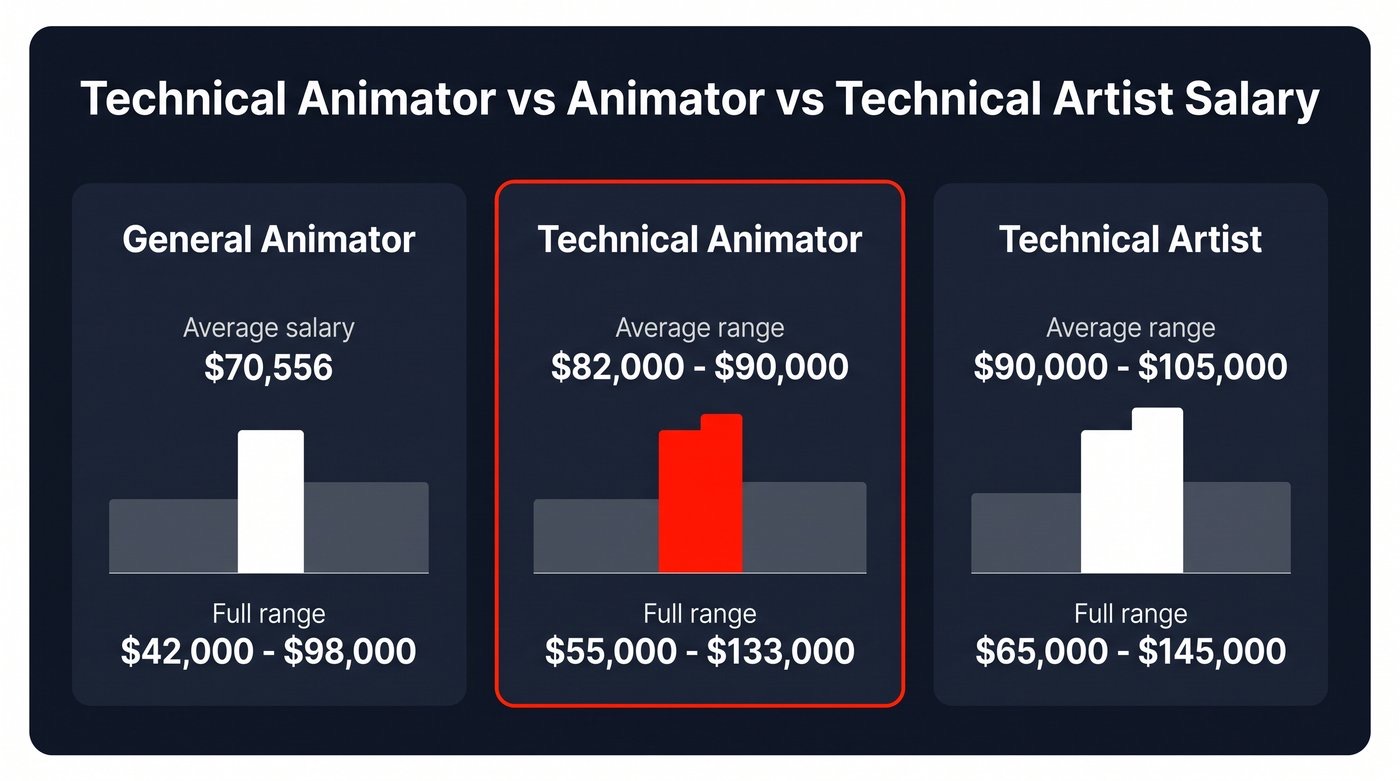
- Technical animators average $82,000 to $90,000, with a full range of $55,000 to $133,000.
- The average hourly rate is $39.41, ranging from $21.88 to $63.94.
- They out-earn general animators, who average $70,556.
- Technical artists earn more still, averaging $90,000 to $105,000.
- California is among the top-paying states, with roles reaching $161,000.
What Is a Technical Animator and Why Does It Pay More?
A technical animator sits at the intersection of artistry and engineering. Unlike a general animator who focuses primarily on motion and performance, a technical animator builds and maintains the systems that make animation possible inside a production pipeline.
That means rigging characters, writing scripts in Python or MEL, optimizing assets for real-time engines like Unreal or Unity, and troubleshooting the workflow issues that slow down an entire team. The hybrid skill set is rare, and that scarcity is exactly why compensation tends to run higher than for general animation roles.
According to ArtBlast's 2026 Animation Salary Guide, technical artists and technical animators consistently rank as above-average earners within the broader animation field, largely because their work directly impacts production efficiency rather than just output quality.
Technical Animator Salary Ranges: The 2026 Numbers
Salary data for technical animators varies widely depending on the source, and for good reason. Job boards pull from live listings, compensation platforms aggregate self-reported data, and staffing firms use placement history. Here is how the major sources stack up for 2026.
National Averages and Hourly Rates
ZipRecruiter reports an average hourly rate of $39.41 for technical animators in the U.S., with the full range spanning from approximately $21.88 to $63.94 per hour. That translates to roughly $45,500 to $133,000 annually depending on where you fall in the distribution.
Salary.com's role-specific technical animator data shows annual base salaries clustering between $74,000 and $103,000 for mid-level roles, with senior positions and specialized studios pushing beyond that ceiling. PayScale's broader animator data, which includes some technical roles, shows an average of $70,556 with total compensation reaching as high as $121,000 when bonuses and overtime are factored in.
Salary Comparison: Technical Animator vs. Animator vs. Technical Artist
One of the most common points of confusion in compensation research is how these three titles differ in pay. The table below compares estimated 2026 annual salary ranges across all three roles.
| Role | Avg. Annual Salary | Typical Range | Key Skills |
|---|---|---|---|
| General Animator | $70,556 | $42,000 - $98,000 | Motion, performance, keyframing |
| Technical Animator | $82,000 - $90,000 | $55,000 - $133,000 | Rigging, scripting, engine pipelines |
| Technical Artist | $90,000 - $105,000 | $65,000 - $145,000 | Shaders, tools programming, optimization |
The overlap between technical animator and technical artist is real, and at many studios these roles blur together. However, technical artists who lean heavily into tools development and shader programming tend to command a small but consistent pay premium over pure technical animators.
How Experience Level Affects Your Salary
Experience is the single strongest predictor of where you land in the salary range. Here is a general breakdown of how pay scales with seniority in technical animation roles.
- Entry-level (0 to 2 years): Typically $45,000 to $65,000 annually. Most entry roles require a strong reel focused on rigging or pipeline work rather than character performance alone.
- Mid-level (3 to 6 years): The $74,000 to $95,000 range is most common here. Candidates with Python scripting experience or Unreal Engine familiarity tend to land at the upper end.
- Senior (7 or more years): Senior technical animators at established game studios or VFX houses commonly earn $100,000 to $130,000, with lead and principal roles exceeding that at top-tier employers.
Robert Half's 2026 animator compensation guide benchmarks the broader animator range at $67,750 to $98,000, which reinforces that technical depth consistently pushes compensation above the general animator ceiling at the senior level.
Industry and Location: The Two Biggest Pay Multipliers
Which Industries Pay Technical Animators the Most?
Not all studios pay the same rate for identical work. The industry you work in has a significant impact on your total compensation package.
- Game development: AAA game studios are the highest-paying employers for technical animators. Real-time engine demands, complex character systems, and tight release cycles drive up the value of hybrid skill sets considerably.
- VFX and film: High-end VFX houses pay competitively for technical animators with creature rigging experience or simulation pipeline knowledge, though project-based work can create income gaps between productions.
- Product and tech companies: Emerging opportunities at companies building AR, VR, and interactive product experiences are increasingly competitive, especially for technical animators who understand real-time rendering workflows.
- Broadcast and advertising: These industries tend to pay at or slightly below the national average for technical animation, though remote work and volume of projects can offset lower base rates.
Regional Pay Differences in the U.S.
Geography creates dramatic compensation differences within the United States. ZipRecruiter's 2026 job listing data shows California-based full-time technical animator roles advertising starting pay in the $108,900 to $161,160 range, reflecting both the high cost of living and the density of major game and entertainment studios in the region.
Markets like Austin, Seattle, and New York also carry notable premiums compared to mid-market cities. Remote roles have helped flatten this gap somewhat, but many studios still tier compensation by employee location.
How to Increase Your Technical Animator Salary
The clearest path to higher pay is expanding your technical skill stack. Here is a practical roadmap for moving your compensation upward over the next 12 to 24 months.
- Learn Python or MEL scripting. Even basic scripting proficiency signals pipeline awareness and immediately differentiates your resume from candidates without it. Many studios list scripting as a preferred or required skill.
- Get certified or deeply proficient in Unreal Engine or Unity. Real-time engine fluency is in high demand across games, virtual production, and emerging interactive media. Employers pay a premium for animators who can work directly inside engine environments without handoff delays. Unity Pro offers advanced features essential for technical animation workflows.
- Build a pipeline-focused reel. Technical animation reels that demonstrate rigging systems, constraint setups, and animation state machines are far more compelling to hiring managers than reels showing only finished character motion.
- Target industries with higher pay ceilings. If you are currently working in broadcast or advertising, consider building skills that open doors into game development or VFX, where the salary ceiling is meaningfully higher.
- Track and negotiate total compensation. School of Motion's 2026 compensation research highlights that technical and tech-adjacent creative roles often include bonuses, overtime, and equity that significantly exceed the base salary figure. Always negotiate the full package, not just the base rate.
Conclusion
Technical animation pays more than general animation for a clear reason: the role demands both creative ability and technical depth that most animators do not have. This technical animator salary guide shows that most U.S. professionals in this role earn between $74,000 and $103,000 at the mid-level, with senior positions in games or VFX regularly crossing $120,000 or more.
The key takeaways from the 2026 data are straightforward:
- Hybrid skills like scripting and engine fluency are the fastest route to higher pay.
- Industry and geography create wide salary variation, with California and game development leading compensation nationally.
- Total compensation including bonuses and overtime often exceeds base salary by a meaningful margin.
- Benchmarking against role-specific data, not general animator averages, gives you a far more accurate picture of your market value.
Whether you are entering the field or looking to move up, understanding the full salary landscape puts you in a stronger position to negotiate the pay you have earned. For those considering a transition into this field, learn more about how to become an animator and explore the various career paths available.
Frequently Asked Questions
What is the average technical animator salary in the United States?
The average technical animator salary in the U.S. ranges from approximately $74,000 to $103,000 per year for mid-level roles, according to Salary.com's 2026 data. ZipRecruiter reports an average hourly rate of $39.41, which works out to roughly $82,000 annually for full-time positions. Senior technical animators at major studios often earn well above $100,000.
How much does a technical animator make per hour?
ZipRecruiter's July 2025 data shows the average hourly rate for a technical animator is $39.41, with the full range spanning from $21.88 at the lower end to $63.94 per hour for experienced professionals. California-based roles show even higher hourly equivalents, with some listings starting above $52 per hour.
Do technical animators earn more than regular animators?
Yes, in most cases technical animators earn more than general animators because the role requires a broader and more specialized skill set. While general animators average around $70,556 per year according to PayScale, technical animators with rigging, scripting, and engine pipeline skills tend to command $10,000 to $25,000 more annually at comparable experience levels.
What skills increase a technical animator's salary the most?
The skills most consistently linked to higher technical animator pay include Python or MEL scripting, Unreal Engine or Unity proficiency, character rigging, and animation pipeline troubleshooting. Candidates who can build or maintain animation tools in addition to creating rigs are particularly valued at game studios and VFX houses, often earning premium salaries relative to peers without those capabilities.
How much do technical animators earn in California?
California is among the highest-paying markets for technical animators in the U.S. ZipRecruiter's 2026 job listing data shows full-time technical animator roles in California advertising starting salaries between $108,900 and $161,160 annually. The premium reflects both the high cost of living and the concentration of AAA game studios, VFX houses, and entertainment companies in the region.
What is the difference between a technical animator and a technical artist?
A technical animator focuses on character rigs, motion systems, and animation pipeline work, while a technical artist typically covers a broader scope including shaders, rendering optimization, and tool development. Both roles pay above general animation rates, but technical artists with strong programming backgrounds often command slightly higher salaries, typically in the $90,000 to $145,000 range compared to $74,000 to $133,000 for technical animators.
Is technical animation a good career for long-term earning potential?
Yes. Technical animation offers strong long-term earning potential because demand for hybrid technical-creative professionals continues to grow alongside real-time production, game development, and virtual production workflows. Senior and lead technical animators at major studios regularly earn six-figure salaries, and the skill set transfers well across industries, providing both stability and room to grow total compensation over time.