
2D Artist Salary Guide: What You Can Really Earn
Did you know a 2D artist in Minneapolis earns an average of $135,214 per year, while a counterpart in Russia takes home just $1,000 to $1,500 per month? That staggering gap is the reality of the modern creative industry, and this 2D artist salary guide breaks it all down so you can stop guessing and start negotiating.
These are ArtBlast's own numbers, from the real 2D artist job postings we track across 600+ studio job boards. You will not find them anywhere else.
- 159 2D artist openings tracked across 111 studios
- 27% of those roles were remote
- Only 2% of postings disclosed a salary range, the rest hid the number
- Top hiring studios: Wargaming, Good Job Games, Hype Reel, Nordcurrent, Tripledot Studios
- Most active markets: United States, Vietnam, Turkey
Source: ArtBlast game art job tracking, 2026. Using these figures? Please cite ArtBlast and link to this page.
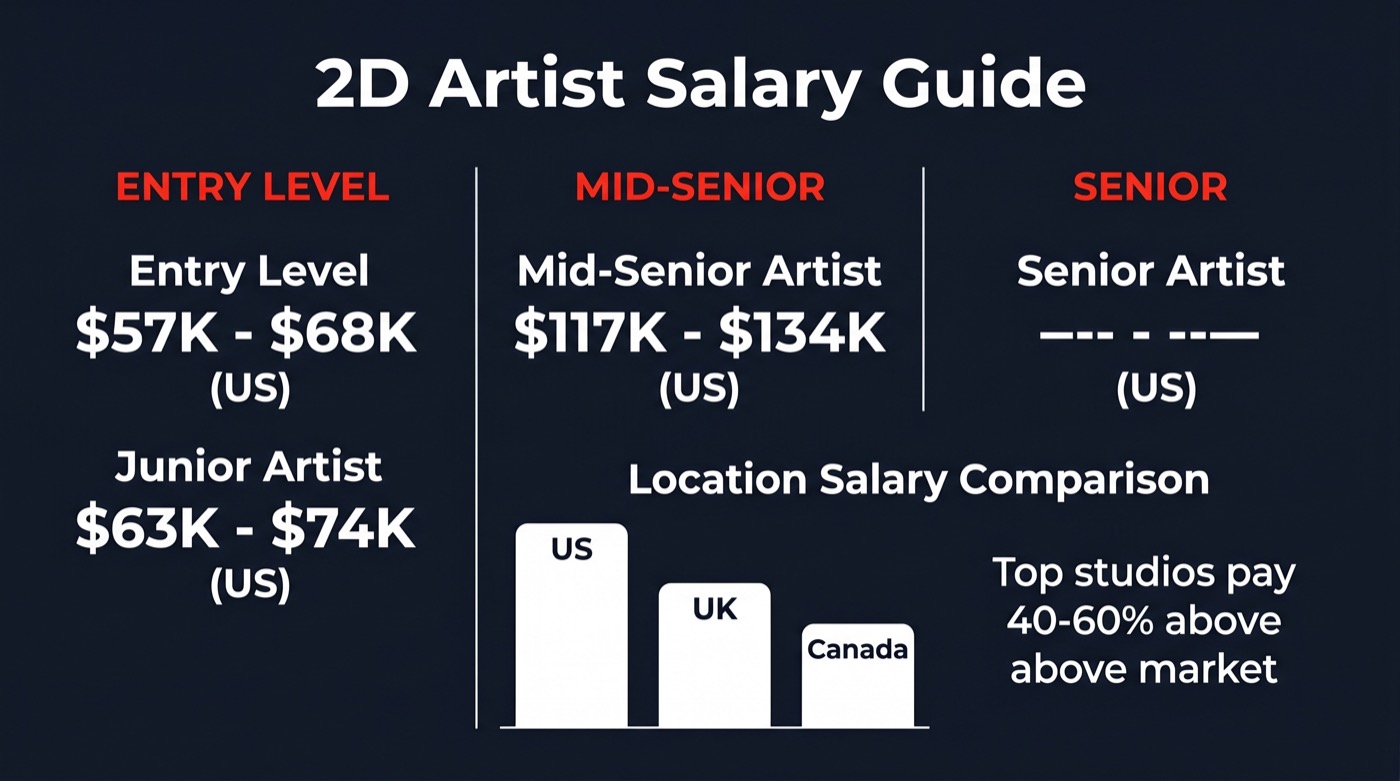
In short, 2D artist salaries range from roughly $30,000 per year at the entry level to over $150,000 for senior and animation roles, with location, experience, and industry being the three biggest factors that determine where you land on that spectrum.
Whether you are a recent graduate trying to benchmark your first offer, a mid-career artist eyeing a relocation, or a freelancer wondering whether to go full-time, this guide gives you the numbers, the context, and the actionable steps to maximize your income.
2D Artist Salary by Location: The Numbers That Matter
Geography is the single most powerful lever in your earning potential. The same skill set commands radically different pay depending on the city, country, and even the specific studio culture in your market. Let's look at what the data actually says.
United States: The Premium Market
U.S.-based 2D artists working full-time in major gaming and animation hubs earn significantly above global averages. According to ZipRecruiter, Minneapolis, MN, currently leads with an average full-time salary of $135,214 per year, with top earners reaching $159,000. Chicago, IL, follows closely at $133,446 annually. These figures reflect demand in concentrated gaming and media production markets where specialized talent commands a premium.
Entry-level roles in the U.S. typically start around $30,000 to $45,000 per year, climbing to $75,000 and beyond with demonstrated experience and a strong portfolio. Senior animation artists and art directors at established studios routinely break the $150,000 mark.
Canada and International Markets
Canada presents a middle ground. North Vancouver, BC, sees full-time 2D artists earning around $58,822 per year, which is competitive domestically but trails U.S. hubs by a wide margin. The lower cost of living in many Canadian cities partially offsets the gap, though visa and residency considerations add complexity for foreign talent.
Singapore offers an interesting case study for Asia-Pacific artists. Entry-level positions start at approximately SGD 2,000 per month (roughly $1,500 USD), while mid-level artists climb to SGD 4,000 or more, and art directors can reach SGD 12,000 monthly. Foreign workers should note that Employment Pass thresholds currently sit at SGD 3,300 per month, setting a practical floor for international hires.
Istanbul, Turkey, reflects emerging market realities with a median monthly salary of TRY 18,000, ranging from TRY 12,000 to TRY 53,000. At current exchange rates, this translates to roughly $450 to $1,600 USD per month, figures that push many skilled Turkish artists toward international freelancing.
Salary Comparison Table: 2D Artist Pay Around the World (2026)
| Location | Average Annual Salary (USD) | Entry Level | Senior / Art Director |
|---|---|---|---|
| Minneapolis, MN (USA) | $135,214 | ~$30,000 | $159,000+ |
| Chicago, IL (USA) | $133,446 | ~$30,000 | $150,000+ |
| North Vancouver, BC (Canada) | $58,822 | ~$35,000 CAD | $80,000+ CAD |
| Singapore | ~$18,000 | SGD 2,000/mo | SGD 12,000/mo |
| Istanbul, Turkey | ~$6,000 - $19,000 | TRY 12,000/mo | TRY 53,000/mo |
| Russia / Emerging Markets | ~$12,000 - $18,000 | $1,000/mo | $1,500+/mo |
How Experience and Skills Shape Your 2D Artist Pay
Location sets the ceiling, but your experience and skill stack determine where within that range you land. The progression from junior to senior is not just about time served. It is about the quality and relevance of your portfolio, the tools you master, and the roles you actively pursue.
Career Stage Breakdown
- Entry Level (0 to 2 years): Expect $30,000 to $45,000 in the U.S., or equivalent local minimums abroad. Focus here is on surviving a competitive market and building a portfolio.
- Mid Level (3 to 6 years): Salaries jump to $60,000 to $90,000 in U.S. markets. Skills in character design, environment art, or animation workflows become differentiators.
- Senior Level (7+ years): Top-tier pay from $100,000 to $150,000+ in premium U.S. cities. Art direction and leadership experience unlock the highest bands.
- Freelance / Remote: Highly variable, but skilled freelancers in emerging markets can match or exceed local full-time salaries by targeting U.S. and European clients directly.
Specializations That Command Premium Pay
Not all 2D work pays equally. Storyboard artists consistently earn above average because the role demands both visual skill and narrative thinking. Animation specialists at established studios average around $150,000 annually, driven by the high demand in streaming and gaming pipelines. Concept artists at AAA game studios also command significant premiums over generalist illustrators.
Full-Time vs. Freelance: Which Pays More?
This is one of the most common questions among working artists, and the honest answer is: it depends entirely on where you are and who your clients are.
Full-time roles offer stability, benefits, and predictable income. For artists in U.S. hubs, a staff position at a gaming or animation studio is genuinely the fastest path to six-figure earnings. The trade-off is limited flexibility and, in entry-level roles, lower starting pay than the averages suggest.
Freelancing, however, is increasingly the preferred route for artists in lower-wage markets. A 2D artist based in Istanbul or Eastern Europe with access to international clients can earn 3 to 5 times the local full-time rate by billing in USD or EUR. The barrier is almost always portfolio quality and client acquisition, not skill. For aspiring freelance artists, understanding this global dynamic can unlock significant income potential regardless of local market conditions.
How to Increase Your 2D Artist Salary: A Step-by-Step Action Plan
Ready to move up the pay scale? Follow this practical roadmap.
- Audit your portfolio against industry benchmarks. Compare your work to artists earning in your target salary band. Identify the three biggest gaps and focus your next 90 days on closing them.
- Specialize in a high-demand niche. Storyboarding, character design for mobile games, and UI illustration for apps are currently among the highest-paid 2D specializations. Generalists plateau faster.
- Target salary-transparent job postings. Use platforms like ZipRecruiter and Glassdoor to filter for roles that list compensation ranges. This gives you real-time market data and negotiation leverage before you even apply.
- Research location-specific averages before accepting any offer. A $70,000 offer in Chicago may look identical on paper to the same number in a smaller market, but the cost of living and career trajectory differ enormously.
- Negotiate using data, not gut feeling. Cite specific city averages and your specialization when countering an offer. Employers expect negotiation, and coming in with precise numbers signals professionalism.
- Consider remote freelancing as a parallel income stream. Even full-time artists can build a freelance client base over time. A single international client paying USD rates can meaningfully supplement a local salary in emerging markets. Industry-standard tools like Adobe Photoshop remain essential for professional-quality work that commands premium rates.
Industry Trends Affecting 2D Artist Earnings
The gaming and animation industries are both experiencing growth cycles that directly benefit 2D artists. Streaming platforms continue commissioning animated content at record levels, and mobile gaming remains one of the largest employers of 2D talent globally.
One important caveat: the last comprehensive gaming industry salary survey was conducted in 2014 by Gamasutra, leaving a significant data gap for the years since. Most current figures come from aggregated job posting data on platforms like ZipRecruiter and Glassdoor rather than formal industry surveys. This means advertised salaries may skew slightly higher than what artists actually accept.
Remote work has also permanently changed the market structure. Artists no longer need to relocate to San Francisco or Los Angeles to access premium clients, though physical presence at major studios still correlates with higher pay at the senior level. For digital artwork and illustrations, Clip Studio Paint has become increasingly popular among professional 2D artists for its animation features and competitive pricing.
Conclusion: Know Your Worth and Act on It
This 2D artist salary guide makes one thing clear: the range of possible earnings in this field is enormous, and the artists who earn at the top of it are not necessarily more talented than those earning at the bottom. They are better informed, more strategically positioned, and more proactive about negotiation and career development.
Here are the four takeaways you should walk away with:
- U.S. cities like Minneapolis and Chicago offer the highest full-time salaries, averaging above $133,000 for experienced artists.
- Experience and specialization can double or triple your salary within the same market, especially in animation and storyboarding.
- Freelancing with international clients is the fastest income multiplier for artists in emerging markets.
- Always benchmark against location-specific, role-specific data before accepting or countering any offer.
The market rewards artists who know their value. Use the data in this guide as your starting point, build the portfolio that supports your target salary, and never leave money on the table.
Looking for a 2D artist job? ArtBlast curates 10-60+ game art and animation jobs daily, with salary shown on every listing. Subscribe at artblast.co/subscribe/?src=site and apply while the role is still fresh.
Frequently Asked Questions
What is the average salary for a 2D artist in the United States?
The average 2D artist salary in the U.S. varies by city. As of 2026, Minneapolis leads at approximately $135,214 per year, while Chicago averages $133,446. Entry-level positions typically start around $30,000, while senior artists and art directors at established gaming or animation studios can earn $150,000 or more annually. Location and specialization are the two biggest factors in determining your exact figure.
How much does a 2D artist make per hour?
Hourly rates for 2D artists depend on experience and market. In the U.S., full-time roles translate to roughly $15 to $75 per hour. Freelance 2D artists billing international clients in USD often charge between $25 and $150 per hour depending on their niche, portfolio strength, and client budget. Storyboard artists and character designers typically command the highest hourly freelance rates.
What is the 2D artist salary for entry-level positions?
Entry-level 2D artist salaries in the U.S. generally range from $30,000 to $45,000 per year. In markets like Singapore, starters earn around SGD 2,000 per month. In emerging markets such as Turkey or Eastern Europe, entry salaries can fall below $500 per month, which is why many junior artists in those regions pivot early to international freelancing to access higher-paying clients.
Do 2D artists earn more than 3D artists?
Generally, 3D artists earn slightly more than 2D generalists at comparable experience levels because 3D skills have higher technical barriers. However, specialized 2D roles like storyboarding, animation, and concept art can match or exceed 3D pay. Senior 2D animation artists average around $150,000 annually, competitive with mid-to-senior 3D roles. The gap narrows significantly with specialization and industry focus.
Is freelancing more profitable than a full-time 2D artist job?
Freelancing can be significantly more profitable for artists in lower-wage countries who target U.S. or European clients. A skilled 2D freelancer in Eastern Europe billing USD rates can earn 3 to 5 times the local full-time salary. For U.S.-based artists, a staff position at a top studio often provides better total compensation including benefits, but freelancing adds flexibility and potentially higher hourly earnings at senior experience levels.
Which industries pay 2D artists the most?
Animation studios and AAA gaming companies consistently pay 2D artists the most. Animation roles average around $150,000 annually at the senior level. Mobile gaming is one of the largest employers of 2D talent globally. Streaming platform productions also drive high demand. Advertising and marketing agencies pay competitively for UI and illustration work, though typically below entertainment industry rates for equivalent experience.
How can I increase my salary as a 2D artist?
The most effective strategies include specializing in high-demand niches like storyboarding or character design, building a portfolio targeted at your desired salary range, and using platforms like Glassdoor and ZipRecruiter to benchmark offers before negotiating. For artists in lower-wage markets, pursuing international freelance clients is the fastest income multiplier. Consistently updating your skills and targeting salary-transparent postings also accelerates pay growth.
See the full guide: 2D Artist Career Path.