The average Creative Director in the U.S. earns far more than most digital artists expect, and the gap between what agencies pay versus what tech companies offer could be the most important career decision you make this decade. According to Glassdoor’s 2026 data, total compensation for Creative Directors now averages $178,612, yet many professionals are negotiating blind, leaving tens of thousands on the table every year.
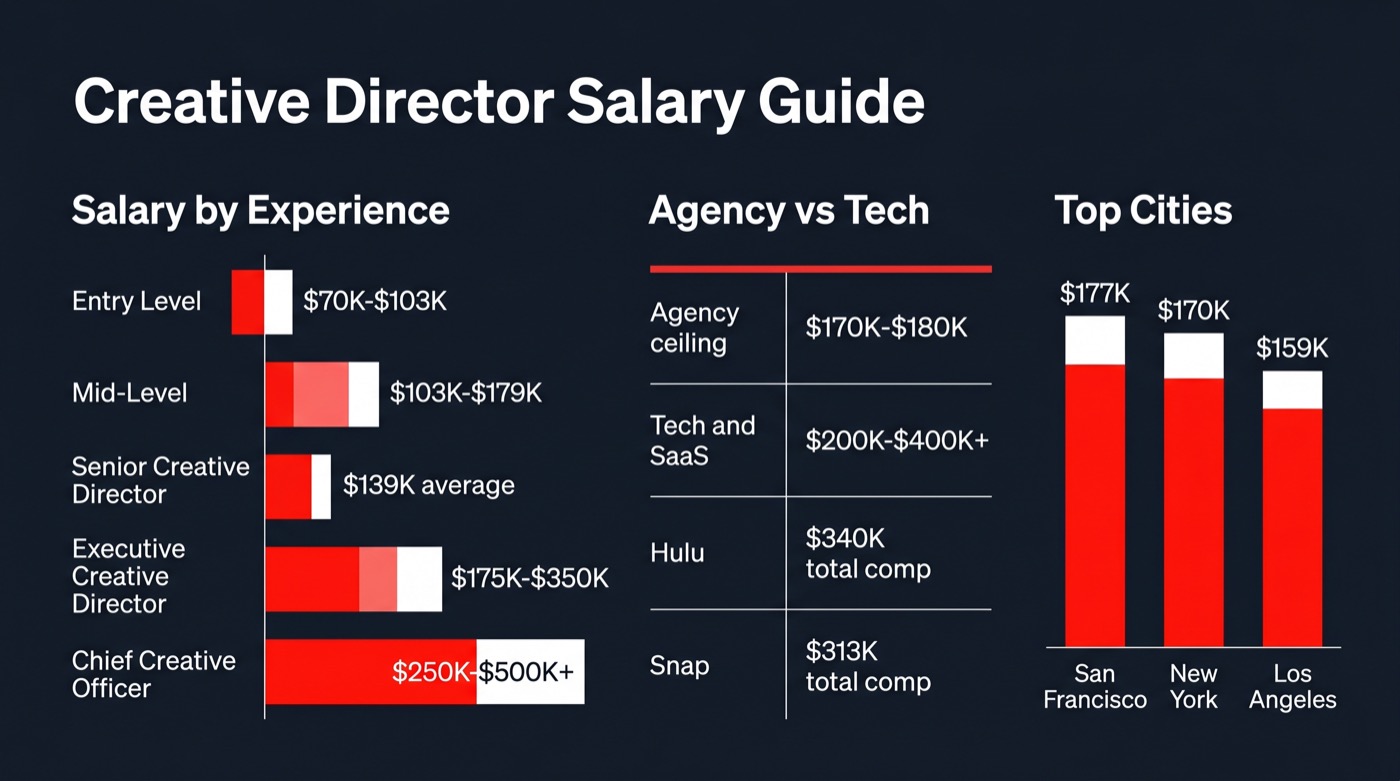
So what does a Creative Director Salary Guide actually need to tell you in 2026? Here is the direct answer: U.S. Creative Directors earn between $103,000 and $179,000 on average, with top earners at companies like Hulu and Snap exceeding $313,000 to $340,000 in total compensation. Your industry, city, and career track determine which end of that range you land on.
If you are a digital artist eyeing the Creative Director title, or already holding it and wondering whether you are being underpaid, this guide breaks down every variable that moves the needle. From agency versus in-house pay gaps to the equity upside hiding in tech roles, here is everything you need to negotiate from a position of knowledge.
Creative Director Salary Benchmarks for 2026
Salary data for Creative Directors varies significantly depending on the source, and that is not a flaw. It reflects the genuine range of compensation structures across industries. Understanding each data point helps you triangulate your own market value.
PayScale’s 2026 data reports a median base salary of $103,401, ranging from $60,000 to $174,000, with bonuses adding $1,000 to $25,000 on top. Indeed, drawing from 942 active job postings updated as of November 2025, places the average at $129,323, with a wider band of $74,000 to $225,000. Glassdoor’s total compensation figure of $178,612 accounts for base pay, bonuses, and equity, making it the most complete picture for roles that include performance incentives.
The Bureau of Labor Statistics (BLS May 2024, occupation code 27-1011) sets the median for Art Directors at $105,180, with the top 10% earning more than $207,000. Robert Half’s 2026 salary calculator pegs the range at $102,000 on the low end to $163,000 on the high end, reflecting experience-based bands.
Salary by Specialization
The Creative Circle 2025 Salary Guide breaks down compensation by creative discipline, and the differences are meaningful for digital artists choosing a specialization path.
- Art Creative Director: $125,000 to $188,000 (tiered by market and seniority)
- Copy Creative Director: $137,000 to $206,000
- Senior Creative Director: $139,000 average across markets
- Executive Creative Director: $175,000 to $350,000
Copy CDs consistently outpace their Art CD counterparts at the top of the range, a reflection of the premium placed on brand voice in an era of content saturation. However, Art CDs with strong motion design or AI-augmented production skills are closing that gap rapidly.
Agency vs. In-House: The Salary Gap That Changes Careers
This is the comparison every creative professional needs to see side by side. The difference between an agency Creative Director salary and an in-house tech company salary is not just a number. It is a lifestyle, a risk profile, and often a six-figure decision.
| Work Environment | Typical Base Salary | Total Compensation | Equity Potential |
|---|---|---|---|
| Small / Mid-Size Agency | $100,000 to $150,000 | $110,000 to $160,000 | Rare |
| Large Agency Network | $140,000 to $180,000 | $150,000 to $200,000 | Limited |
| In-House Brand | $130,000 to $200,000 | $150,000 to $250,000 | Moderate |
| Tech / SaaS Company | $150,000 to $250,000+ | $200,000 to $400,000+ | High (RSUs / Options) |
| Finance / Fintech | $140,000 to $200,000 | $160,000 to $230,000 | Moderate to High |
| Motion Picture / Entertainment | $130,000 to $175,000 | $150,000 to $200,000 | Low to Moderate |
The agency ceiling sits at roughly $170,000 to $180,000 before most experienced Creative Directors make the jump to in-house roles. That transition typically delivers a 20 to 40 percent pay increase, driven not just by salary but by equity compensation at tech firms. Pre-IPO equity at a high-growth SaaS company can double or triple total compensation in ways that agency bonuses simply cannot replicate.
Why Tech Pays More and What That Means for You
Apple, Google, Snap, and Hulu are not just offering higher base salaries. They are offering restricted stock units (RSUs) that vest over four years, converting creative leadership into a wealth-building vehicle. Indeed data shows Hulu Creative Director roles averaging $340,000 and Snap roles averaging $313,000 in total compensation. These numbers represent the reality of what brand-building talent is worth to companies competing for user attention at scale.
The migration from agency life to in-house tech is not slowing down. Brand consistency demands in fintech, the rise of AI-driven content production, and the need for cohesive multi-channel ideation are all driving enterprise demand for senior creative leadership. If you are currently agency-side, your skills are directly transferable and your market value may be higher than your current paycheck suggests.
Creative Director Salary by City: Where You Live Matters
Location remains one of the most powerful salary multipliers for Creative Directors. Indeed’s November 2025 data shows a wide range across major U.S. metros.
- San Francisco, CA: $177,000 average (highest in the nation, driven by tech density)
- New York, NY: $170,000 average (advertising and finance hubs)
- Los Angeles, CA: $159,000 average (entertainment and streaming industry demand)
Remote and hybrid roles are increasingly blurring geographic salary differentials, though many companies still apply location-based pay bands. If you are negotiating a remote Creative Director role with a San Francisco-headquartered tech company, anchoring your ask to SF market rates rather than your local market can yield a significant compensation lift.
How to Negotiate Your Creative Director Salary in 2026
Knowing the numbers is only half the battle. Here is a practical step-by-step approach to entering a negotiation with confidence and walking out with a better offer.
- Anchor to total compensation, not just base salary. Always ask for the full package breakdown: base, bonus target, equity (type, vesting schedule, cliff), benefits, and any signing bonus. Comparing base-only figures across employers is one of the most common negotiation mistakes creative professionals make.
- Use multiple data sources to build your range. Cite Glassdoor’s $178,612 total comp average alongside Indeed’s $129,323 base average to demonstrate market awareness. Recruiters respect candidates who come prepared with layered data rather than a single number.
- Quantify your portfolio impact. Generic negotiation fails. Come with specific results: campaign ROI, brand metric improvements, team size managed, or revenue attributed to creative work. Creative Directors who can speak the language of business outcomes earn the 12-plus percent late-career premium that PayScale data identifies.
- Request equity even if the initial offer omits it. In-house tech roles often have equity headroom that hiring managers do not surface in the first offer. Asking specifically about RSU grants or stock option eligibility is a legitimate and expected move at the Creative Director level.
- Counter with a range, not a single number. Offer a range where your true target sits in the lower third. This gives the employer a sense of flexibility while still pulling the offer toward your goal. For example, if you want $160,000, a range of $158,000 to $175,000 is more effective than a flat ask.
Career Progression and Long-Term Earning Potential
The Creative Director title is not a ceiling. It is a launchpad. Understanding the progression path helps digital artists plan not just for their next role but for the trajectory of their earning power over a decade.
- Creative Director: $100,000 to $250,000 (entry point into leadership)
- Executive Creative Director: $175,000 to $350,000 (typically 3 to 5 years as CD)
- Chief Creative Officer (CCO): $250,000 to $500,000 and above (reputation and portfolio-driven)
The CCO path is less about tenure and more about brand recognition, industry presence, and the ability to attract and retain creative talent. Building a strong professional network, speaking at industry events, and publishing thought leadership work are all investments that accelerate this trajectory faster than titles alone. For those serious about showcasing their creative leadership, tools like Adobe Photoshop remain essential for creating compelling portfolio presentations.
PayScale’s experience premium data shows a 20 percent lift for experienced Creative Directors over their peers, while entry-level roles start roughly 33 percent below the median. Every year of demonstrated creative leadership compounds into a stronger negotiating position for the next move.
Conclusion: Use This Creative Director Salary Guide to Your Advantage
The data in this Creative Director Salary Guide tells a clear story. Here are the four takeaways every digital artist and creative professional should carry forward.
- Total compensation, not base salary, is the true measure. Glassdoor’s $178,612 average reflects the full picture that base-only sources like PayScale’s $103,401 median miss entirely.
- The agency-to-in-house jump represents a potential 20 to 40 percent pay increase, with tech company equity capable of doubling that advantage over a four-year vesting period.
- Location still matters. San Francisco, New York, and Los Angeles command the highest salaries, but remote negotiation strategies can help you access those market rates from anywhere.
- Career progression from Creative Director to CCO is a structured path with documented salary milestones. Planning for it now means negotiating every role with the next step already in mind.
You now have the benchmarks, the comparisons, and the negotiation framework. Use them. Your creative expertise has a market value, and in 2026, the market is paying premium rates for the leaders who can navigate AI workflows, build cohesive brand systems, and drive measurable results. Whether you’re preparing How to Build a Game Art Portfolio in 2026 or looking to understand the broader Art Director Career Path, strategic career planning remains your most valuable asset.
Frequently Asked Questions
What is the average Creative Director salary in the U.S. in 2026?
The average Creative Director salary in the U.S. ranges from $103,000 to $179,000 depending on the source and compensation structure. PayScale reports a $103,401 median base salary, Indeed cites a $129,323 average from job postings, and Glassdoor’s total compensation figure including bonuses and equity reaches $178,612. Top earners at companies like Hulu and Snap exceed $300,000 in total compensation.
How much more do in-house Creative Directors earn compared to agency Creative Directors?
In-house Creative Directors typically earn 20 to 40 percent more than their agency counterparts when total compensation is factored in. Agency CDs generally earn $100,000 to $180,000, with a practical ceiling around $170,000 to $180,000. In-house tech roles at companies like Apple or Google can reach $250,000 or more in base salary, with equity compensation pushing total packages significantly higher.
What city pays Creative Directors the most?
San Francisco pays Creative Directors the highest average salary at $177,000, followed by New York at $170,000 and Los Angeles at $159,000, according to Indeed data updated in November 2025. San Francisco’s premium reflects the high concentration of tech and SaaS companies that compete aggressively for senior creative talent. Remote roles tied to San Francisco-based employers can still command these market rates in negotiation.
What is the career path from Creative Director to Chief Creative Officer?
The typical career progression moves from Creative Director ($100,000 to $250,000) to Executive Creative Director ($175,000 to $350,000) after roughly three to five years, and then to Chief Creative Officer ($250,000 to $500,000 and above). The CCO level is heavily driven by industry reputation, portfolio strength, and the ability to attract top creative talent, rather than tenure alone.
How does AI affect Creative Director salaries?
AI is reshaping creative workflows rather than reducing demand for Creative Director roles. Companies in fintech, SaaS, and media are increasing investment in senior creative leadership to ensure brand consistency across AI-generated content pipelines. Creative Directors who demonstrate fluency with AI production tools while maintaining strong strategic vision are positioned to command premium compensation, particularly at tech companies where equity upside is highest.
What skills increase a Creative Director’s salary the most?
Multi-channel ideation, AI workflow integration, and the ability to quantify creative impact in business terms are the skills most consistently linked to higher Creative Director compensation in 2026. Robert Half and Creative Circle data both highlight certifications and demonstrated cross-functional leadership as factors that support offers at the higher end of the $102,000 to $163,000 Robert Half range, with equity-eligible roles requiring strategic brand vision at scale.
Is a Creative Director salary different for digital artists moving into leadership?
Yes. Digital artists transitioning into Creative Director roles typically enter at the lower range of $70,000 to $103,000 during the early leadership stage, reflecting the experience premium documented by PayScale. Entry-level Creative Director salaries sit roughly 33 percent below the median. Building a portfolio that demonstrates team leadership, brand strategy, and measurable campaign outcomes accelerates the move toward the $129,000 to $179,000 mid-range within two to four years.