Did you know the reported median salary for animators can swing by nearly $40,000 depending on which source you read? That is not a rounding error. It is a data problem that confuses thousands of working artists every year. This 2D animator salary guide cuts through the noise by comparing government data, job boards, and compensation surveys side by side so you know exactly what each number actually measures.
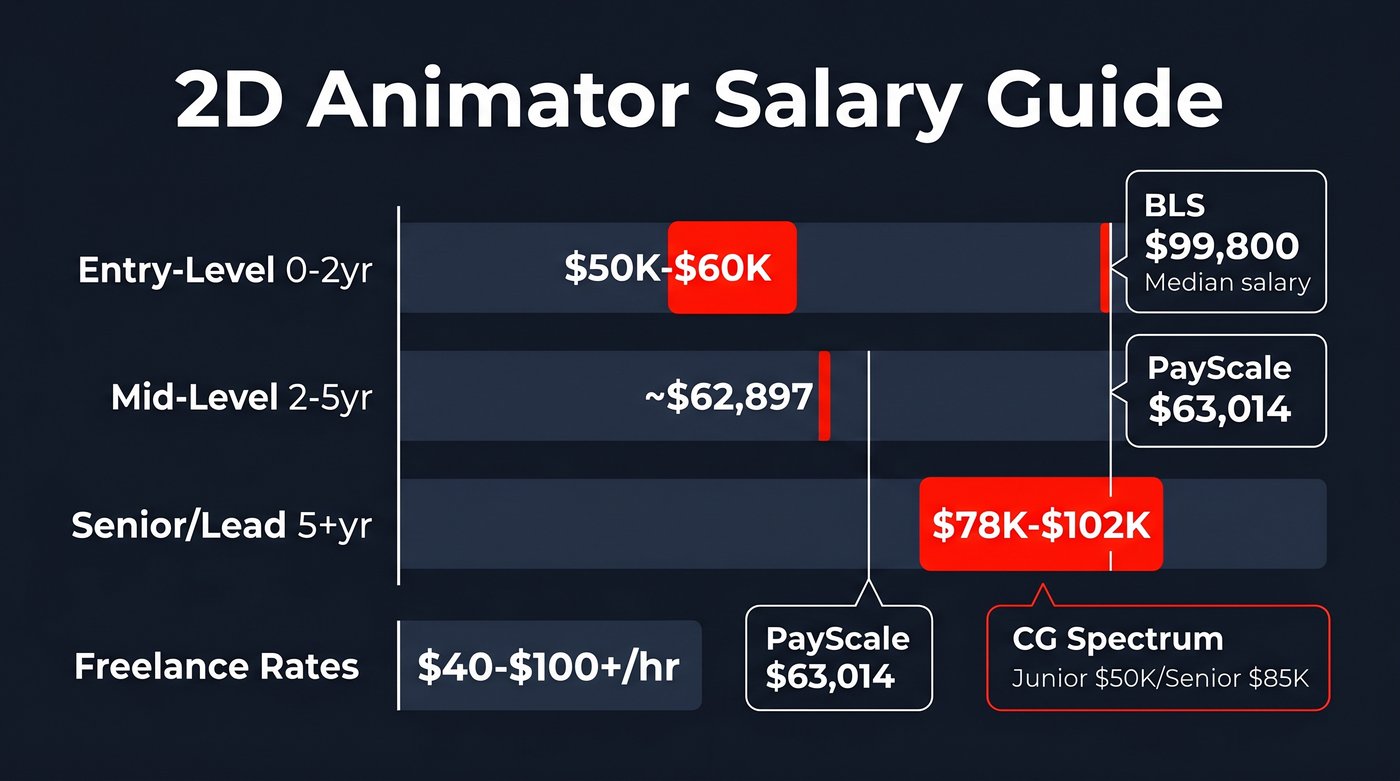
Quick Answer: In the United States, 2D animators typically earn between $50,000 and $85,000 per year, with entry-level roles starting near $50,000 and senior positions reaching $85,000 or more. Government data from the U.S. Bureau of Labor Statistics places the broader animator category at a $99,800 median, reflecting all disciplines and seniority levels combined.
The real challenge is not finding a salary number. It is knowing whether that number applies to you. Your experience level, city, industry, and employment type all shift the range significantly. This guide explains every major factor so you can set realistic expectations and negotiate with confidence.
Why Salary Sources Give You Such Different Numbers
Before diving into figures, it helps to understand why your Google search returns wildly different answers. Each data source measures something slightly different, and treating them as interchangeable leads to real financial miscalculations.
Here is how the major sources compare:
| Source | Reported Figure | What It Actually Measures |
|---|---|---|
| Bureau of Labor Statistics (2024) | $99,800 median annual wage | All special effects artists and animators across all disciplines and experience levels |
| PayScale (2026) | $63,014 average base salary | Self-reported data from animators with 2D-specific skills |
| Noble Desktop | ~$60,000 U.S. median | Multi-source compilation focused on 2D animation roles |
| Indeed (2025) | $30.42/hour average | Active job postings, limited to 18 posted listings at time of report |
| CG Spectrum | $50,000 junior / $85,000 senior | Role-level estimates from an animation education provider |
The BLS figure is the highest because it covers every animator specialty, including visual effects artists at major studios. Indeed’s hourly average reflects only the postings actively listed at a given moment, which skews toward contract and mid-level roles. PayScale draws from voluntary self-reporting, which can undersample both the very low and very high ends of the pay spectrum.
None of these sources is wrong. They are just answering different questions.
2D Animator Salary by Experience Level
Experience is the single strongest predictor of what a 2D animator earns. The jump from entry-level to senior pay is not incremental. It can be substantial, often doubling over a career span.
Entry-Level (0 to 2 Years)
Junior animators typically earn between $50,000 and $60,000 annually. PayScale reports $50,844 for animators with less than one year of experience. CG Spectrum places junior salaries around $50,000. Some metropolitan markets post entry-level roles above $70,000, but those listings are outliers tied to high cost-of-living cities or well-funded studios.
Mid-Level (2 to 5 Years)
With one to four years of professional experience, PayScale shows average compensation climbing to approximately $62,897. Animators at this stage typically handle more complex sequences, take on feedback loops independently, and begin specializing in a genre or style. That specialization accelerates future pay growth faster than generalist experience alone.
Senior and Lead Roles (5+ Years)
Senior animators and lead titles command significantly higher pay. Noble Desktop cites Lead Animator at $78,000 and Senior Lead Animator at $102,000. CG Spectrum places senior animation positions at around $85,000. Roles involving production oversight, mentoring junior artists, or directing animation pipelines consistently push total compensation toward or past six figures.
How Location Affects Your 2D Animator Salary
Where you work matters almost as much as how long you have worked. Market demand, industry density, and cost of living all interact to shape regional pay rates.
Indeed’s city-level data highlights notable geographic variation across U.S. markets:
- Walpole, MA: $56.26 per hour average
- Boston, MA: $53.06 per hour average
- Major animation hubs like Los Angeles and New York also tend to pay above the national average, driven by the concentration of film, TV, and advertising studios
- Smaller markets with fewer studios typically offer lower base salaries but may offset that with lower cost of living
Remote work has changed this equation somewhat. Studios hiring remotely may peg pay to their headquarters location or apply a regional multiplier. If you are negotiating a remote role, always ask whether salary is location-adjusted or market-rate for the studio’s city.
Salary by Industry and Studio Type
The industry you work in shapes your paycheck just as much as your skill level. A 2D animator at a major entertainment studio and a 2D animator producing corporate e-learning content may have the same reel but very different salaries.
Film and Television
Feature animation and episodic TV tend to offer the highest base salaries, particularly at union studios. Projects backed by major distributors carry larger budgets and structured pay scales. Senior roles in this sector align most closely with the BLS $99,800 median figure.
Games and Interactive Media
Game studios increasingly hire 2D animators for UI animation, concept visualization, and mobile titles. Pay varies widely by studio size. AAA studios in major cities offer competitive salaries, while indie studios often pay less but may offer profit-sharing or creative freedom as compensation.
Advertising and Motion Design
Commercial work and motion graphics blend 2D animation with design skills. Animators who can handle both often command premium rates, especially as freelancers. This category blurs into the motion designer salary bracket, which is why some sources lump these roles together and inflate the averages.
E-Learning and Corporate Media
This sector offers consistent work volume but typically pays below entertainment industry rates. Entry-level animators often find their first steady roles here. It can be a strong starting point for building speed and professional workflow habits that translate into higher-paying work later.
Freelance vs. Full-Time: What the Numbers Do Not Tell You
Most salary guides focus on full-time employment data and ignore freelance income entirely. That leaves a major gap for a field where contract work is common.
Freelance 2D animators typically price work by the second of finished animation, by the project, or by the hour. Hourly freelance rates for experienced animators often range from $40 to $100 or more, which can exceed salaried equivalents when work is consistent. However, freelancers also absorb the cost of their own equipment, software subscriptions, health insurance, and unpaid downtime between projects.
When comparing freelance rates to salaried offers, a useful rule of thumb is to add 25 to 35 percent to the salaried base to account for employer-paid benefits. A $65,000 salary with full benefits is genuinely worth more than $65,000 in gross freelance income after expenses.
How to Increase Your 2D Animator Salary: A Practical Roadmap
Understanding where salaries land is only half the goal. Here is how to move your pay upward intentionally.
- Build a focused portfolio. Generalist reels get generalist pay. A portfolio that demonstrates mastery of character animation, dialogue scenes, or a specific style signals specialization that employers and clients pay a premium for.
- Develop adjacent technical skills. Animators who understand rigging, compositing, or motion graphics pipelines become more valuable across production roles. That cross-functional ability is one of the clearest paths to a lead title and its associated pay bump.
- Research before you negotiate. Use multiple sources, including BLS data, PayScale, and active job postings in your target city, to build a realistic salary range before any offer conversation. Coming in with specific data shifts the negotiation dynamic.
- Target industries with higher budgets. If e-learning is your current market, consider whether your skills transfer to advertising or game studios. Even one industry shift can add $10,000 to $20,000 to your annual base.
- Consider union membership. Union agreements at major studios set minimum rates that often exceed non-union market averages. Research whether the Animation Guild or local IATSE chapters cover work in your target sector.
For 2D animators working with digital tools, having reliable software is crucial for maintaining productivity and meeting deadlines. Professional tools like Adobe After Effects can significantly streamline your animation workflow, helping you deliver higher quality work faster—a key factor in earning higher rates.
Conclusion
This 2D animator salary guide points to four clear takeaways for any digital artist navigating the job market. First, no single salary figure tells the whole story. Government data, job boards, and compensation surveys each measure something different. Second, experience level is the most powerful lever you control, with senior roles paying $30,000 to $50,000 more than entry-level positions. Third, location and industry matter almost as much as skill. A senior animator in Boston working on a TV production earns substantially more than a senior animator in a smaller market doing corporate explainers. Fourth, freelance income requires its own calculation that accounts for taxes, benefits, and downtime before it can be compared to salaried offers fairly.
Use these benchmarks as a starting point, cross-reference them against live job postings in your city, and go into every salary conversation with specific data in hand. That approach consistently produces better outcomes than accepting the first number offered. For broader context on animation careers, our animator career path guide covers the skills and milestones that drive long-term salary growth in the field.
Frequently Asked Questions
What is the average 2D animator salary in the United States?
The average 2D animator salary in the U.S. ranges from approximately $50,000 at the entry level to $85,000 or more at the senior level. PayScale reports an average base salary of $63,014 for animators with 2D skills, while the BLS places the broader animator and special effects artist category at a $99,800 median annual wage for 2024, which includes all animation disciplines and seniority levels.
How much do entry-level 2D animators make?
Entry-level 2D animators typically earn between $50,000 and $60,000 per year in the United States. PayScale data shows $50,844 for animators with less than one year of experience. Some metropolitan markets list entry-level roles above $70,000, but those positions are outliers tied to high-cost cities or large, well-funded studios with competitive starting packages.
Does location significantly affect a 2D animator’s salary?
Yes, location has a major impact on 2D animator pay. Indeed data shows top U.S. markets like Walpole, MA reporting $56.26 per hour and Boston, MA at $53.06 per hour. Animation hubs such as Los Angeles and New York also pay above national averages. Remote roles may be pegged to the studio’s headquarters location, so always confirm whether remote pay is location-adjusted.
Do 2D animators earn more in film and TV than in other industries?
Generally, yes. Film and television studios, especially those with union agreements, tend to offer the highest base salaries for 2D animators. These productions carry larger budgets and structured pay scales. E-learning and corporate media typically pay less, while advertising and game studios fall in a mid-range that varies widely based on the studio’s size and funding.
How does freelance 2D animator pay compare to full-time salaries?
Experienced freelance 2D animators can earn $40 to $100 or more per hour, which may exceed equivalent salaried income when work is consistent. However, freelancers pay for their own software, equipment, health insurance, and unpaid gaps between projects. A salaried role with full benefits is typically worth 25 to 35 percent more than the same gross income earned through freelancing.
What skills help a 2D animator earn a higher salary?
Specialization in high-demand styles, such as character animation or dialogue scenes, consistently commands premium pay. Animators who add rigging, compositing, or motion graphics skills become more versatile and qualify for lead roles that pay significantly more. Strong communication and production management skills also support the jump into senior or supervisory titles with higher compensation bands.
Why do different salary websites show such different numbers for 2D animators?
Each platform measures something different. The BLS tracks all animation disciplines combined. PayScale uses voluntary self-reporting from individual workers. Indeed reflects active job postings at a given moment. Noble Desktop compiles multiple sources. None is wrong, but mixing them without context creates confusion. Always check what job titles, specializations, and experience levels a source includes before using its figures as your benchmark.