The average senior FX artist in Los Angeles earns nearly three times what a junior starting in London takes home. If you have ever accepted an offer without knowing that, you may have left real money on the table.
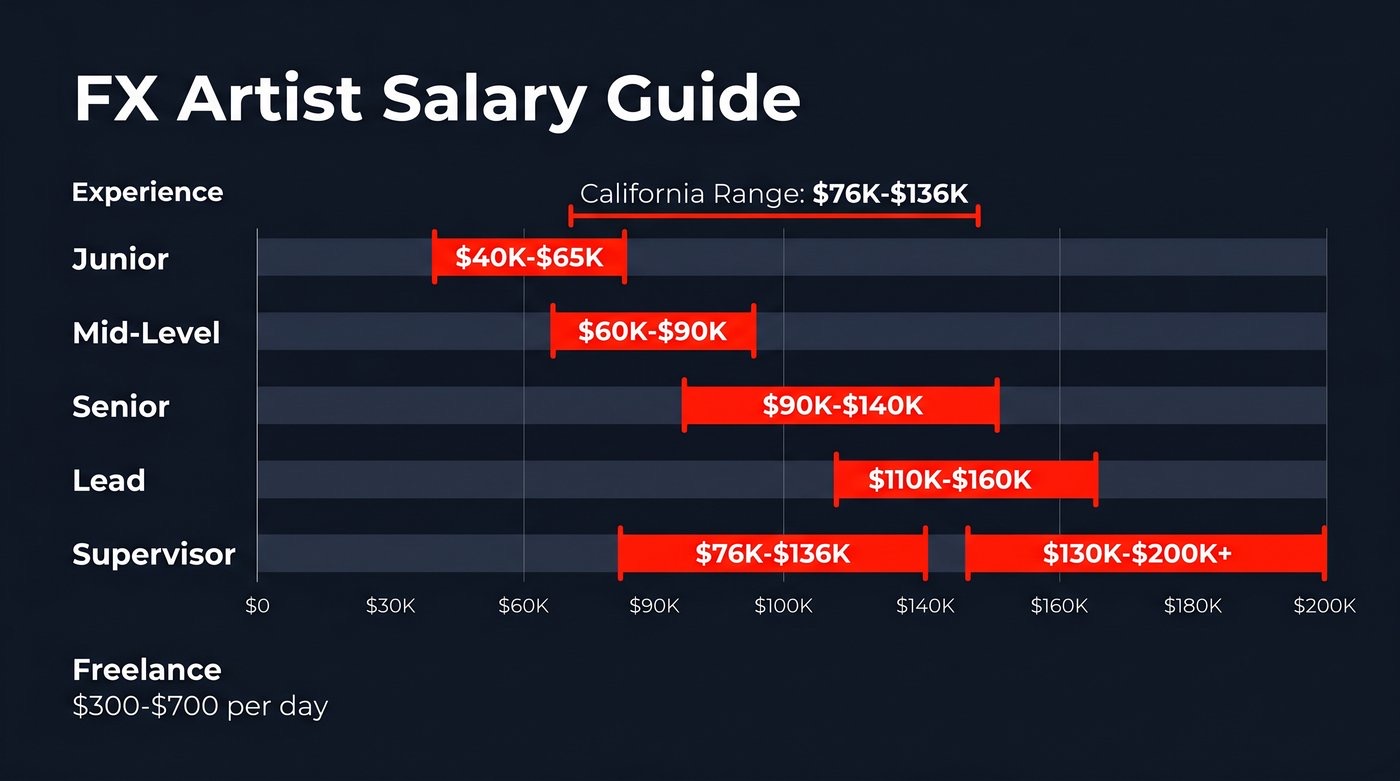
This FX Artist Salary Guide cuts through the noise of vague aggregator data and gives you current, specific, and actionable numbers. Whether you are just breaking in or deciding whether to go freelance, you will leave with a clear benchmark.
Quick answer: FX artists in the U.S. typically earn between $40,000 and $65,000 at the junior level, $60,000 to $90,000 at mid-level, and $90,000 to $140,000+ at the senior level. Supervisors and leads regularly exceed $110,000 to $160,000, especially in major production hubs.
Salary aggregators often mix FX artists, FX TDs, and VFX supervisors into one blended number, producing figures that mislead more than they inform. This guide separates those roles, layers in location and sector, and gives you the multi-dimensional picture you need to negotiate with confidence.
FX Artist Salary Ranges by Seniority Level
Experience is the single biggest lever on your paycheck. The jump from junior to senior is not incremental; it is transformational. According to ActionVFX’s VFX career salary guide, a junior VFX artist starts at $40,000 to $60,000, while a VFX supervisor can command $80,000 to $150,000 or more.
Below is a consolidated salary matrix that combines data from CG Spectrum, ESMA, ActionVFX, ERI’s California dataset, and industry educator breakdowns. Use it as your personal benchmark.
| Seniority Level | U.S. (National) | U.S. (California) | United Kingdom | France |
|---|---|---|---|---|
| Junior / Entry-Level | $40,000 – $65,000 | $55,000 – $76,000 | £20,000 – £30,000 | €25,000 – €35,000 |
| Mid-Level | $60,000 – $90,000 | $76,000 – $105,000 | £30,000 – £45,000 | €35,000 – €42,000 |
| Senior / Specialist | $90,000 – $140,000 | $105,000 – $135,810 | £40,000 – £60,000 | €40,000 – €45,000+ |
| Lead / Supervisor / TD | $110,000 – $160,000+ | $130,000 – $200,000+ | £55,000 – £80,000+ | €45,000 – €60,000+ |
ERI’s 2026 compensation dataset for California specifically places the VFX artist range at $76,129 to $135,810, which aligns closely with these figures for a high-cost state. London similarly pulls UK averages above the national figures reported by Prospects UK.
Junior FX Artist Salary
Most junior FX artists in the U.S. start between $40,000 and $65,000 annually. CG Spectrum’s FX-specific career pathway places the junior film FX artist figure closer to $74,000, which reflects the premium that film pipelines pay over general VFX work. At this stage, your portfolio and Houdini literacy matter far more than years on a resume.
Mid-Level FX Artist Salary
With two to four years of production experience, expect to move into the $60,000 to $90,000 range nationally. An industry educator’s salary progression breakdown puts the two-to-four-year mark at roughly $67,000, which sits comfortably within this band. Mid-level artists who specialize in fluid or destruction simulations often push toward the upper end faster.
Senior and Specialist FX Artist Salary
Senior FX artists with five or more years of experience typically earn $90,000 to $140,000 in the U.S. CG Spectrum cites a senior film FX artist figure of approximately $138,000. ESMA reports senior and specialist roles reaching $90,000 to $120,000+, depending on studio size and location.
How Location Shapes Your FX Artist Pay
Where you work can shift your salary by 20 to 40 percent without any change in your skill level. This is one of the most under-discussed variables in any FX artist salary guide, and it deserves direct attention.
- Los Angeles and San Francisco: California-based roles consistently run 10 to 20 percent above national U.S. averages. ERI’s data confirms this with a range ceiling of $135,810 for senior VFX artists in California alone.
- Vancouver and Montreal: Canadian tax incentives have made both cities major VFX hubs. Salaries are competitive with U.S. figures on a nominal basis, though currency exchange and local taxes affect real take-home pay.
- London: Prospects UK places experienced VFX artists at £40,000 to £60,000, with London roles paying noticeably more than regional UK studios.
- Remote and outsourcing hubs: Remote FX roles are growing but often pay below hub rates. Artists based in lower cost-of-living regions who work remotely for U.S. studios occupy a wide salary range, sometimes negotiating closer to U.S. rates based on deliverables and seniority.
The takeaway is clear: the same skill set earns very different money depending on your zip code. Before you accept any offer, research the local cost of living alongside the gross salary.
Film, Games, and Advertising: Does Your Sector Change Your Salary?
Yes, it does, and not always in the direction you might expect.
Film and Streaming
Feature film and high-end episodic streaming work pays competitively at the senior level, often reaching the top of established salary bands. The trade-off is project-based contracts, overtime-heavy crunches, and gaps between productions. Income volatility is real, especially for mid-level artists who have not yet built a consistent studio network.
Games and Real-Time FX
Game studios may offer slightly lower base salaries than top-tier film facilities, but they typically compensate with more stable employment, benefits packages, and performance bonuses. The rapid growth of real-time FX roles using Unreal Engine is creating a new premium tier. Artists who can bridge offline Houdini pipelines and real-time engines are increasingly rare and increasingly valued.
Advertising and Commercial Work
Commercial and advertising projects can pay very well on a per-project basis, sometimes exceeding film rates in a short window. However, this sector is highly cyclical, and building a sustainable income requires strong client relationships and consistent self-promotion.
Staff vs. Freelance: Which Path Pays More?
This is one of the most common questions FX artists face, and the honest answer is: it depends on your utilization rate. Understanding the journey of a freelance artist can help you make an informed decision about which path aligns with your career goals.
Staff roles offer predictability. A senior FX artist on staff in Los Angeles might earn $110,000 to $130,000 with benefits, paid leave, and employer pension contributions. Freelancers at the same seniority level often charge $300 to $700 per day, which sounds dramatically higher until you subtract taxes, health insurance, equipment costs, and unpaid gaps between bookings.
Here is a simple framework for comparing the two paths:
- Calculate your realistic utilization rate. Most freelancers are not booked 52 weeks a year. A realistic assumption is 40 to 45 billable weeks annually for a well-networked mid-senior artist.
- Subtract overhead. Self-employment taxes, software subscriptions, hardware, and health insurance can add up to $15,000 to $25,000 per year in the U.S.
- Compare net figures. A freelancer earning $500 per day for 200 days ($100,000 gross) may net less than a staff artist on $90,000 with full benefits after accounting for those costs.
- Factor in career growth. Staff roles often provide mentorship, pipeline experience, and internal promotion pathways. Freelancers grow faster in breadth but sometimes slower in organizational seniority.
The Skills That Push Your FX Salary Higher
Technical depth is the clearest path to the upper salary tiers in FX. Knowing which tools and skills to prioritize can accelerate your earning trajectory by years.
- Houdini mastery: CG Spectrum explicitly identifies Houdini as the primary hiring criterion for FX roles. Artists with deep simulation expertise in destruction, fluids, and complex procedural systems consistently access the $100,000+ range sooner than generalists.
- Real-time FX and Unreal Engine: The convergence of offline and real-time pipelines is creating hybrid roles. Artists who can work in both environments are commanding premiums as virtual production expands.
- Scripting and technical pipeline work: ESMA emphasizes Python scripting and pipeline literacy as salary multipliers. FX TDs who can build and maintain tools are among the highest-paid specialists in VFX studios.
- Broad compositing and lighting knowledge: Artists who understand how their simulations are rendered and composited are easier to integrate into fast-moving productions. Adobe After Effects proficiency for compositing can be a valuable addition to your technical toolkit. That versatility translates into faster promotions and stronger negotiating positions.
How to Negotiate a Better FX Artist Salary
Knowing the numbers is only half the battle. Here is a practical approach to negotiating an offer that reflects your actual value:
- Anchor with market data. Use ranges from this guide, ERI’s California dataset, and Prospects UK to frame your expectations with credibility. Vague requests are easy to decline. Specific, sourced benchmarks are harder to dismiss.
- Quantify your shot complexity. If you have handled large-scale destruction, multi-layered fluid simulations, or real-time FX pipelines, say so explicitly. Shot complexity directly correlates with the upper salary tiers, and hiring managers know it.
- Address overtime norms early. Film and TV productions often build overtime into budgets. Clarify whether your quoted salary is base or inclusive of expected overtime. For staff roles, this distinction can represent $10,000 to $20,000 in real annual income.
- Negotiate the full package. Benefits, remote work flexibility, software licensing, training budgets, and end-of-project bonuses all have monetary value. If base salary is fixed, these levers are often more moveable.
- Show your showreel strategically. A reel that leads with your highest-complexity FX work positions you as a specialist, not a generalist. Specialists earn more. Structure your presentation to reinforce the rate you are asking for.
Career Progression and Long-Term FX Salary Growth
The salary curve in FX is steep and front-loaded with effort. The good news is that structured career moves compound quickly.
A realistic progression based on multiple industry sources looks like this: you start at roughly $50,000 in your first two years, move to approximately $67,000 by year four, cross $100,000 after five or more years as a senior specialist, and reach $150,000 to $160,000+ at the supervisor level. These are not guarantees; they reflect artists who actively build their skills, network, and portfolio throughout each stage.
Practical steps that accelerate this progression include entering portfolio competitions like The Rookies and ArtStation challenges, seeking internships at studios known for complex FX work, and targeting roles that expose you to Houdini-heavy pipelines early. For comprehensive guidance on building a standout portfolio, check out our guide on how to build a game art portfolio in 2026. The artists who reach senior and supervisor salaries fastest are almost never the ones who waited for opportunities; they built toward them deliberately.
Conclusion: Your FX Artist Salary Roadmap
This FX Artist Salary Guide has covered the full landscape. Here are the four things to take away right now:
- Seniority is the biggest driver. The gap between junior and senior salaries can exceed $75,000 in the U.S. alone. Every deliberate career move compounds.
- Location changes everything. A California or London role can pay 20 to 40 percent more than the same role in a smaller market. Factor cost of living into the equation before comparing offers.
- Houdini and real-time skills are your fastest path to premium pay. Technical depth in simulation and real-time FX is under-supplied and increasingly in demand across film, TV, and games.
- Freelance math requires honesty. Higher day rates do not always mean higher net income. Model your realistic utilization and overhead before making the switch.
You now have the numbers, the context, and the negotiation framework. Use this guide as your benchmark every time you evaluate a new opportunity, revisit your rate, or plan your next career move. For detailed insights into related career paths, explore our comprehensive VFX artist career path guide.
Frequently Asked Questions
What is the average FX artist salary in the United States?
The average FX artist salary in the U.S. ranges from $40,000 to $65,000 at the junior level and $90,000 to $140,000 at the senior level. ERI’s 2026 California-specific data places the VFX artist range at $76,129 to $135,810, reflecting the premium paid in high-cost production hubs. National averages without location context can be misleading.
How much do entry-level FX artists make per year?
Entry-level FX artists in the U.S. typically earn between $40,000 and $65,000 per year. Film-specific pipelines, as noted by CG Spectrum, can push this starting figure closer to $74,000. Internationally, UK juniors start at £20,000 to £30,000, while French entry-level FX artists earn approximately €25,000 to €35,000 annually.
Does knowing Houdini increase FX artist salary?
Yes, significantly. Houdini proficiency is the primary hiring criterion for FX roles according to CG Spectrum, and artists with deep simulation expertise in destruction, fluids, and procedural systems consistently access the $100,000 to $140,000 salary range faster than generalists. Technical pipeline knowledge, including scripting, amplifies this premium further.
How much do freelance FX artists charge per day?
Freelance FX artists typically charge between $300 and $700 per day depending on seniority, region, and project type. Mid-level freelancers generally operate in the $350 to $500 range, while senior and specialist FX artists can command $500 to $700 or more. These rates must be weighed against taxes, benefits costs, and gaps between bookings to assess true net income.
What is the highest-paying FX artist role?
VFX supervisors and FX TDs are the highest-paid roles in this career path. ActionVFX reports VFX supervisor salaries between $80,000 and $150,000+, with top-tier producers on major feature projects occasionally exceeding $200,000. FX TDs who build and maintain pipeline tools are also among the highest-paid specialists inside major VFX studios.
Is FX artist salary higher in film or games?
Film and streaming work can reach higher peak salaries at the senior level, but game studios offer greater employment stability, benefits, and bonuses that can make total compensation comparable or superior. Real-time FX roles in game production, especially those requiring Unreal Engine expertise alongside Houdini, are increasingly commanding premiums that rival film rates.
How long does it take to reach a six-figure FX artist salary?
Most FX artists reach six-figure salaries after approximately five years of production experience, assuming active skill development and strategic career moves. Industry educators and sources like ESMA and ActionVFX consistently map the $100,000+ milestone to the senior stage, which typically arrives around year five for artists who pursue Houdini specialization and build strong portfolio credentials early.