Did you know that character artists in San Jose earn nearly twice the national average, while entry-level positions in other markets struggle to break $50,000? The geographic divide in this specialized profession is more dramatic than almost any other creative field.
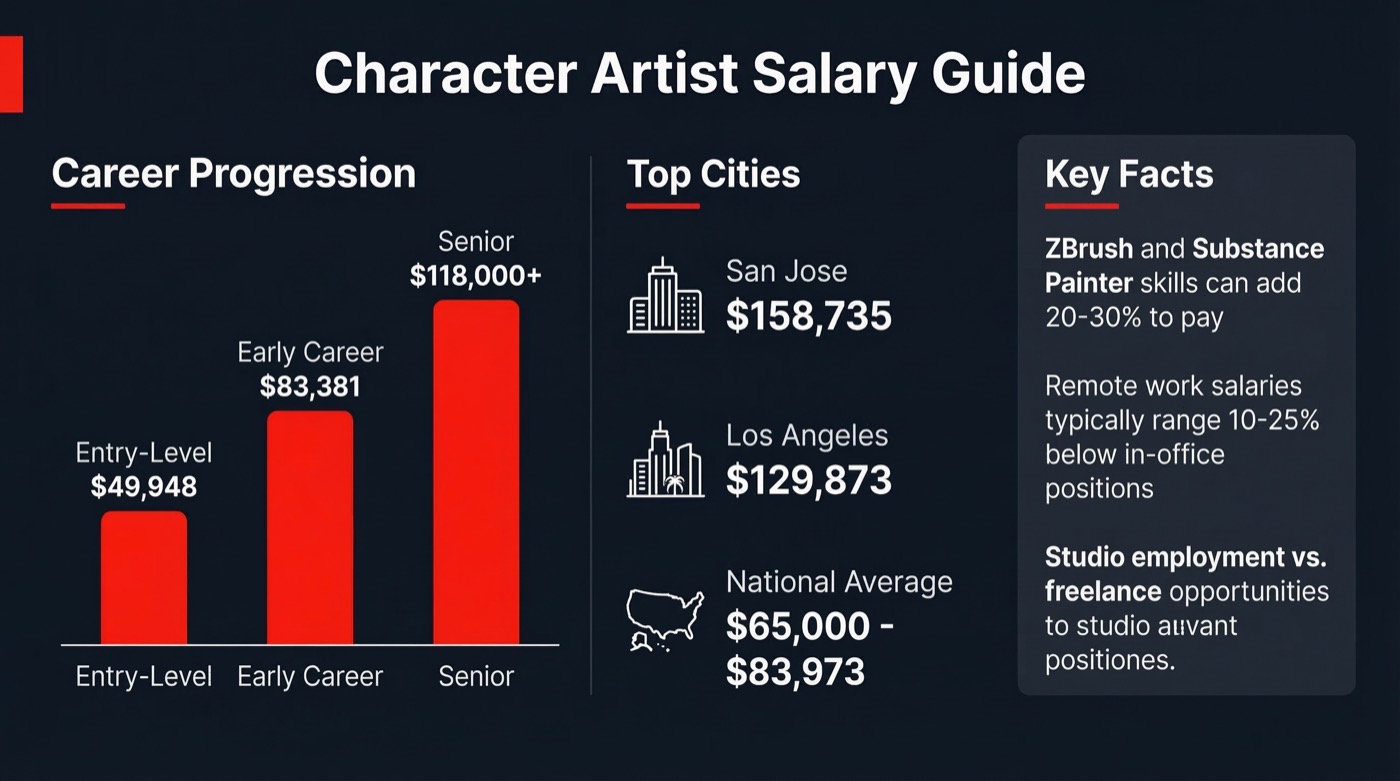
If you’re pursuing a career as a character artist or evaluating your current compensation, understanding the salary landscape is essential. The average character artist salary in the United States ranges from $65,000 to $83,973 annually as of 2026, with significant variations based on location, experience level, and specialization. However, these national figures tell only part of the story.
This comprehensive character artist salary guide breaks down what you can realistically expect to earn at every career stage, which cities offer the highest premiums, and how your compensation compares to related creative professions. According to data from PayScale, the profession shows clear advancement pathways with senior roles commanding over $118,000 in base salary alone.
What Does a Character Artist Actually Earn? National Salary Benchmarks
The baseline compensation for character artists varies depending on data collection methodology and sample size. Multiple authoritative sources provide a consistent picture of the national market.
VelvetJobs reports an average annual salary of $65,000 for character artists, with a typical range between $52,100 and $85,400. This translates to approximately $25.00 per hour, though hourly rates span from $20.00 to $32.80 depending on factors like project complexity and employment type.
PayScale’s 2026 data shows a higher national average of $83,973 annually, suggesting that more experienced professionals and those in competitive markets pull the average upward. The platform tracks total compensation including bonuses, which can add $2,000 to $10,000 to base salaries.
Entry-Level Character Artist Salaries
Breaking into the profession typically means accepting lower compensation while building your portfolio and technical skills. Character artists with less than one year of experience earn an average of $49,948 in total compensation.
This entry-level figure reflects the steep learning curve required to master industry-standard software like ZBrush, Maya, and Substance Painter while developing the artistic fundamentals that distinguish professional work. Many studios invest heavily in training junior artists, which partially explains the initial compensation gap.
Early-Career Salary Growth
The good news? Compensation increases rapidly for those who demonstrate competence. Character artists with 1-4 years of experience see average earnings jump to $83,381, representing a 67% increase over entry-level pay.
This dramatic early-career progression rewards artists who can work independently on production assets, require less supervision, and contribute to multiple projects simultaneously. Studios value artists who transition from trainees to reliable production team members.
Location Makes All the Difference: Geographic Salary Premiums
Where you work as a character artist matters as much as your skill level. Coastal technology and entertainment hubs command compensation that dwarfs national averages.
Los Angeles: Entertainment Industry Hub
As the center of film, television, and a major gaming market, Los Angeles offers character artists exceptional earning potential. ZipRecruiter reports an average salary of $129,873 annually as of March 2026, with hourly rates reaching $62.44.
This represents a 100% premium over the national baseline, though cost of living in Los Angeles is correspondingly higher. Salary.com provides a slightly more conservative estimate at $98,567, with most professionals earning between $85,135 and $102,089.
The variation between data sources likely reflects differences between positions at major studios (Disney, Netflix, major game publishers) versus smaller production companies and contract work.
San Jose: The Highest-Paying Market
Silicon Valley’s gaming and tech companies push character artist compensation to its highest levels. San Jose character artists earn an average of $158,735 annually, approximately 97% above the U.S. average.
This premium reflects both the concentration of well-funded gaming companies and VFX studios in the Bay Area and the region’s overall compensation structure. Tech companies entering gaming and virtual reality development often pay above traditional entertainment industry rates.
Other High-Paying Markets
While Los Angeles and San Jose lead the pack, other metropolitan areas offer above-average compensation:
- Seattle: Home to major gaming studios, offers 20-30% above national average
- San Francisco: Similar to San Jose with Bay Area tech premiums
- Austin: Emerging gaming hub with competitive rates and lower cost of living
- New York: Film and advertising work supports above-average compensation
Career Progression: From Junior to Senior Character Artist
Understanding the advancement pathway helps you set realistic career expectations and salary negotiation benchmarks.
| Experience Level | Years of Experience | Average Total Compensation | Typical Responsibilities |
|---|---|---|---|
| Entry-Level | Less than 1 year | $49,948 | Asset creation under supervision, learning pipeline |
| Early-Career | 1-4 years | $83,381 | Independent asset production, multiple projects |
| Mid-Career | 5-9 years | $118,000 | Lead character work, mentoring, complex characters |
| Senior | 10+ years | $118,592 – $143,000 | Art direction, team leadership, hero characters |
Senior Character Artist Compensation Breakdown
Senior character artists represent the top tier of individual contributor roles before transitioning into management. PayScale data shows base salaries averaging $118,592, with total compensation reaching $143,000 when including bonuses and profit-sharing.
Additional compensation for senior roles typically includes:
- Performance bonuses: $8,000 to $20,000 annually based on project completion and quality
- Profit sharing: $0 to $4,000 depending on studio structure and project success
- Stock options: Common at publicly-traded gaming companies and tech firms
Senior artists who transition to lead or principal roles can command even higher compensation, often exceeding $150,000 in major markets.
How Character Artist Salaries Compare to Related Professions
Character artists occupy a competitive middle-to-upper tier among creative and technical art positions. Understanding relative compensation helps you evaluate career pivots and specialization decisions.
Based on national average data, here’s how character artists compare:
- Storyboard Artists: $90,000 (highest among comparable roles)
- Technical Artists: $78,700
- Concept Artists: $77,800
- VFX Artists: $77,000
- Environment Artists: $68,700
- 3D Artists: $66,600
- Character Artists: $65,000 – $83,973
Character artists with strong technical skills often transition into technical artist roles, which combine artistic sensibility with programming and pipeline development. This career pivot can increase earning potential while reducing the physical demands of full-time modeling and sculpting.
How to Maximize Your Character Artist Salary: Strategic Career Moves
Strategic decisions throughout your career significantly impact long-term earning potential. These actionable steps help you command top-tier compensation.
Step 1: Build Specialization Within Character Art
General character artists face more competition than specialists. Focus on high-demand niches like realistic human characters, creature design, or stylized characters for mobile games. Studios pay premiums for artists who solve specific production challenges.
Step 2: Master Industry-Standard Software
Proficiency in the current tool ecosystem directly correlates with compensation. Prioritize these skills:
- ZBrush: Industry standard for high-resolution sculpting and detail work
- Maya or Blender: Production modeling, topology, and UV mapping
- Substance Painter: Texturing workflow that most studios require
- Marvelous Designer: Clothing simulation increasingly expected for character work
- Game engine basics: Understanding Unity or Unreal Engine implementation
Step 3: Consider Strategic Relocation
The 100-150% salary premium in major markets often justifies relocation costs despite higher living expenses. Calculate your real purchasing power by comparing take-home pay to housing, transportation, and taxes in target cities.
Remote work opportunities are expanding but still rare for character artists due to collaboration requirements and proprietary asset security. When available, remote positions for Los Angeles or San Francisco studios may offer geographic arbitrage opportunities.
Step 4: Negotiate Beyond Base Salary
Many artists focus exclusively on base salary during negotiations. Consider the full compensation package:
- Performance bonuses: Can add 10-20% to annual earnings at studios with profit-sharing
- Equity/stock options: Particularly valuable at pre-IPO gaming companies
- Professional development: Conference attendance and training budgets enhance skills and networking
- Remote work flexibility: Even partial remote work provides geographic flexibility
Industry Sectors and Their Impact on Character Artist Compensation
Not all character artist positions offer equivalent compensation. The industry sector significantly influences both salary and working conditions.
AAA Game Studios
Major publishers like Electronic Arts, Activision Blizzard, and Ubisoft typically offer the most competitive base salaries with comprehensive benefits. These positions demand the highest technical standards but provide stable employment and clear advancement paths.
Expect salaries 15-25% above independent studios, with better benefits packages including health insurance, retirement matching, and paid time off.
Film and Visual Effects
Film production and VFX houses often pay project-based compensation with less stability but potentially higher short-term earnings. Character artists working on major film productions may earn premium rates during production cycles.
However, project-based employment means gaps between contracts. Successful film character artists often work as freelancers commanding $50-100+ per hour but must manage their own benefits and retirement planning.
Mobile and Casual Gaming
Mobile game studios generally offer lower compensation than AAA console/PC developers but provide faster production cycles and broader creative opportunities. Salaries typically run 10-20% below AAA rates.
The trade-off includes seeing your work released more quickly and often having greater creative input on stylized character designs.
Emerging Sectors: Virtual Reality and Metaverse
Companies developing VR experiences and metaverse platforms actively recruit character artists and often pay at or above AAA game studio rates. These positions require adapting to new technical constraints but represent growth markets.
Tech companies entering gaming (like Meta, Apple, and Google) may offer compensation packages that include significant equity components, potentially exceeding traditional entertainment industry totals.
Key Takeaways from This Character Artist Salary Guide
Understanding compensation benchmarks helps you make informed career decisions and negotiate confidently. Here are the essential insights:
- National averages of $65,000-$83,973 mask dramatic geographic variation, with Los Angeles and San Jose offering double or triple baseline compensation
- Career progression delivers substantial earning growth, with mid-career professionals earning 135% more than entry-level positions
- Specialization and technical mastery directly impact compensation, making continuous skill development essential for salary advancement
- Industry sector matters as much as skill level, with AAA studios and tech companies offering the most competitive total compensation packages
Whether you’re starting your journey as a character artist or evaluating your current compensation, these benchmarks provide the foundation for strategic career planning. The field rewards both artistic talent and business savvy in navigating opportunities across markets and sectors.
Frequently Asked Questions About Character Artist Salaries
What is the starting salary for a character artist with no experience?
Entry-level character artists with less than one year of professional experience typically earn around $49,948 annually according to PayScale data. However, this figure varies significantly by location. Entry positions in major markets like Los Angeles or San Francisco may start at $60,000-$70,000, while smaller markets or remote positions might offer $40,000-$45,000. Building a strong portfolio during education and completing internships can help secure higher starting offers.
How much do senior character artists make?
Senior character artists earn an average base salary of $118,592, with total compensation reaching $143,000 when including bonuses, profit-sharing, and other incentives. In premium markets like San Jose and Los Angeles, senior character artists can command $150,000-$180,000 or more, particularly at well-funded gaming studios and tech companies. Senior roles typically require 7-10 years of experience and demonstrated leadership capabilities.
Do freelance character artists earn more than salaried positions?
Freelance character artists can potentially earn more on an hourly basis, often charging $50-$150+ per hour depending on specialization and reputation. However, freelancers must account for inconsistent work flow, self-funded health insurance, retirement savings, and business expenses. Most freelancers need to bill 50-60% more per hour than their salaried equivalent to achieve comparable take-home compensation. Freelancing works best for established artists with strong industry networks.
Which companies pay character artists the highest salaries?
The highest-paying employers for character artists typically include major tech companies entering gaming (Meta, Apple, Google), top-tier AAA game studios (Activision Blizzard, Electronic Arts, Riot Games), and prestigious film VFX houses (Industrial Light & Magic, Weta Digital). These companies offer base salaries in the $100,000-$150,000+ range for experienced artists, plus comprehensive benefits and equity packages. Geographic location (Silicon Valley, Los Angeles) also concentrates the highest-paying opportunities.
How does remote work affect character artist salaries?
Remote character artist positions remain relatively rare compared to other tech roles due to collaboration requirements and asset security concerns. When available, remote positions typically offer 10-25% below equivalent in-office roles in major markets. However, this can still represent significant geographic arbitrage if you live in a lower cost-of-living area while earning Los Angeles or San Francisco rates. The remote work landscape continues evolving, with more studios offering hybrid arrangements post-pandemic.
What skills increase character artist salary the most?
The most valuable salary-boosting skills include advanced ZBrush sculpting, realistic human anatomy and facial modeling, efficient retopology for game engines, Substance Painter texturing mastery, and understanding of character rigging constraints. Increasingly, knowledge of real-time rendering in Unreal Engine or Unity, cloth simulation in Marvelous Designer, and procedural workflow tools command premium compensation. Technical artists who bridge character art and programming can earn 20-30% above pure character artist roles.
Is a degree required to become a character artist, and does it affect salary?
A formal degree is not strictly required for character artist positions as portfolio quality matters most. However, degrees from respected programs (Gnomon, SCAD, Ringling) provide networking opportunities and structured skill development. Data on education’s direct salary impact is limited, but degree holders may advance to senior roles faster due to foundational knowledge. Many successful character artists are self-taught or attended specialized training programs rather than traditional four-year degrees. Focus on portfolio quality over credential collection.