
How Much Do Game Artists Make? Salary Guide by Role & Studio
Did you know that technical artists in the gaming industry can earn up to $139,000 annually, while entry-level positions start at just $35,000? The salary gap in game art careers is wider than ever, and understanding where you fit can make a six-figure difference over your career.
These are ArtBlast's own numbers, from the real game artist job postings we track across 600+ studio job boards. You will not find them anywhere else.
- 266 game artist openings tracked across 166 studios
- 35% of those roles were remote
- Only 1% of postings disclosed a salary range, the rest hid the number
- Top hiring studios: Voodoo, King, Paxie Games, Panteon, Fortune Mine Games
- Most active markets: Turkey, Vietnam, United Kingdom
Source: ArtBlast game art job tracking, 2026. Using these figures? Please cite ArtBlast and link to this page.
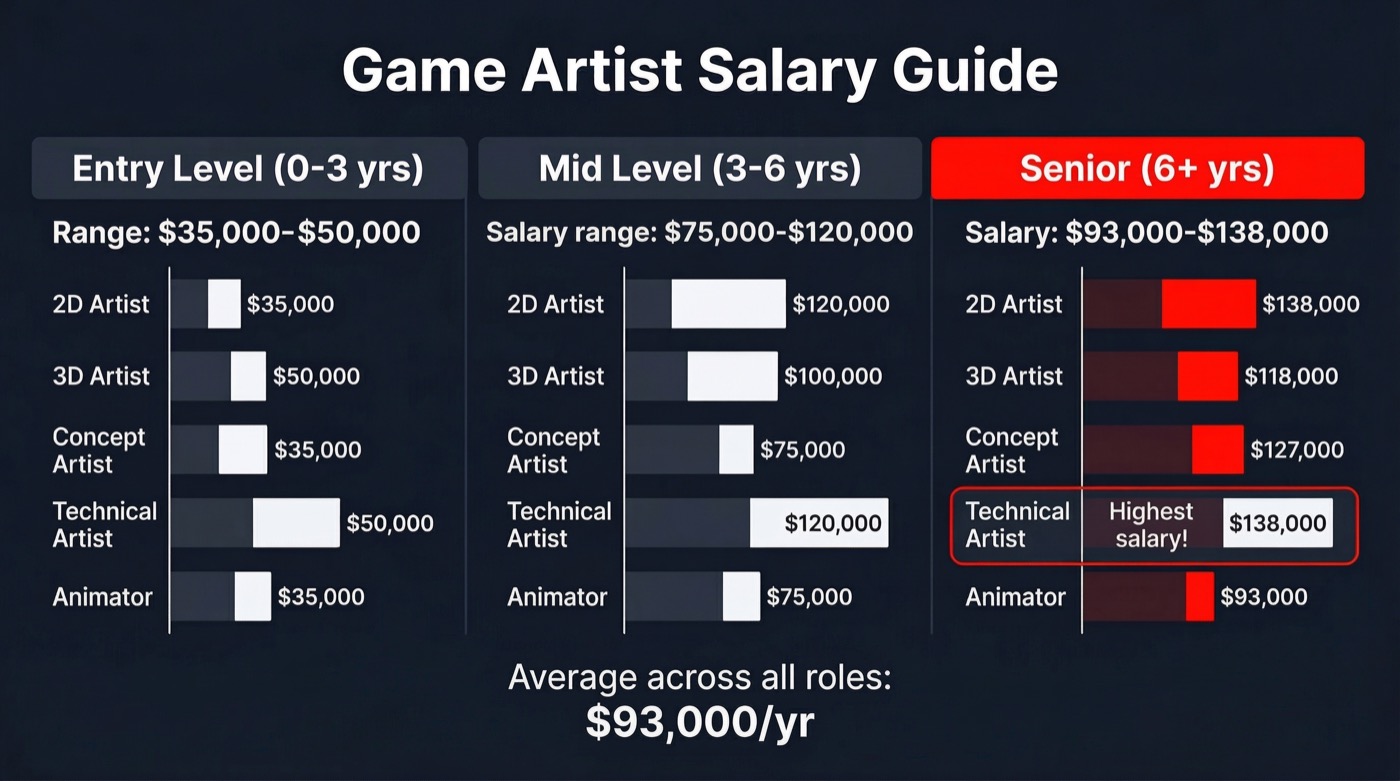
The Game Artist Salary Guide 2026 shows average compensation ranging from $35,000 for newcomers to $139,000 for specialized senior roles. Entry-level artists (under 3 years) earn $35,000-$50,000, mid-career professionals (3-6 years) make $75,000-$120,000, while senior artists command $93,000-$139,000 depending on specialization and studio size.
For a focused breakdown by software and specialization, see the 3D artist salary guide covering entry to senior pay rates across game and film studios.
Whether you’re considering a career switch, negotiating your first game art position, or planning your next career move, this comprehensive salary breakdown reveals exactly what game artists earn in 2026. We’ll explore how experience, specialization, location, and studio size impact your earning potential, plus actionable strategies to maximize your compensation in this booming $600 billion industry.
Understanding Game Artist Salary Ranges by Experience Level
Game artist salaries follow a clear progression tied to experience, but the climb is steeper than most creative fields. According to PayScale’s 2026 data, the overall average sits at $58,631, with significant variation based on years in the industry.
Entry-level artists with under one year of experience average $45,781, while those in their first four years see modest increases to around $59,945. The real salary jumps happen at the mid-career mark, where 3-6 years of experience pushes compensation into the $75,000-$120,000 range.
Senior artists with 6+ years command the highest salaries, ranging from $93,000 to $139,000 depending on specialization. Lead artists and art directors break into six figures consistently, with art directors averaging $110,000 annually across studios of all sizes.
Entry-Level Game Artist Compensation (0-3 Years)
Breaking into the game art industry typically means starting between $35,000 and $50,000 annually. This range reflects the competitive nature of entry positions and the portfolio-building phase most artists experience early in their careers.
PayScale reports that artists with less than one year of experience average $45,781, though this can dip as low as $39,000 in smaller studios or contract positions. Geographic location plays a massive role at this level, with coastal studios offering 20-30% premiums over regional markets.
The first three years represent the steepest learning curve, where artists develop production skills, learn studio pipelines, and build industry connections. This foundational period sets the stage for mid-career acceleration.
Mid-Career Earnings (3-6 Years Experience)
Artists who survive the entry-level gauntlet see substantial salary increases between years three and six. The $75,000-$120,000 range reflects specialization choices and the transition from junior to regular artist status.
At this stage, role-specific expertise begins driving compensation differences. Environment artists at mid-career levels average $62,000-$120,000, while character artists command $45,000-$110,000 depending on the complexity of their work and studio prestige.
Technical artists, who bridge art and programming, often outpace their purely artistic peers during these years. Their hybrid skill set positions them for the upper end of mid-career ranges and faster promotion tracks to lead roles.
Senior and Lead Artist Salaries (6+ Years)
Senior game artists with six or more years earn between $93,000 and $139,000, with technical artists frequently hitting the upper range. Lead artists average $71,000-$105,000, though this varies significantly by studio size and project budgets.
Art directors represent the pinnacle of the traditional artist career path, averaging $110,000 annually. At major studios like Riot Games or established publishers, concept artists at senior levels can exceed $200,000 when bonuses and profit-sharing are included.
These roles require not only artistic excellence but also team management, cross-departmental communication, and technical pipeline knowledge. The compensation reflects this expanded responsibility beyond pure creation.
Game Artist Salary Breakdown by Role Specialization
Specialization dramatically impacts earning potential in game art. A 2D artist and a technical artist with identical experience levels can see salary differences exceeding $60,000 annually due to market demand and technical complexity.
The following table compares salary ranges across major game artist specializations based on 2026 industry data:
| Artist Specialization | Low Range | High Range | Key Skills Required |
|---|---|---|---|
| 2D Artist | $37,000 | $75,000 | UI/UX, texture painting, concept support |
| Generalist Artist | $40,000 | $95,000 | Multi-disciplinary, adaptable workflows |
| Concept Artist | $45,000 | $100,000+ | Visual development, rapid ideation |
| Character Artist | $45,000 | $110,000 | Anatomy, rigging knowledge, sculpting |
| Environment Artist | $62,000 | $120,000 | World-building, lighting, optimization |
| Technical Artist | $40,000 | $139,000 | Scripting, shaders, pipeline development |
Why Technical Artists Earn Premium Salaries
Technical artists represent the highest-paid specialization, with top earners reaching $139,000 annually. Their unique blend of artistic sensibility and technical programming skills addresses a persistent talent shortage in the industry.
These professionals create tools, optimize workflows, and solve complex rendering challenges that directly impact production efficiency. As game engines become more sophisticated and AI integration accelerates, technical artist demand continues outpacing supply.
Studios increasingly view technical artists as force multipliers who enable entire art teams to work faster and achieve higher quality. This strategic value justifies premium compensation compared to traditional artist roles.
Environment Artists: The High-Floor Specialists
Environment artists show the highest salary floor at $62,000, reflecting the technical demands and scope of world-building work. Creating believable, performant game spaces requires expertise in lighting, composition, modular design, and performance optimization.
The $120,000 ceiling for experienced environment artists aligns with their critical role in open-world games and live-service titles. Studios building expansive game worlds prioritize environment talent, driving competitive compensation.
This specialization also benefits from clear portfolio demonstration potential. Shipping levels in successful games provides concrete proof of skill that translates directly to negotiating power.
Geographic and Studio Size Impact on Salaries
Where you work matters as much as what you create. Game artist salaries in San Francisco average $110,000+ for mid-career roles, while similar positions in regional markets might pay $70,000-$80,000.
Studio size creates equally dramatic variations. Major publishers like Electronic Arts, Microsoft, and Riot Games offer compensation packages reaching $200,000+ for senior concept artists when including bonuses, equity, and benefits.
Independent studios and smaller developers typically pay 30-40% below major publisher rates but often offer more creative freedom, faster advancement, and better work-life balance. The trade-off between compensation and culture influences career trajectories significantly.
Top-Paying Markets for Game Artists
Coastal tech hubs dominate the highest-paying game art markets. San Francisco, Seattle, Los Angeles, and Austin lead with 25-50% premiums over national averages due to studio concentrations and cost-of-living factors.
However, remote work trends since 2024 have begun equalizing compensation across geographies. Many studios now offer location-adjusted salaries that split the difference, paying remote artists 80-90% of coastal rates regardless of residence.
International opportunities also factor into modern salary considerations. Canadian studios in Montreal and Vancouver offer competitive USD-equivalent salaries with favorable exchange rates, while European positions typically pay 10-20% less than American equivalents.
How to Maximize Your Game Artist Salary in 2026
Strategic career planning can accelerate your progression through salary tiers. Understanding which skills, credentials, and career moves yield the highest returns helps you optimize earning potential throughout your career.
The path from entry-level to six-figure compensation isn’t purely time-based. Artists who specialize strategically, build hybrid skill sets, and navigate studio transitions deliberately can compress the typical 8-10 year timeline to senior salaries.
Here’s a step-by-step approach to maximizing your game artist compensation:
Step 1: Choose High-Value Specializations Early
Identify specializations with the widest salary ranges and highest ceilings within your first two years. Technical art, environment art, and character art offer superior long-term earning potential compared to 2D or generalist tracks.
Invest in learning complementary technical skills like scripting, shader development, or real-time rendering optimization. These hybrid capabilities create premium positioning even at mid-career levels.
Track industry trends through job postings and salary surveys annually. Emerging specializations like AI-assisted workflow development or virtual production may offer first-mover advantages in compensation.
Step 2: Build a Portfolio That Commands Premium Rates
Your portfolio drives salary negotiations more than years of experience alone. Focus on quality over quantity, showcasing 5-7 exceptional pieces that demonstrate technical mastery and artistic vision.
Include shipped game work when possible, as production experience carries significantly more weight than personal projects. Document your specific contributions to collaborative projects to clarify your role and impact.
Regularly update your portfolio to reflect current industry standards and techniques. Outdated work signals stagnation, even if your actual skills have progressed. For comprehensive portfolio guidance, learn how to build a game art portfolio that stands out to hiring managers.
Step 3: Leverage Studio Transitions for Salary Jumps
Internal promotions typically yield 5-10% salary increases, while strategic studio transitions can deliver 20-40% jumps. Plan career moves around skill milestones rather than arbitrary timelines.
Target transitions when you’ve shipped a major title or mastered a new specialization. This timing maximizes your negotiating leverage and portfolio strength.
Research studio compensation tiers before applying. Moving from a mid-size independent to a major publisher at the right career stage can accelerate you past peers who remain at single studios.
Step 4: Develop Leadership and Communication Skills
Lead and director positions require more than artistic excellence. Cultivate mentoring abilities, cross-disciplinary communication, and project management skills starting at mid-career levels.
Volunteer for presentations, documentation, or onboarding responsibilities that demonstrate leadership potential. These opportunities signal promotion readiness to management while building essential senior-level skills.
The jump from senior artist ($93,000-$139,000) to art director ($110,000+) depends heavily on proven team leadership, not just individual artistic achievement.
Industry Trends Shaping 2026 Game Artist Salaries
The global video game market’s projected growth to $600 billion by 2030 creates sustained upward pressure on game artist salaries. This 12.2% compound annual growth rate from 2024’s $299 billion market signals expanding opportunities despite periodic industry layoff cycles.
AI integration represents the most significant variable in 2026 compensation trends. Artists who master AI-assisted workflows command premiums, while those resisting adaptation face increased competition for traditional positions.
Remote and hybrid work models have fundamentally restructured geographic salary differences. Studios increasingly compete for talent globally, forcing compensation adjustments that benefit artists in lower cost-of-living regions.
The AI Proficiency Premium
Artists proficient in AI-assisted creation tools are seeing 15-25% salary premiums over peers with equivalent traditional skills. This advantage appears strongest in concept art and early production phases where AI accelerates iteration.
However, technical artists who develop AI integration pipelines command even higher premiums. Creating tools that enable entire teams to leverage AI multiplies individual impact and justifies corresponding compensation.
The key is positioning AI as a force multiplier rather than a replacement. Artists who increase output quality and speed through AI assistance demonstrate clear ROI that translates to higher salaries.
Contract and Freelance Market Dynamics
Contract positions sustain many artists between full-time roles, with day rates ranging from $200-$800 depending on specialization and experience. Annualized, successful freelancers can match or exceed studio salaries while maintaining flexibility.
The contract market has strengthened in 2026 as studios prefer flexible staffing during development cycles. This creates opportunities for artists willing to trade security for potentially higher effective hourly rates.
Platform marketplaces and remote collaboration tools have globalized freelance competition, requiring premium quality and specialization to command top rates. Understanding the journey of a freelance artist helps navigate this increasingly competitive landscape.
Education and Credentials Impact on Earning Potential
While portfolio quality ultimately determines hiring and salary, educational credentials influence starting compensation and advancement speed. Industry data shows 74% of game artists hold bachelor’s degrees, with this group averaging higher lifetime earnings.
Artists with master’s degrees show potential earnings up to $122,000, though this correlation may reflect the ambition and networking opportunities graduate programs provide rather than the degrees themselves. Self-taught artists with exceptional portfolios can match these earnings without formal credentials.
Specialized certificates in emerging tools or techniques (Unreal Engine, Houdini, ZBrush mastery) often deliver better ROI than additional degrees. Professional software like Substance 3D Painter for texturing or Adobe Photoshop for concept art becomes essential for competitive positioning.
Key Takeaways for Game Artists in 2026
The Game Artist Salary Guide 2026 reveals a dynamic compensation landscape where specialization, technical skills, and strategic career moves determine earning potential more than time alone. Entry-level positions starting at $35,000-$50,000 can progress to $1310,000+ for senior technical artists within 6-8 years through deliberate skill development.
Geographic arbitrage opportunities through remote work, combined with the growing $600 billion gaming market, create unprecedented flexibility in balancing compensation with lifestyle preferences. Artists who develop AI proficiency and hybrid technical skills position themselves for premium salaries regardless of location.
Studio size, role specialization, and portfolio quality collectively impact compensation as much as experience level. Understanding these variables empowers you to negotiate effectively and plan career transitions that maximize both earnings and creative fulfillment.
Whether you’re entering the industry or advancing to leadership, the data-driven insights in this guide provide the foundation for informed career decisions in an evolving game art landscape.
Frequently Asked Questions
What is the average salary for a game artist in 2026?
The average game artist salary in 2026 is approximately $58,631 according to PayScale data. However, this varies significantly by experience level, ranging from $35,000-$50,000 for entry-level positions to $93,000-$139,000 for senior artists. Role specialization also impacts averages, with technical artists commanding the highest compensation at up to $139,000, while 2D artists average $37,000-$75,000. Geographic location and studio size create additional 20-40% variations around these baseline figures.
How much do entry-level game artists make?
Entry-level game artists with under three years of experience typically earn between $35,000 and $50,000 annually. Artists with less than one year in the industry average $45,781, though starting salaries can dip to $39,000 at smaller studios or in lower cost-of-living regions. Coastal markets like San Francisco or Seattle offer 25-30% premiums, pushing entry salaries toward $50,000-$55,000. Your specific starting salary depends heavily on portfolio quality, specialization choice, and whether you join an independent studio or major publisher.
Which game artist specialization pays the most?
Technical artists command the highest salaries in game development, with compensation ranging from $40,000 to $139,000 depending on experience. Environment artists follow closely with $62,000-$120,000 ranges, showing the highest salary floor among specializations. Character artists earn $45,000-$110,000, while concept artists at major studios like Riot Games can exceed $200,000 when including bonuses. The premium for technical artists reflects their hybrid skill set combining artistic ability with programming and pipeline development, addressing a persistent industry talent shortage.
Do game artists need a degree to earn competitive salaries?
A degree is not strictly required to earn competitive game artist salaries, though 74% of professionals hold bachelor’s degrees. Portfolio quality and demonstrable skills matter more than credentials for both hiring and compensation. Self-taught artists with exceptional portfolios regularly match or exceed the earnings of degree holders. However, formal education provides networking opportunities, structured skill development, and potentially faster entry into the industry. Targeted certificates in specialized tools often deliver better salary ROI than additional degrees, especially for mid-career artists expanding their skill sets.
How does studio size affect game artist salaries?
Studio size creates 30-40% salary variations for equivalent roles. Major publishers like Electronic Arts, Microsoft, and Riot Games offer compensation packages reaching $200,000+ for senior positions when including bonuses and equity, while mid-size studios typically pay $75,000-$120,000 for similar experience levels. Independent and small studios often pay at the lower end of industry ranges but compensate with creative freedom, faster advancement, and better work-life balance. Remote work trends are beginning to equalize some disparities, with large studios offering location-adjusted salaries to access talent regardless of geographic proximity.
Can game artists increase their salary through freelancing?
Experienced game artists can match or exceed studio salaries through successful freelancing, with day rates ranging from $200-$800 depending on specialization and reputation. Annualized, a freelancer billing 200 days yearly at $400/day would earn $80,000 before expenses, comparable to mid-career studio positions. Top freelancers in specialized areas like concept art or technical art can significantly surpass studio equivalents. However, freelancing requires consistent client acquisition, lacks benefits and job security, and faces global pricing pressure. It works best for established artists with strong networks and in-demand specializations.
How will AI impact game artist salaries in 2026 and beyond?
AI is creating a bifurcated salary impact in 2026. Artists who master AI-assisted workflows are commanding 15-25% premiums over peers with equivalent traditional skills, as they deliver faster iteration and higher output. Technical artists developing AI integration tools see even larger premiums due to their force-multiplier impact on entire teams. Conversely, artists resisting AI adaptation face increased competition for traditional positions, potentially suppressing entry-level salaries. The key to maintaining or growing compensation is positioning AI as a creative enhancement tool rather than viewing it as competition, focusing on uniquely human skills like artistic vision and emotional resonance.
Curious about which game studios pay the most? We break down salary data by studio size and revenue.
Looking for work? Browse open game artist jobs on ArtBlast, updated daily.
Related Articles
For role-specific data, see the Technical Artist Salary Guide covering base, bonus, and stock compensation by studio.
For a full breakdown of UI/UX artist earnings by seniority and city, see the UI/UX Artist Salary Guide.
Browse open roles by discipline: Concept Artist Jobs, Environment Artist Jobs, Character Artist Jobs, 3D Artist Jobs, Technical Artist Jobs.
See also: game artist salaries by country
Use the free Artist Salary Calculator to look up pay ranges for your role and country.
For a full pay breakdown by location and seniority, see the 2D Artist Salary Guide.