
Motion Designer Salary Guide: What You Can Really Earn
The average motion designer earns more than most people think, and the gap between a good salary and a great one comes down to a few key decisions. In 2026, U.S. motion designers earn anywhere from $35,000 to well over $170,000 depending on experience, location, and the industry they work in. If you have ever wondered where you stand or how to level up your income, this Motion Designer Salary Guide breaks it all down with real numbers.
These are ArtBlast's own numbers, from the real motion designer job postings we track across 600+ studio job boards. You will not find them anywhere else.
- 1354 motion designer openings tracked across 873 studios
- 27% of those roles were remote
- Only 12% of postings disclosed a salary range, the rest hid the number
- Top hiring studios: 1000heads, Monks, Agave Games, AntiSocial, Gameloft Saigon
- Most active markets: United States, United Kingdom, Germany
Source: ArtBlast game art job tracking, 2026. Using these figures? Please cite ArtBlast and link to this page.
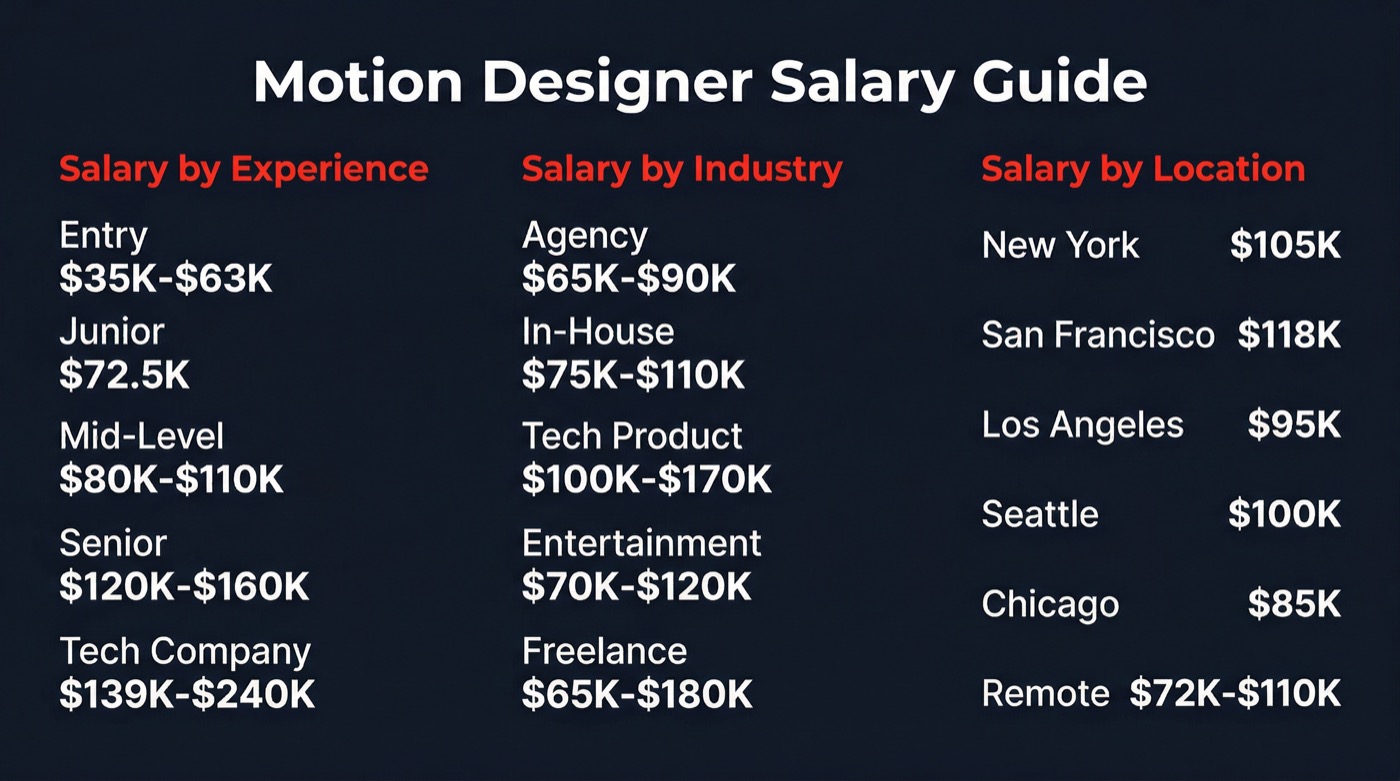
Motion designers who work in tech product roles at companies like Meta or Google can earn $139,000 to $240,000 in total compensation, a figure that rarely makes it into generic salary articles. Meanwhile, freelancers are quietly outpacing full-time peers in take-home pay. The landscape has shifted dramatically since 2024, and the old benchmarks no longer apply.
Quick Answer: In 2026, U.S. motion designers earn an average of $72,900 to $89,500 annually. Entry-level roles start around $35,000, mid-level reaches $80,000 to $110,000, and senior tech roles exceed $170,000. Freelancers average $65,000 or more, often surpassing full-time equivalents.
This guide covers every tier of the career path, from your first job out of school to landing a senior role at a top tech company. You will find salary tables, negotiation tips, and a clear picture of where the industry is heading through 2028.
Motion Designer Salary Benchmarks: The 2026 Numbers You Need to Know
Let's start with the raw data. According to ZipRecruiter's April 2026 data, the national median sits at $72,900, with the 75th percentile reaching $86,700. Robert Half, one of the most authoritative staffing firms in the country, puts the 2026 range at $76,250 to $107,000, with a mid-level average of $89,500.
These numbers represent a meaningful jump from pre-2025 estimates. The old School of Motion poll from 2017 cited a $62,000 average, that figure is now outdated. The 2026 updated baseline from School of Motion places the competent full-time range at $80,000 to $110,000, reflecting real wage growth driven by AI tool adoption, talent shortages, and surging UI/UX demand.
Salaries have grown 10 to 20 percent since 2024 alone, and the trajectory points upward through at least 2028.
Salary by Experience Level
Experience remains the single biggest driver of your paycheck. Here is how the tiers break down across the U.S. market in 2026:
- Entry-Level (0-1 years): $35,000 to $63,000, typically in-house junior roles or agency assistants
- Junior (1-3 years): Around $72,500, with a solid reel and client-facing experience
- Mid-Level (3-8 years): $80,000 to $110,000, the competent full-time baseline per School of Motion
- Senior (8+ years): $110,000 to $150,000+, leads, art directors, and specialized VFX artists
- Top Earners / Tech Roles: $170,000+ base, up to $200,000 or more in total comp with equity and bonuses
The Bureau of Labor Statistics confirms that the top 10 percent of motion-adjacent creatives exceed $170,000 annually. Studio owners and independent creative directors operate outside these ceilings entirely, their earning potential scales with their client base.
How Location and Industry Shape Your Motion Designer Salary
Where you work matters almost as much as what you know. The gap between a motion designer in a mid-tier market and one in San Francisco can be $20,000 to $40,000 per year for the same skill set.
U.S. City Salary Comparison
| City / Market | Average Annual Salary | Salary Range |
|---|---|---|
| San Francisco, CA | $85,000 | $56,000 to $147,000 |
| Los Angeles, CA | $64,000 | $45,000 to $120,000 |
| New York, NY | $64,000 | $45,000 to $120,000 |
| National Average (U.S.) | $72,900 | $35,000 to $107,000 |
| Remote (U.S.-Based Pay) | $75,000 to $95,000 | Varies by employer |
San Francisco pays the most, but high living costs erode those gains fast. Rent alone can run $1,600 or more per month for modest accommodations. Remote work has become the great equalizer, many designers now earn San Francisco-level salaries while living in lower-cost markets, dramatically improving their real purchasing power.
Industry Breakdown: Where the Biggest Paychecks Live
Not all motion design work pays the same. Tech and product design roles now offer compensation packages that blow traditional agency and broadcast work out of the water.
- Tech / Product Design (Meta, Google): $139,000 to $149,000 base, with total comp reaching $200,000 to $240,000 including equity and bonuses
- Entertainment / VFX (Senior Level): $100,000 to $150,000 base, with top VFX seniors clearing $140,000+
- Agency and Broadcast: $60,000 to $90,000 on average, creative work, but tighter margins
- In-House Brand Teams: $65,000 to $100,000, with stronger benefits and stability
The motion-plus-product-design hybrid role is the fastest-growing and highest-paying path in the field. Designers who can build 60fps micro-interactions, prototype in Figma, and deliver production-ready assets for app environments are commanding premiums that pure animators simply cannot match.
Global Salary Snapshot
Motion design is a global craft, and pay varies widely across markets. Australia sits at AUD $70,000 to $120,000, while Canada ranges from CAD $55,000 to $130,000. In India, salaries span roughly $3,700 to $8,500 USD per year depending on experience, with Bangalore emerging as the top-paying city at approximately $7,100 USD. These figures reflect local purchasing power and cost of living differences, not a direct quality gap.
Freelance vs. Full-Time: Which Path Pays More?
Freelance motion designers average around $65,000 per year, slightly ahead of the full-time average of $62,000 reported in older industry data. But the real story is at the top. Experienced freelancers with strong portfolios and direct client relationships regularly exceed $100,000 to $150,000 in annual billings.
The tradeoff is income volatility. Feast-and-famine cycles are real, and freelancers absorb costs that employers cover for staff, health insurance, software subscriptions, self-employment taxes, and unpaid vacation time. A $90,000 freelance income can feel closer to $70,000 after overhead when compared honestly to a full-time offer.
Use the free Artist Salary Calculator to look up pay ranges for your role and country.
That said, freelancers gain flexibility, client diversity, and the ability to scale rates aggressively. Contract and freelance work now dominates the industry, particularly in entertainment and advertising sectors. For artists considering this path, our complete guide to freelance artist careers covers the business side of independent creative work.
How to Increase Your Motion Designer Salary: A Step-by-Step Approach
Knowing the numbers is only useful if you act on them. Here is a practical path to moving up the pay scale, regardless of where you are starting from.
- Audit your current rate against market data. Use ZipRecruiter, Robert Half's salary guides, and School of Motion's 2026 report to benchmark your current pay against real market figures. Most designers are underpaid simply because they have never checked.
- Specialize in a high-demand skill set. UI/UX motion, 60fps micro-interactions, and product design motion command 20 to 30 percent premiums over general animation skills. Learning tools like Rive or Jitter alongside Adobe After Effects puts you in a different hiring tier.
- Build a portfolio that targets your income goal. Agencies and studios hire on reel quality. If you want tech-level pay, your portfolio needs tech-product case studies, not just broadcast or brand work. Show process, not just output.
- Negotiate with data, not feelings. When presented with an offer, reference specific salary ranges from Robert Half or ZipRecruiter. Frame your ask around market value and your measurable contributions. Most employers expect negotiation.
- Pursue remote-first roles at tech companies. A remote senior motion designer role at a growth-stage tech company can pay $110,000 to $140,000 with full benefits, from anywhere. This is one of the highest-leverage moves available to experienced designers right now.
- Add equity and bonus negotiation to your toolkit. Big Tech standardizes equity grants and performance bonuses. If you are in a senior tech role conversation, ask about RSU vesting schedules and sign-on bonuses as part of your total comp conversation.
The Trends Driving Motion Design Salaries Higher Through 2028
Several structural forces are pushing salaries upward, and understanding them helps you position yourself ahead of the curve rather than reacting to changes after they happen.
AI and no-code tools are not replacing motion designers, they are accelerating output and raising the quality bar. Designers who integrate AI-assisted workflows (for storyboarding, asset generation, or iteration speed) are producing more in less time, making them more valuable to employers and clients alike.
Micro-interactions and UI motion have moved from nice-to-have to essential in product design. As app experiences compete on feel and responsiveness, motion designers with product chops are being recruited into roles that previously went to UX designers or engineers.
Talent shortages at the senior and specialist level are real. The pipeline of truly skilled motion designers has not kept pace with demand from tech and entertainment. This imbalance favors experienced professionals and gives them leverage in compensation conversations.
Ready to find motion designer and motion graphics jobs? ArtBlast lists salary on every posting so you know the number before you apply.
Conclusion: Your Earning Potential as a Motion Designer
The 2026 motion design market rewards specialization, strategic positioning, and willingness to negotiate. Here are the four takeaways to carry with you from this Motion Designer Salary Guide:
- The national average is $72,900 to $89,500, but that number is a floor, not a ceiling, tech roles reach $200,000 or more in total comp.
- Location still matters, but remote work has unlocked high-paying roles for designers outside major metros.
- Freelancers can outpace full-time salaries, but the comparison only works when overhead costs are factored in honestly.
- The fastest path to higher pay runs through product design motion, AI-integrated workflows, and a portfolio built for the roles you want, not the roles you have had.
The industry is growing, salaries are rising, and skilled designers have more leverage than they have had in years. Use that leverage intentionally. For related salary insights across the creative industry, explore our comprehensive animation artist salary guide to understand how motion design fits within the broader animation career landscape.
Looking for motion design or animation jobs? ArtBlast curates 10-60+ game art and animation jobs daily. Subscribe at artblast.co/subscribe/?src=site and apply while the role is still fresh.
Frequently Asked Questions
What is the average motion designer salary in the U.S. in 2026?
The average motion designer salary in the U.S. in 2026 is approximately $72,900 per year, according to ZipRecruiter. Robert Half places the mid-level average at $89,500, with a national range of $76,250 to $107,000. Entry-level roles start around $35,000, while senior designers and tech specialists earn $110,000 to $170,000 or more. Total compensation at Big Tech companies can exceed $200,000 when equity and bonuses are included.
How much do freelance motion designers make compared to full-time employees?
Freelance motion designers average around $65,000 annually, slightly above the full-time baseline of $62,000 cited in older data. However, experienced freelancers with strong client rosters regularly bill $100,000 to $150,000 per year. The key difference is overhead: freelancers pay for their own benefits, software, and taxes, which reduces net take-home. Full-time roles offer stability, while freelance offers higher upside and flexibility for those who can manage the variability.
Which cities pay motion designers the most in the U.S.?
San Francisco pays the highest average motion designer salary in the U.S. at approximately $85,000 per year, with individual salaries ranging from $56,000 to $147,000. Los Angeles and New York both average around $64,000. Remote roles are increasingly matching or exceeding big-city averages while allowing designers to live in lower-cost areas. Tech hubs and cities with strong entertainment industries consistently offer the highest compensation.
What skills increase a motion designer's salary the most?
Motion designers who specialize in UI/UX motion and product design earn 20 to 30 percent more than generalists. Skills with the highest salary impact include 60fps micro-interaction design, prototyping in tools like Rive or Figma, and integrating AI tools into creative workflows. Combining traditional animation expertise with product design or front-end development knowledge positions designers for the highest-paying tech and product roles, where total compensation regularly exceeds $139,000.
What do senior motion designers earn at companies like Google or Meta?
Senior motion designers at Google, Meta, and similar tech companies earn base salaries of $139,000 to $149,000, with total compensation packages ranging from $200,000 to $240,000 when equity (RSUs), performance bonuses, and benefits are included. These roles typically require a strong product design portfolio, experience with design systems, and the ability to collaborate directly with engineering and UX teams on production-ready motion specifications.
How has the motion designer salary changed since 2024?
Motion designer salaries have grown 10 to 20 percent since 2024, driven primarily by AI tool integration, increased demand for UI/UX motion in product development, and ongoing talent shortages at the senior level. The previous benchmark of $62,000, based on a 2017 School of Motion poll, is now significantly outdated. The 2026 competent full-time baseline sits at $80,000 to $110,000, and the industry is projected to continue its upward trajectory through at least 2028.
Is motion design a good career for income growth in 2026?
Yes, motion design offers strong income growth potential in 2026, particularly for designers who move into tech, product design, or senior specialist roles. The field is experiencing wage growth of 10 to 20 percent, talent demand is outpacing supply at the senior level, and hybrid motion-plus-product roles command premium compensation. Studio ownership and direct client freelance work offer uncapped earning potential. Designers who continuously update their skills and portfolio are well-positioned to grow their income significantly over the next three to five years.
See the full guide: Motion Designer Career Path.
See also: What Does a Motion Designer Do? Roles, Skills & Career Guide