
Production Artist Salary Guide: What You Should Earn
The average production artist earns between $52,000 and $64,000 per year in the United States, but that number alone tells you almost nothing. Depending on your city, specialization, and years of experience, your real earning potential could be $36,500 or $75,000 or more. If you have ever wondered whether you are being underpaid, this Production Artist Salary Guide will give you the exact benchmarks you need to find out.
These are ArtBlast's own numbers, from the real production artist job postings we track across 600+ studio job boards. You will not find them anywhere else.
- 26 production artist openings tracked across 19 studios
- 8% of those roles were remote
- Only 27% of postings disclosed a salary range, the rest hid the number
- Most active markets: United States, Canada
Source: ArtBlast game art job tracking, 2026. Using these figures? Please cite ArtBlast and link to this page.
According to ZipRecruiter's 2025 salary data, the national average for a production artist sits at $51,263 per year, while the arts-focused job platform ArtsUSA places the figure closer to $63,081. That gap exists because salary data varies by source, industry, and experience level. This guide triangulates multiple authoritative sources to give you the most complete picture available.
Below, you will find salary breakdowns by experience level, geography, specialization, and role type, along with a step-by-step framework for moving from the 25th percentile to the 75th percentile of pay.
What Does a Production Artist Actually Do?
Before diving into numbers, it helps to understand what the market is actually paying for. A production artist is a technical-creative professional who executes and adapts designs for print and digital output. The role focuses on file readiness, brand consistency, and high-volume accuracy rather than original concept work.
Core responsibilities typically include preparing artwork for print production, managing digital asset libraries, building out templates from designer comps, and ensuring files meet vendor or platform specifications. Proficiency in Adobe Creative Cloud, particularly InDesign, Illustrator, and Photoshop, is considered a baseline requirement by virtually every employer.
According to staffing firm 4 Corner Resources, preferred qualifications for higher-paying positions include 1 to 3 years of print and digital production experience, familiarity with HTML and CSS for digital asset prep, and direct experience working with printers or external vendors. These technical skills are a clear salary lever.
Production Artist Salary by Experience Level
Experience is one of the strongest predictors of pay in this field. PayScale's 2025 dataset for Production Artist (Graphic Arts) offers one of the clearest breakdowns available.
Entry-Level (Under 1 Year)
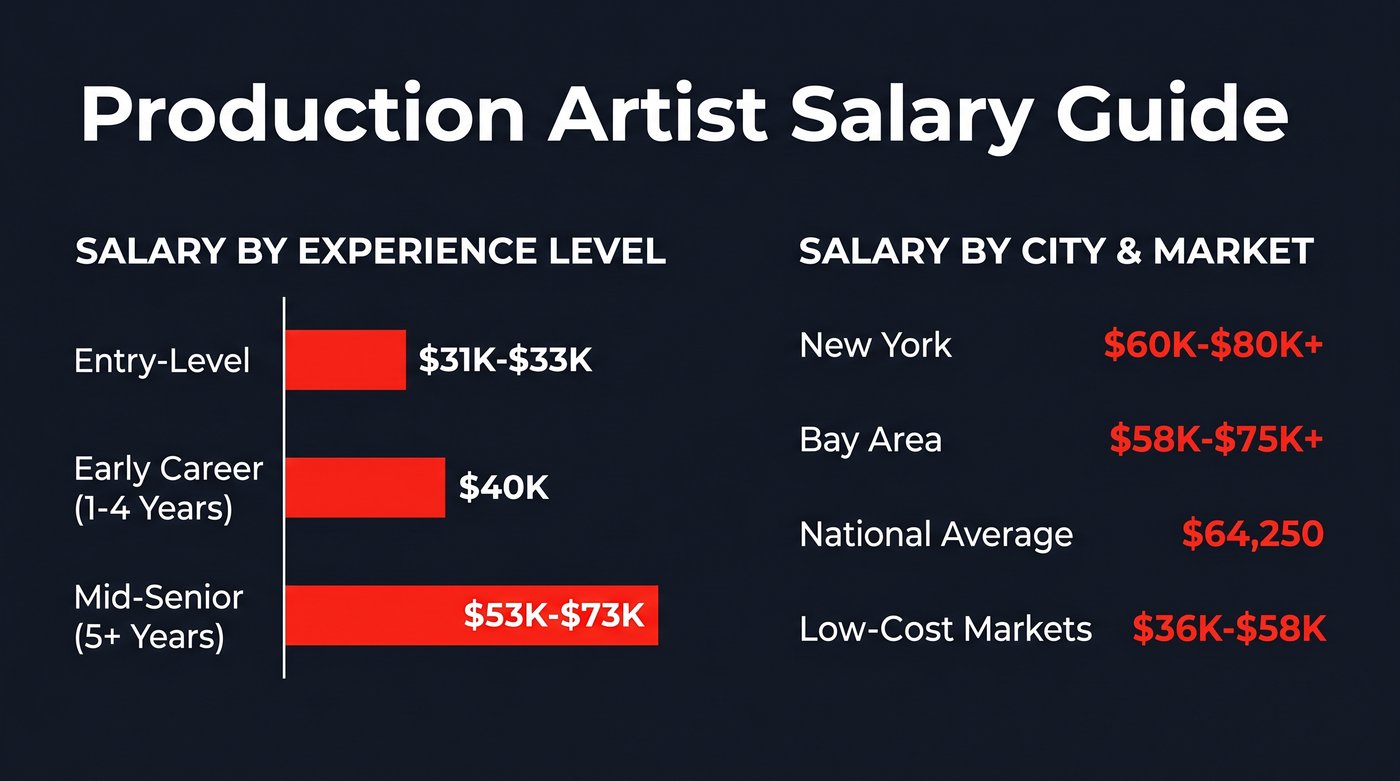
Entry-level production artists typically earn around $15.03 per hour, which translates to roughly $31,000 to $33,000 annually. At this stage, employers are paying for foundational Adobe CC skills, attention to detail, and the ability to execute under direction. Expect to spend time building speed and accuracy before meaningful pay growth occurs.
Early Career (1 to 4 Years)
After the first year, pay climbs to approximately $19.68 per hour, according to PayScale. By the 3 to 4 year mark, many production artists cross into the $22 to $25 per hour range as they take on greater responsibility, manage more complex file builds, and handle multi-channel deliverables independently.
Mid-Level to Senior (5 or More Years)
Robert Half's 2026 salary guide places the national mid-band for production artists at $64,250 per year, with the high band reaching $73,000. Comparably's 2026 data for the Senior Production Artist role shows an average of $60,663, with top earners at major entertainment and tech companies reaching well above $100,000. The wide range reflects how dramatically industry and employer type affect senior pay.
Production Artist Salary by City and Region
Geography may be the single biggest variable outside of specialization. Here is a comparison of salary ranges across key markets using data from Robert Half and ZipRecruiter.
| Location | Low | Mid / Average | High |
|---|---|---|---|
| National Average | $53,250 | $64,250 | $73,000 |
| New York, NY | $60,000+ | $70,000+ | $80,000+ |
| Minneapolis, MN | $52,000+ | $63,000+ | $72,000+ |
| Napa, CA (Bay Area) | $58,000+ | $66,689 | $75,000+ |
| Lower-Cost Markets | $36,500 | $48,000 | $58,000 |
Coastal and major metro markets consistently pay 15 to 25 percent above the national average. The good news for production artists outside those cities is that remote work has materially changed the equation. A production artist based in a mid-cost state who lands a remote role with a New York or San Francisco employer can access metro-level pay without metro-level living costs.
Salary by Specialization: Where the Real Earning Upside Lives
General production work pays in the $52,000 to $64,000 range, but specialized creative roles that share DNA with production art command significantly higher compensation. ZipRecruiter's 2025 data highlights the gap clearly.
- Remote Game Artist: $123,136 per year (~$59/hr)
- Remote Storyboard Artist: $72,499 per year (~$35/hr)
- Mural Artist: $55,388 per year (~$27/hr)
- Makeup Artist: $52,605 per year (~$25/hr)
Motion graphics and 3D production roles also show strong upside, particularly in advertising, streaming content, and brand video. Production artists who expand into motion work using tools like After Effects or Cinema 4D can realistically target $70,000 to $90,000 or more within a few years of specialization.
How to Move from the 25th Percentile to the 75th Percentile
If you are currently earning at or below the $36,500 to $51,000 range, the following framework outlines a practical path toward the $58,000 to $75,000 band.
- Master multi-channel output. Production artists who handle print, digital, email, and social media formats in a single role consistently command higher pay. Add each output type to your portfolio with documented results.
- Learn basic HTML and CSS. Even surface-level front-end knowledge, enough to prep email templates or digital ad specs, places you in a higher-value candidate tier according to 4 Corner Resources hiring data.
- Pursue a specialization. Identify whether motion, UI asset production, or 3D rendering aligns with your interests, then invest 6 to 12 months building a focused portfolio in that niche.
- Use public salary data in negotiations. Reference specific figures from Robert Half, ArtsUSA, and ZipRecruiter when negotiating offers. Framing your ask against multiple credible sources makes the conversation data-driven rather than personal.
- Target remote roles at higher-paying companies. Remote access to NYC, LA, or Bay Area employers is now realistic for most production roles. Actively filtering job searches to include remote positions at larger or coastal companies can increase your effective salary ceiling by 20 to 30 percent.
Are You Being Underpaid? Key Benchmarks to Know
Here is a quick reality check based on 2025 and 2026 data from multiple sources. If your pay falls significantly below these thresholds for your experience level, it may be time to renegotiate or explore other opportunities.
- Under 1 year of experience: $15 to $19 per hour is the market rate. Below $14 per hour is below the market floor in most states.
- 1 to 4 years of experience: $20 to $26 per hour. If you are still earning $17 or $18 after 3 years, you are likely underpaid.
- 5 or more years, generalist: $60,000 to $73,000 nationally. Below $50,000 for a full-time senior generalist role suggests either a low-cost market or below-market compensation.
- 5 or more years, specialized (motion, game, UI): $75,000 to $100,000 and above is achievable in metro or remote roles.
One important note: salary aggregators like Glassdoor and Comparably rely on self-reported data, which can skew high or low depending on who submits. Cross-referencing at least two or three sources, including staffing firm data from Robert Half, gives you a more reliable benchmark.
Production Artist vs. Related Roles: Pay Comparison
Understanding where production artists sit relative to adjacent roles helps you plan a realistic career trajectory. Graphic designers often earn in the $55,000 to $70,000 range for mid-level roles, while art directors typically start around $75,000 and climb well above $100,000 at senior levels. Digital designers, particularly those with UX knowledge, frequently command $70,000 to $90,000 in mid-career positions.
The production artist role can serve as a strong launchpad into any of these paths, particularly for candidates who build a hybrid skill set that combines execution precision with design judgment and cross-channel technical knowledge.
Conclusion: Know Your Number and Make It Work for You
The core takeaways from this Production Artist Salary Guide are straightforward. First, the national average of $52,000 to $64,000 is a starting point, not a ceiling. Second, geography and specialization are the two levers with the most impact on your earning potential. Third, the shift toward remote work and digital production has opened higher-paying markets to artists regardless of where they live. And fourth, you now have the data to negotiate with confidence.
Use the benchmarks in this guide to assess your current compensation, identify your target range, and build a skills roadmap that gets you there. The market rewards production artists who combine technical precision with multi-channel versatility, and the salary data confirms it. For additional guidance on building your artistic career, check out our comprehensive game art portfolio guide and explore whether specializing or staying generalist aligns better with your career goals.
Frequently Asked Questions
What is the average production artist salary in the US?
The national average production artist salary ranges from $51,263 (ZipRecruiter, 2025) to $63,081 (ArtsUSA, 2026), depending on the data source. Robert Half's 2026 staffing guide places the mid-band at $64,250, with experienced professionals in major markets earning up to $73,000 or more. A realistic anchor for most full-time roles is $52,000 to $64,000 per year.
How much does an entry-level production artist make per hour?
Entry-level production artists with under one year of experience typically earn around $15.03 per hour, according to PayScale's 2025 data. Early-career professionals with one to four years of experience average approximately $19.68 per hour. In higher-cost markets like New York or the Bay Area, entry-level rates can start closer to $18 to $22 per hour.
What is a senior production artist salary?
Comparably's 2026 data shows the average senior production artist salary at $60,663, though the range is wide, from roughly $28,000 at the low end to over $265,000 for highly specialized roles at entertainment or tech companies. Robert Half's high band for experienced production artists nationally is $73,000, with major metro markets pushing above that figure.
Which cities pay the most for production artists?
The highest-paying markets for production artists include New York City, the San Francisco Bay Area (including Napa, CA, which ZipRecruiter lists at $66,689 average), and other major coastal metros. Remote positions offered by employers in these cities also pay at or near metro rates, making location less of a barrier than it was five years ago.
How can a production artist increase their salary?
The most effective ways to increase production artist pay include adding multi-channel skills (print, digital, email, social), learning basic HTML and CSS, specializing in motion graphics or game art, and targeting remote roles at larger or coastal companies. Using public salary data from sources like Robert Half and ArtsUSA when negotiating also consistently improves outcomes.
What is the difference between a production artist and a graphic designer in terms of salary?
Graphic designers typically earn $55,000 to $70,000 at the mid-career level, which slightly overlaps with and often exceeds the production artist range of $52,000 to $64,000. The key difference is that designer roles involve more conceptual work and tend to carry higher pay floors. Production artists who add design judgment to their technical skills can move into designer and art director compensation bands.
Do freelance production artists earn more than salaried ones?
Freelance production artists can earn more on an hourly basis, typically $30 to $55 per hour for experienced contract work, but they absorb costs that salaried employees do not, including self-employment taxes, benefits, and downtime between projects. A full-time salaried role with benefits is often the better total compensation package unless you have a strong client network and consistent project flow.