
Prop Artist Salary Guide: What You Can Really Earn
What if two prop artists doing nearly identical work earn $51,000 and $131,000 per year, at the same time? That pay gap is real, and it comes down to specialization, location, and knowing which salary data to actually trust. This prop artist salary guide cuts through the noise so you can walk into your next negotiation with confidence.
These are ArtBlast's own numbers, from the real prop artist job postings we track across 600+ studio job boards. You will not find them anywhere else.
- 9 prop artist openings tracked across 6 studios
- 44% of those roles were remote
- Only 0% of postings disclosed a salary range, the rest hid the number
Source: ArtBlast game art job tracking, 2026. Using these figures? Please cite ArtBlast and link to this page.
So, what does a prop artist earn? In the U.S., most prop artists and props-adjacent roles fall between $50,000 and $75,000 per year. Entry-level artists start closer to $30,000–$40,000, while senior specialists in high-cost creative hubs can surpass $100,000. Your exact number depends on your medium, experience, and market.
The challenge is that salary data for this role is fragmented and often mislabeled. Job titles like props artist, prop designer, and prop and effects designer all describe overlapping work but pull up very different pay ranges online. This guide untangles those inconsistencies and gives you a clear, source-backed picture of what the market actually pays in 2026.
Key Findings: Prop Artist Salary
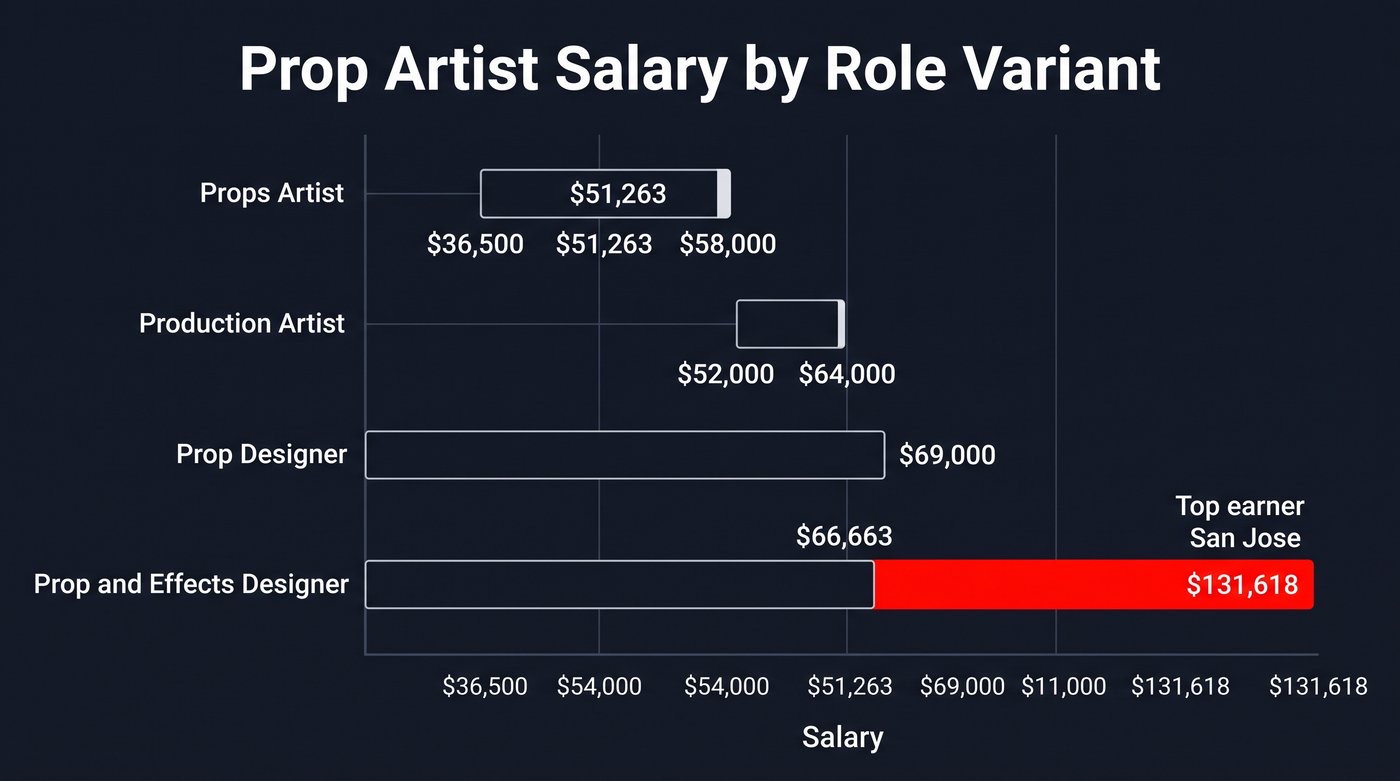
- US props artists average $51,263, typically ranging $36,500 to $58,000.
- Prop designers average $69,000; prop and effects designers average $66,663.
- Top earners reach $131,618 in San Jose.
- Canadian prop artists average CA$61,188.
- Specialization, hard surface skills, and AAA studio placement drive the biggest pay jumps.
Why Prop Artist Salary Data Is So Confusing
Before diving into numbers, it helps to understand why salary lookups for this role can feel unreliable. A quick search on ZipRecruiter for "Prop Artist" returns an average of $129,541 per year. Search for "Props Artist" on the same platform, and the average drops to $51,263. That is an $80,000 gap for what most people consider the same job.
This discrepancy is almost certainly a data artifact. The "Prop Artist" listing likely captures a narrow, non-standard job definition or a different industry context, while "Props Artist" reflects a much larger and more representative sample of real-world roles. Cross-validated data from Salary.com, Comparably, and multi-source industry guides all point to a core band of $50,000–$75,000 for the majority of practitioners.
The takeaway: always triangulate salary data across at least three sources before using any figure as a negotiation benchmark.
Prop Artist Salary Ranges by Role Type
Not all prop work pays the same. The role you hold within the production pipeline has a meaningful impact on where you land in the pay spectrum. Here is a breakdown of the most common prop-related titles and their associated salary ranges.
Props Artist (Hands-On Production)
This is the most common entry point into the field. According to ZipRecruiter's June 2025 data, props artists in the U.S. earn an average of $51,263 per year, or about $24.65 per hour. The 25th percentile sits at $36,500, the 75th at $58,000, and top earners reach approximately $72,000.
ArtBlast's 2026 production artist salary synthesis, which draws from Robert Half, ArtsUSA, ZipRecruiter, and PayScale, places the realistic anchor for full-time props-adjacent work at $52,000–$64,000 per year. Robert Half's 2026 mid-band lands at $64,250, with high-band compensation at $73,000 or more.
Prop Designer (Design-Led Track)
Prop designers who lead the creative concepting and design process rather than purely executing production tasks earn slightly more. Salary.com's July 2026 data places prop designer salaries between $60,457 and $77,702 per year in the U.S. This range reflects the added responsibility of original design, client communication, and creative direction.
Prop and Effects Designer (Specialized Track)
Blending prop work with effects design unlocks one of the highest pay bands in this career path. Comparably reports an average U.S. salary of $66,663 per year for prop and effects designers. In high-cost tech and entertainment markets like San Jose, California, the average climbs to $131,618, nearly 97% above the national average.
Prop Artist Salary Comparison Table
| Role Title | Average U.S. Salary | Typical Range | Top Earners | Source |
|---|---|---|---|---|
| Props Artist | $51,263/yr | $36,500 – $58,000 | ~$72,000 | ZipRecruiter (2025) |
| Production Artist (Props-Adjacent) | $52,000 – $64,000/yr | $31,000 – $73,000+ | $100,000+ | ArtBlast / Robert Half (2026) |
| Prop Designer | ~$69,000/yr | $60,457 – $77,702 | $77,702+ | Salary.com (2026) |
| Prop and Effects Designer | $66,663/yr | Varies widely | $131,618 (San Jose) | Comparably (2026) |
| Prop Artist (Canada) | CA$61,188/yr | CA$48,671 – CA$78,156 | CA$99,549 | Glassdoor (2025) |
| Prop Artist (India) | ₹4,75,000/yr | ₹3,00,000 – ₹7,20,000 | ₹7,20,000+ | Glassdoor (2024) |
How Prop Artist Salary Grows With Experience
Career stage is one of the strongest predictors of pay in this field. Here is a realistic progression map based on current industry data, so you know what to expect and when to push for more.
- Entry-Level (0–1 year): Expect around $15.03 per hour, which works out to roughly $31,000–$33,000 per year. These roles focus on assisting senior artists and learning studio pipelines. This is the hardest financial stretch of the career path.
- Junior to Mid-Level (1–3 years): Pay rises to approximately $19.68 per hour after the first year, according to ArtBlast's 2026 synthesis. Full-time equivalent salaries in this range typically land between $40,000 and $52,000. This is the critical window where building a specialized skill set pays off fastest.
- Mid-Level (3–6 years): This is where most professionals settle into the core band of $52,000–$64,000 per year for full-time roles. Strong portfolios and niche skills in 3D, VFX, or effects push salaries toward the upper end of this range.
- Senior and Lead (6+ years): Senior production artist averages from Comparably sit at $60,663, but high-band senior roles at major entertainment and tech companies exceed $100,000. Robert Half's 2026 high-band figure of $73,000 represents a conservative floor for experienced specialists in competitive markets.
- Supervisor or Specialist (10+ years): Lead and supervisory roles, particularly those combining prop design with effects, digital asset creation, or pipeline management, consistently break the $80,000–$100,000 ceiling, especially in major U.S. production hubs.
Global Prop Artist Salaries: U.S., Canada, and India
If you work remotely or are considering opportunities abroad, understanding how compensation scales globally gives you real negotiating power. The differences are significant.
United States
The U.S. market remains the highest-paying environment for prop artists, particularly in entertainment-heavy cities. ZipRecruiter's hourly data for props artists clusters between $17.55 and $27.88 per hour as of June 2025. Location matters enormously: prop-related roles in cities like San Jose, Los Angeles, and New York consistently outperform national averages.
Canada
Canada's film and television industry has expanded rapidly, and prop artist pay reflects that growth. Glassdoor's July 2025 data shows an average total pay of CA$61,188 per year (approximately CA$29 per hour), with most professionals earning between CA$48,671 and CA$78,156. Top earners report total compensation up to CA$99,549. Notably, about 70% of prop artists surveyed on Glassdoor Canada reported satisfaction with their pay.
India
India's growing VFX, animation, and film production sectors create demand for prop artists, though compensation reflects local cost-of-living differences. Glassdoor's 2024 data places the median at ₹4,75,000 per year, with most roles falling between ₹3,00,000 and ₹7,20,000. For U.S.-based studios hiring internationally, this range represents a significant cost difference worth understanding for remote hiring context.
How to Negotiate a Better Prop Artist Salary
Knowing the numbers is only half the battle. Here is a practical framework for turning this data into actual pay increases.
- Anchor to the right title. If your role involves design leadership, position yourself as a prop designer (Salary.com range: $60,457–$77,702) rather than a props artist ($51,263 average). The same work can justify different pay depending on how it is framed.
- Specialize strategically. Artists who combine prop work with effects design, 3D asset creation, or VFX access pay bands of $65,000 or more, with some specialists earning well above $100,000 in tech-heavy markets. Picking up one adjacent skill set can shift your entire earning tier.
- Use multi-source benchmarks. Present data from at least two sources during negotiations. The combination of Salary.com's prop designer range, Comparably's effects designer average, and Robert Half's 2026 mid-band creates a compelling case that the $60,000–$75,000 range is market-standard for experienced practitioners.
- Factor in location premiums. If you are based in or willing to work for studios in high-cost markets, explicitly reference the city-specific premium. San Jose prop and effects designers earn nearly double the national average. That is leverage.
- Know the freelance alternative. Full-time roles offer stability, but experienced freelance prop artists often structure day rates that effectively exceed annual equivalent salaries at the top of the employed range. If a studio will not meet your full-time benchmark, freelance rates can reframe the conversation.
Conclusion: Know Your Worth as a Prop Artist
This prop artist salary guide reveals one central truth: the range is wide, but it is not random. Your pay is shaped by how you title your role, which medium you work in, how specialized your skill set is, and where you are located. Here are the four key takeaways to carry with you:
- The core U.S. pay band for most prop-related roles sits at $50,000–$75,000 per year, with entry-level starting around $31,000–$40,000 and senior specialists exceeding $100,000.
- Specializing in effects, 3D, or VFX alongside prop work is the fastest path to the upper pay bands.
- Location creates dramatic salary differences: San Jose prop and effects designers earn nearly twice the national average.
- Always triangulate salary data across multiple sources. Single-platform figures, including some ZipRecruiter listings, can be significantly misleading.
Armed with this data, you have what you need to advocate for fair, market-aligned compensation at every stage of your career. To strengthen your position further, consider building a compelling portfolio that showcases your specialized skills and understanding 3D artist compensation trends if you're expanding into digital prop creation.
Frequently Asked Questions
What is the average prop artist salary in the United States?
The average prop artist salary in the U.S. is approximately $51,263 per year for props artists (ZipRecruiter, 2025), while prop designers earn between $60,457 and $77,702 (Salary.com, 2026). Prop and effects designers average $66,663, with specialists in cities like San Jose earning up to $131,618. Most full-time prop-related roles fall in the $50,000–$75,000 range depending on title, specialization, and location.
How much do entry-level prop artists make?
Entry-level prop artists typically earn around $15.03 per hour, or approximately $31,000–$33,000 per year, according to ArtBlast's 2026 production artist salary guide. Pay rises to about $19.68 per hour after the first year of experience. The first one to three years represent the steepest growth curve, making early portfolio development and skill specialization critical financial decisions.
What is a senior prop artist salary?
Senior prop artists earn considerably more than their junior counterparts. Comparably data shows a senior production artist average of $60,663 per year, while Robert Half's 2026 high-band figure sits at $73,000 or more. Senior specialists at major entertainment and tech companies, particularly those blending prop work with effects or 3D asset creation, can exceed $100,000 per year in competitive markets.
How does prop artist pay in Canada compare to the U.S.?
Canadian prop artists earn an average total pay of CA$61,188 per year (Glassdoor, July 2025), with most falling between CA$48,671 and CA$78,156. Top earners report up to CA$99,549. While nominally similar to U.S. averages, the figures reflect Canada's growing film and streaming production sector and represent strong purchasing power given lower average cost-of-living in many Canadian production markets.
Do prop artists in games earn more than those in film or theater?
Digital prop artists working in game studios and VFX pipelines generally access higher pay bands than those in traditional film production or theater, especially when their work overlaps with 3D asset creation, effects design, or technical art. Roles that sit at the intersection of props and VFX or game-asset pipelines can command $65,000–$100,000+, particularly at larger studios in tech-centric markets. Many digital prop artists use Substance 3D Painter for professional texturing work that commands premium rates.
What skills increase a prop artist's salary the most?
The highest-impact skills for increasing prop artist pay include effects design, 3D modeling, VFX pipeline knowledge, and game-asset creation. Artists who combine physical or digital prop work with one of these specializations consistently land in higher pay bands. Comparably data shows prop and effects designers earning an average of $66,663 nationally, with specialists in tech hubs earning close to double that figure. Digital artists often leverage tools like Adobe Photoshop for concept development and texture work.
How much does a prop artist earn in India?
Prop artists in India earn a median salary of approximately ₹4,75,000 per year, with most roles falling between ₹3,00,000 and ₹7,20,000 annually, according to Glassdoor's 2024 data. Pay varies based on experience, studio size, and whether the role involves physical prop fabrication or digital asset creation for animation and VFX, which tends to offer higher compensation in India's growing production sector.