
Storyboard Artist Salary Guide: What You'll Really Earn in 2026
Did you know a storyboard artist can earn anywhere from $40,000 to over $150,000 per year depending on experience, location, and employment type? That's a staggering gap, and if you're a digital artist trying to figure out your next move, the difference between knowing and guessing could cost you thousands. This Storyboard Artist Salary Guide cuts through the noise with real, up-to-date benchmarks so you can negotiate with confidence in 2026.
These are ArtBlast's own numbers, from the real storyboard artist job postings we track across 600+ studio job boards. You will not find them anywhere else.
- 91 storyboard artist openings tracked across 56 studios
- 40% of those roles were remote
- Only 1% of postings disclosed a salary range, the rest hid the number
- Top hiring studios: Blizzard Entertainment, Blue Zoo Animation Studio, Bardel Entertainment, The Walt Disney Company, Nori Productions
- Most active markets: United States, Canada, India
Source: ArtBlast game art job tracking, 2026. Using these figures? Please cite ArtBlast and link to this page.
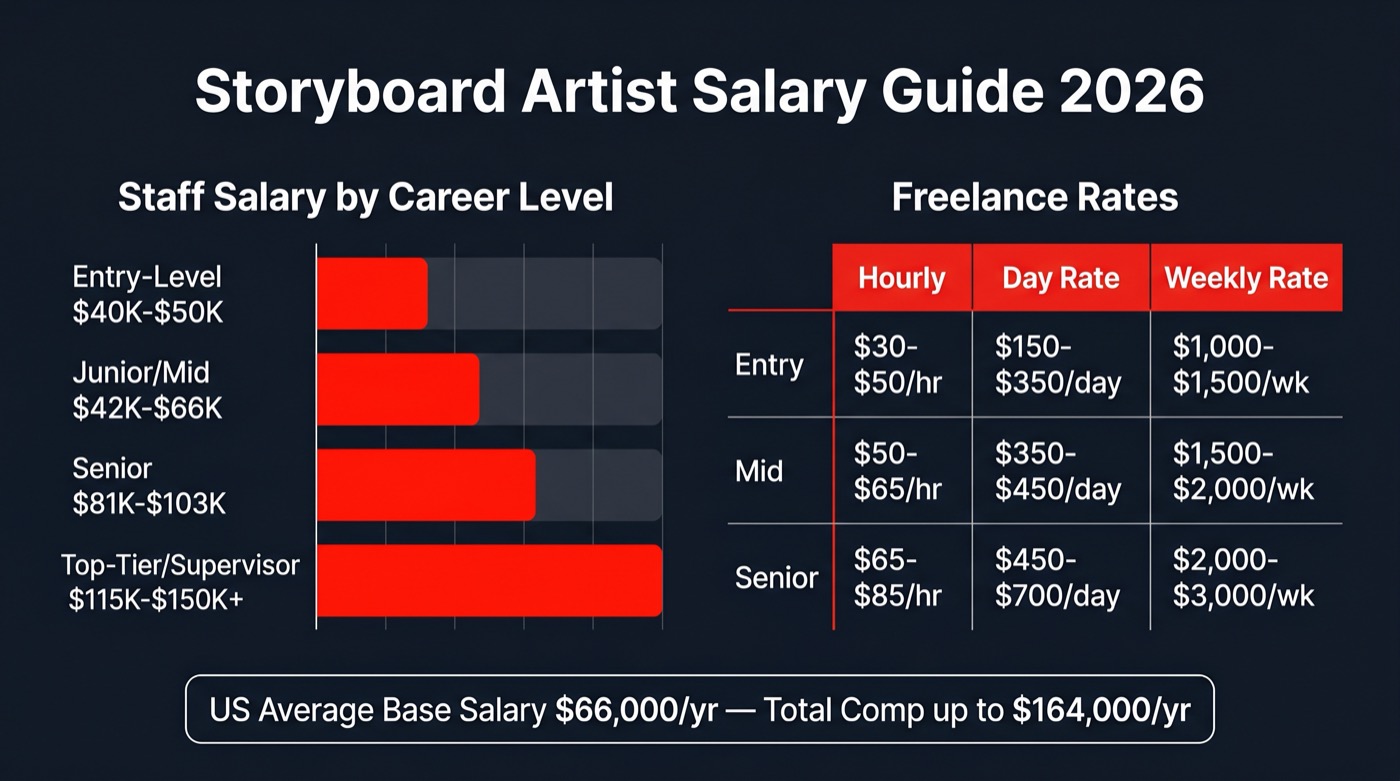
So, what does a storyboard artist actually earn? In the U.S., base salaries average around $66,000 per year, with a typical range of $46,000 to $81,000. Senior artists and freelancers working in high-demand sectors like streaming and VFX can push well past $115,000 in total annual compensation. Your specific earnings depend on experience level, union status, and whether you work staff or freelance.
Whether you're fresh out of an art program or a mid-level artist wondering if you're leaving money on the table, this guide covers every tier of pay, the fastest ways to move up, and the exact freelance rates the industry is using right now. Let's get into it.
Storyboard Artist Salary Ranges: Entry-Level to Senior in 2026
Understanding where you fall on the pay spectrum starts with knowing the benchmarks at each career stage. According to Payscale's 2026 data, the average U.S. storyboard artist earns a base salary of $66,000 annually, with total pay reaching up to $164,000 when bonuses and supplemental income are included. That ceiling is very real for artists who position themselves well.
Here's a breakdown of what to expect at each career stage:
- Entry-Level (0-2 years): $40,000 to $50,000 per year for staff roles. Expect to prove your portfolio before pushing rates higher.
- Junior/Mid-Level (2-5 years): $42,000 to $66,000 per year. CG Spectrum places junior animator-adjacent roles at around $42,000, scaling upward with specialization.
- Senior Level (5+ years): $81,000 to $103,000 in staff roles. Artists taking on supervisory responsibilities can reach six-figure territory with consistency.
- Top-Tier and Supervisors: $115,000 to $150,000+ per year, especially in streaming or high-budget VFX productions (StudioBinder, 2026).
It's worth noting that StudioBinder reports an average closer to $115,000 for seasonal gigs running 9 to 10 months. This higher figure reflects the freelance and contract work that dominates the industry, not traditional salaried employment. Both numbers are accurate, they just describe different working models.
Freelance Storyboard Artist Rates: Day, Week, and Hourly
Freelancing is the dominant employment model in this field. If you're going the contract route, knowing your rate tiers is non-negotiable. According to StoryboardArt.org's updated 2026 guidelines, here's how freelance rates break down across experience levels:
| Experience Level | Hourly Rate | Day Rate | Weekly Rate |
|---|---|---|---|
| Entry-Level | $30 to $50 | $150 to $350 | $1,000 to $1,500 |
| Mid-Level | $50 to $65 | $350 to $450 | $1,500 to $2,000 |
| High-Level / Senior | $65 to $85 | $450 to $700 | $2,000 to $3,000 |
These figures represent the going market rates, not aspirational numbers. Senior freelancers working on major streaming productions or ad campaigns frequently command the upper end of these ranges. If you're quoting below these benchmarks without a reason, you're likely undervaluing your work.
Should You Freelance or Go Staff?
Staff roles offer stability, benefits, and a predictable paycheck. Freelance work offers higher hourly rates, schedule flexibility, and the ability to work with multiple studios simultaneously. The tradeoff is real: freelancers must manage income gaps between projects, handle their own taxes, and continuously market themselves. For digital artists with a strong portfolio and consistent client pipeline, freelancing often yields higher annual income than an equivalent staff role.
What Factors Affect Your Storyboard Artist Salary the Most?
Raw talent matters, but it's rarely the only variable in your paycheck. Several concrete factors push salaries higher or lower in predictable ways.
Experience and Portfolio Strength
This is the single biggest lever. Artists who can demonstrate clear storytelling ability, strong layout skills, and a portfolio with recognizable production credits move up the pay scale faster. Payscale's data confirms that employer switches combined with demonstrated supervisory experience are the two fastest paths to higher compensation.
Geography and Remote Work
Los Angeles and New York historically command the highest rates due to concentration of studios and union infrastructure. However, the rise of remote production in the post-2020 era has partially leveled this playing field. Remote storyboard artists working for major studios now access LA-level budgets without LA-level costs of living, which is a meaningful advantage worth pursuing.
Union vs. Non-Union Status
Union membership, particularly through IATSE and affiliated animation guilds, establishes minimum rate floors that protect artists from lowball offers. Senior union artists regularly achieve six-figure compensation through negotiated minimums and residual structures. Non-union freelancers have more rate flexibility but fewer protections. Checking current union rate cards directly is strongly recommended before any negotiation.
Production Scale and Industry Vertical
VFX-heavy feature films and major streaming platform productions pay at the top of every tier. Advertising and commercial storyboarding pays well per day but can be inconsistent. Television animation offers steadier workflows at slightly compressed rates. Knowing which vertical you're targeting helps you set realistic income expectations.
How to Maximize Your Storyboard Artist Earnings: A Step-by-Step Approach
Moving up the pay scale is a deliberate process. Here's a practical roadmap built around what actually moves the needle:
- Benchmark your current rate against 2026 data. Use this guide, Payscale, and current union rate cards as your reference points. If your rate is below market, that's your starting point for the next negotiation.
- Build a portfolio that speaks to production scale. Clients and studios pay more for artists who can show experience on projects similar in scope to what they're hiring for. Tailor your portfolio presentation to each pitch.
- Target higher-paying employers and verticals. Streaming platforms and VFX-heavy productions pay more than small indie projects. Apply upward deliberately rather than waiting for opportunities to find you.
- Pursue supervisory credits early. Even informal leadership experience, such as overseeing a junior artist's boards or leading a sequence, translates directly to pay increases. Document it and name it in your pitches.
- Quote confidently and anchor high. StoryboardArt.org advises matching your quote to your experience tier and current market demand. Starting the negotiation at the top of your range leaves room to land in the middle, which is often above where you would have started.
- Revisit your rates every 6 to 12 months. The animation and streaming market is growing. Rates that were competitive 18 months ago may already be below market. Treat your rate card as a living document.
2026 Industry Outlook: Is the Market Growing?
The short answer is yes. Demand for storyboard artists is rising alongside the continued expansion of streaming platforms and VFX-driven productions. The digital content boom of the mid-2020s has created consistent pressure on studios to staff and contract visual development talent quickly and at higher rates. This is a favorable environment for experienced artists who are actively positioning themselves.
According to CG Spectrum's 2026 career pathway data, the skills most in demand include strong layout ability, narrative storytelling instincts, and the capacity to collaborate closely with directors and writers. These are not purely technical skills. Artists who invest in developing communication and directorial sensibility alongside their drawing ability tend to advance faster and earn more over time. Creating compelling visual narratives requires industry-standard tools like Adobe Photoshop for digital storyboarding and concept development.
Entry barriers remain real. Breaking in without credits or a strong portfolio is genuinely difficult, and starting rates at the $40,000 to $50,000 level can feel discouraging. The key is treating the early years as a deliberate investment in credits and relationships rather than a long-term rate ceiling.
Key Takeaways from This Storyboard Artist Salary Guide
Before you close this tab, here are the four things worth remembering from this Storyboard Artist Salary Guide:
- Salary ranges are wide for a reason. The gap between $40,000 and $150,000+ reflects real differences in experience, employment model, and production scale, not arbitrary variation.
- Freelance rates are where the ceiling gets high. Senior freelancers billing at $65 to $85 per hour on consistent contracts can out-earn many staff positions with equivalent titles.
- Supervisory experience and strategic employer moves are the fastest pay accelerators. Both are within your control and worth prioritizing intentionally.
- The 2026 market favors skilled artists who stay current. Rising streaming and VFX demand means your leverage is real. Use benchmarks like these to negotiate from a position of knowledge rather than assumption.
Frequently Asked Questions
What is the average storyboard artist salary in the U.S. in 2026?
The average base salary for a storyboard artist in the U.S. is approximately $66,000 per year according to Payscale's 2026 data. Total compensation including bonuses can reach $164,000. StudioBinder reports a higher average of $115,000 for seasonal contract and freelance arrangements, which are the dominant working model in this industry.
How much do freelance storyboard artists charge per day?
Freelance storyboard artist day rates range from $150 to $700 per day depending on experience level. Entry-level artists typically charge $150 to $350 per day, mid-level artists charge $350 to $450, and senior or high-level artists command $450 to $700 per day. These rates reflect current 2026 industry guidelines from StoryboardArt.org.
What is the starting salary for an entry-level storyboard artist?
Entry-level storyboard artists in staff roles typically start between $40,000 and $50,000 per year. Freelance entry-level artists can earn $30 to $50 per hour or $1,000 to $1,500 per week on contract. Building a strong portfolio quickly and targeting higher-budget productions is the most reliable way to move past entry-level rates within two to three years.
Do storyboard artists earn more in Los Angeles than other cities?
Historically, yes. Los Angeles and New York have the highest concentration of studios and union contracts, which push rates upward. However, remote work has partially equalized access to high-budget projects for artists outside major markets. A remote storyboard artist working for a major streaming platform can now access competitive LA-level rates without relocating, which is a meaningful shift from pre-2020 norms.
How does union membership affect storyboard artist pay?
Union membership through IATSE and affiliated guilds establishes minimum rate floors that protect artists from low offers and provide access to residuals and benefits. Senior union storyboard artists regularly earn six-figure compensation. Non-union freelancers have more rate flexibility but fewer protections. Checking current union rate cards before any negotiation is strongly recommended regardless of your membership status.
What skills increase a storyboard artist's salary the most?
Strong layout skills, visual storytelling ability, and experience collaborating with directors and writers are the most valued competencies according to CG Spectrum's career data. Beyond core craft, supervisory experience is the single fastest lever for pay increases. Artists who lead sequences or mentor junior artists and document that leadership experience move into the $100,000+ range significantly faster than those who do not.
Is storyboard artist a good career in 2026?
Yes, particularly for artists willing to build a strong portfolio and stay current with industry demand. The continued expansion of streaming platforms and VFX-driven productions is driving consistent demand for skilled storyboard talent. Entry-level barriers remain, but experienced artists are operating in a favorable market with real upward mobility. The freelance model especially rewards those who position themselves strategically and benchmark their rates regularly.