
3D Animator Salary Guide: What You'll Really Earn
Here is a number most salary pages will not tell you: a 3D animator in Burbank, CA can earn more than twice what a counterpart in a smaller market makes, even with identical experience. A single national average hides that reality entirely. If you are a digital artist trying to price your skills, plan a career move, or evaluate a job offer, that single average number will mislead you every time. This 3D Animator Salary Guide breaks pay down by the factors that actually drive compensation, so you can make decisions based on real data.
These are ArtBlast's own numbers, from the real 3D animator job postings we track across 600+ studio job boards. You will not find them anywhere else.
- 236 3D animator openings tracked across 165 studios
- 33% of those roles were remote
- Only 3% of postings disclosed a salary range, the rest hid the number
- Top hiring studios: Flying Bark Productions, IGG, Behaviour Interactive, REVEL, ICON Creative Studio
- Most active markets: United States, Canada, Indonesia
Source: ArtBlast game art job tracking, 2026. Using these figures? Please cite ArtBlast and link to this page.
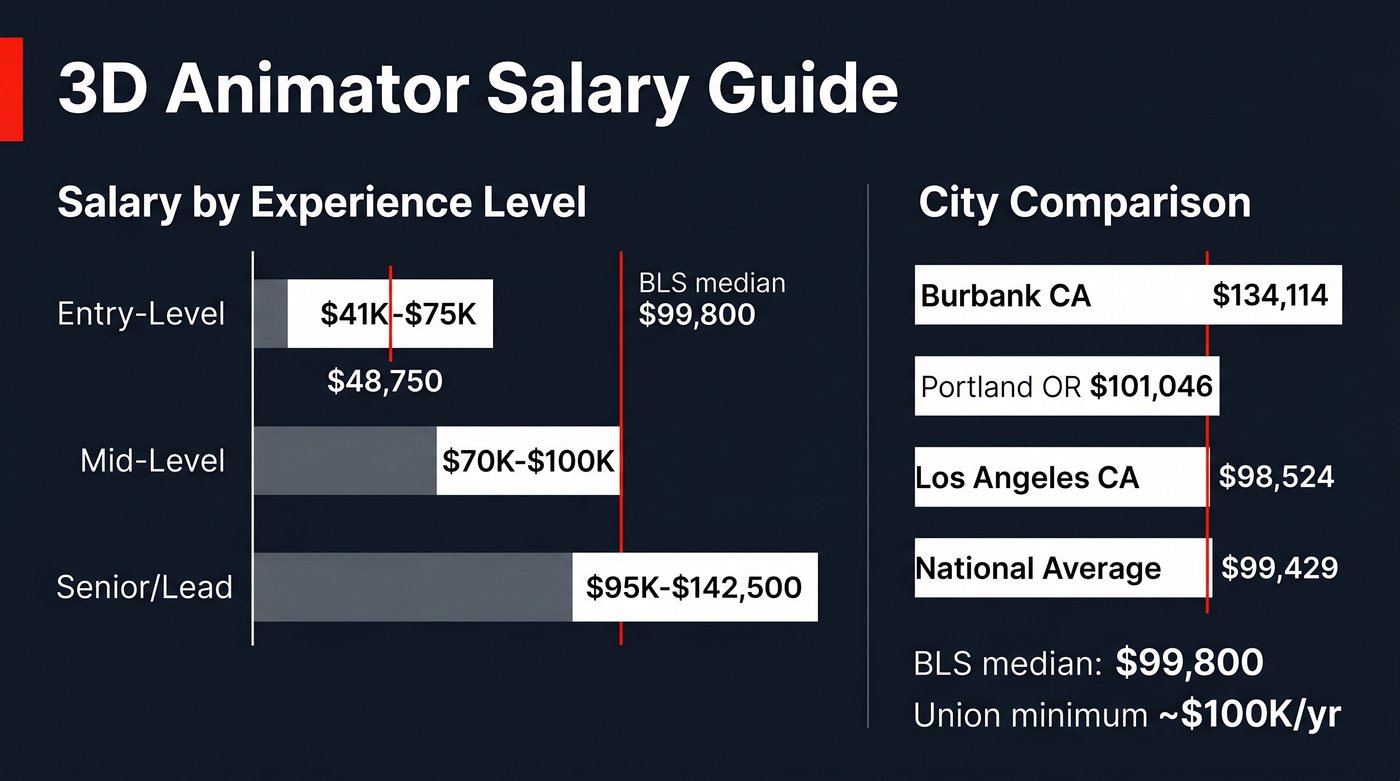
According to the U.S. Bureau of Labor Statistics, the median annual wage for Special Effects Artists and Animators is $99,800, with roughly 57,100 jobs in the field. But that number blends junior generalists with senior supervisors, union workers with non-union freelancers, and small studios with major entertainment companies. Read on for the breakdown that actually helps you.
Why 3D Animator Salary Ranges Vary So Widely
Before diving into specific numbers, it helps to understand why salary sources disagree so sharply. The BLS median sits at $99,800. Indeed reports an average of $99,429. MentorCruise estimates a median closer to $65,000. Noble Desktop puts entry-level pay between $50,000 and $75,000. How can all of these be true at the same time?
The answer comes down to methodology. BLS data pulls from employer-reported payroll figures, which skews toward full-time, established studio roles. Aggregator sites like Indeed and Glassdoor reflect job postings and self-reported salaries, which can include part-time and contract work. Career education platforms often pull from multiple sources without controlling for role type, seniority, or geography.
The practical takeaway: always ask which animators a salary figure describes before trusting it. A number that mixes junior game studio artists with senior VFX leads at a major film house is not very useful for either group.
3D Animator Salary by Experience Level
Career stage is one of the strongest predictors of 3D animator pay. The gap between entry-level and principal-level roles is dramatic, and understanding that progression helps you benchmark where you are and where you are headed.
Entry-Level (0 to 2 Years)
New 3D animators typically earn between $41,000 and $75,000 annually, depending on studio size, location, and degree of specialization. MentorCruise pegs the entry-level median at approximately $48,750. Noble Desktop notes that some first-year salaries span as wide as $41,000 to $96,000, reflecting how sharply different studios pay for the same title.
Mid-Level (3 to 6 Years)
With a few years of production experience, animators move into a range of roughly $70,000 to $100,000. At this stage, specialization starts to matter more. An animator who has built expertise in character performance, technical rigging, or motion graphics will command stronger offers than a generalist with the same tenure.
Senior and Lead Level (7+ Years)
Senior animators and leads commonly earn between $95,000 and $142,500, with principal-level roles at top studios pushing beyond that ceiling. MentorCruise's salary ladder shows principal animator pay averaging around $142,500. Supervisory titles at major studios add management premiums on top of base pay.
3D Animator Salary by Location
Geography may be the single biggest variable after experience level. Entertainment and tech hubs pay substantially more than smaller markets, and that premium often outpaces cost-of-living differences for senior roles.
Here is how major markets compare based on Indeed city-level data:
| City | Average Annual Salary |
|---|---|
| Burbank, CA | $134,114 |
| Portland, OR | $101,046 |
| Los Angeles, CA | $98,524 |
| U.S. National Average (Indeed) | $99,429 |
| Median Entry-Level (MentorCruise) | $48,750 |
Burbank stands out because it hosts major animation studios and production houses where union rates and competitive talent markets drive salaries up. If you are flexible about location, targeting entertainment hubs like Los Angeles, the San Francisco Bay Area, or New York City can meaningfully change your earning potential.
Union vs. Non-Union Pay: A Gap Most Salary Guides Ignore
Union status is one of the most underdiscussed salary variables in the animation industry. Union animators, particularly those working under contracts with major guilds, benefit from negotiated minimums, overtime protections, and benefit packages that non-union workers rarely see.
- Union journey-level minimums can approximate $100,000 annually at established studios, even for mid-level roles.
- Union contracts typically include health insurance, pension contributions, and regulated overtime pay.
- Non-union studios often offer more flexible arrangements but with fewer protections and lower baseline pay.
- Freelancers and contract animators fall almost entirely outside union structures, which means their effective hourly rates need to compensate for the lack of benefits.
If you are evaluating a job offer, add the value of health coverage, retirement contributions, and paid leave before comparing union and non-union compensation side by side. The base salary gap can look smaller than it actually is once benefits are factored in.
Salary by Specialization and Industry Segment
Not all 3D animation work pays the same. The industry segment and your specialization within it both influence where you land on the pay scale. Here is a quick breakdown of how different specializations generally compare:
- Film and VFX: Typically the highest-paying segment, especially at major studios. Senior VFX artists and technical directors at top houses can exceed $130,000.
- Video games: Competitive pay at AAA studios, often ranging from $70,000 to $120,000 for experienced animators with strong gameplay animation skills.
- Motion graphics and advertising: Solid mid-range pay, often between $60,000 and $95,000, with strong freelance demand for project-based work.
- Television and streaming: Pay varies widely. Streaming-driven production has increased demand, but episodic TV budgets can be tighter than feature film work.
- Education and corporate: Generally lower pay than entertainment, but with more stability and a lower barrier to entry for junior roles.
How to Increase Your 3D Animator Salary
Knowing the benchmarks is only useful if you can act on them. Here is a step-by-step approach to moving your compensation upward:
- Specialize deliberately. Generalists earn less than specialists at the same experience level. Pick a high-demand niche, such as character animation for games, creature simulation, or motion graphics, and invest in building a portfolio that reflects that focus.
- Pursue pipeline skills. Animators who understand rigging, technical direction, or pipeline tools like Python scripting command a meaningful premium over pure animators with the same years of experience.
- Target geographic hubs or remote roles at top studios. If relocation is possible, Burbank and Los Angeles remain the strongest markets. If you prefer remote work, prioritize studios that offer location-agnostic pay rather than adjusting salaries to your local cost of living.
- Track union opportunities. If you are working toward a role at a major studio, understanding union membership and its requirements can significantly raise your floor compensation.
- Build a rate card for freelance work. Freelance 3D animators should track their effective hourly rate and account for overhead, taxes, and benefits when setting day rates. Experienced freelancers in entertainment markets often charge $500 to $1,000 or more per day on project work.
For animators building their skills, investing in professional tools can make a significant difference in portfolio quality. Industry-standard software like Adobe After Effects is essential for motion graphics work, while Substance 3D Painter has become the industry standard for texturing work that many studios now expect in portfolios.
Industry Outlook: Stable, Not Explosive
The BLS projects 2% growth for the broader Special Effects Artists and Animators occupation, which is slower than the average for all occupations. CG Spectrum cites a more optimistic 4% rise in 3D animation jobs by 2028, reflecting growth driven by streaming content and game development.
The honest picture is that this field is competitive and stable rather than booming. New graduates will find the entry-level market crowded. That makes portfolio quality, specialization, and professional networking more important salary levers than raw market growth.
For digital artists weighing education costs or a career switch, that context matters. The field rewards skill and specialization more than it rewards simply being present in a growing industry.
Key Takeaways from This 3D Animator Salary Guide
Wrapping up this 3D Animator Salary Guide, here are the four things every digital artist should carry away:
- The BLS median of $99,800 is a useful starting point, but it blends roles, seniority levels, and studio types that pay very differently from each other.
- Location and experience level are the two strongest predictors of your actual pay. Burbank, CA averages $134,114 while entry-level roles nationally start closer to $48,750.
- Union status adds a layer most salary guides skip entirely. Union minimums and benefits can significantly change the real value of a compensation package.
- Specialization in high-demand areas like VFX, character animation for games, or technical direction is one of the most reliable ways to move past the mid-range plateau.
If you're ready to take the next step in your animation career, consider exploring our guide on how to become an animator for practical steps toward building the skills that command higher salaries.
Frequently Asked Questions
What is the average 3D animator salary in the United States?
The U.S. average depends on the data source. The Bureau of Labor Statistics reports a median of $99,800 for Special Effects Artists and Animators. Indeed puts the average at $99,429 based on job postings. Entry-level roles can start as low as $41,000, while senior and principal animators at major studios can earn $130,000 or more. Seniority, location, and studio type all shape the final number.
How much do entry-level 3D animators make?
Entry-level 3D animators typically earn between $41,000 and $75,000 annually, with a median closer to $48,750 according to MentorCruise. Some first-year salaries at major studios or in high-cost cities can push toward $96,000, while smaller studios and lower-cost markets tend to land at the lower end. Building a strong portfolio and specializing early can help push past the entry-level floor faster.
Do 3D animators make more money in certain cities?
Yes, significantly. Burbank, CA leads with an average of $134,114 according to Indeed, followed by Portland, OR at $101,046 and Los Angeles, CA at $98,524. Entertainment and tech hubs consistently pay more because they host larger studios with bigger budgets and more competitive talent markets. Remote work has started to flatten some of this gap, but major markets still command a clear premium.
What is the difference between union and non-union animator pay?
Union animators at major studios benefit from negotiated minimum rates that can approximate $100,000 annually for journey-level work, along with health insurance, pension contributions, and overtime protections. Non-union positions often pay lower base salaries with fewer benefits and protections. When comparing offers, always factor in the full value of benefits alongside base pay to make an accurate comparison.
Which 3D animation specialization pays the most?
Film and VFX animation tends to pay the highest, particularly at major studios where senior VFX animators and technical directors can exceed $130,000. AAA game studio animation is also well-compensated for experienced candidates. Animators who add pipeline skills like rigging or technical direction earn meaningful premiums across all segments compared to generalist animators at the same career level.
Is 3D animation a growing career field?
The BLS projects 2% growth for the broader animator occupation, which is below the average for all occupations. Some industry sources project slightly higher growth driven by streaming content and video game expansion. The field is best described as stable and competitive rather than rapidly growing, which means portfolio quality, specialization, and professional networking matter more than simply entering a growing market.
How much do freelance 3D animators charge per day?
Experienced freelance 3D animators in entertainment markets often charge between $500 and $1,000 or more per day on project work, depending on specialization, market, and client type. Freelancers need to account for self-employment taxes, health insurance, retirement savings, and unpaid downtime between projects when setting rates, which means a freelance day rate needs to be meaningfully higher than an equivalent salaried hourly rate.