
3D Modeler Salary Guide: What You'll Actually Earn in 2026
The difference between a junior 3D modeler and a senior technical artist can mean over $140,000 in annual salary. That is not a typo. If you are a digital artist trying to figure out where you stand, what you should be earning, or how to level up your income, this 3D modeler salary guide will give you the clearest, most current picture available for 2026.
These are ArtBlast's own numbers, from the real 3D modeler job postings we track across 600+ studio job boards. You will not find them anywhere else.
- 147 3D modeler openings tracked across 101 studios
- 23% of those roles were remote
- Only 7% of postings disclosed a salary range, the rest hid the number
- Top hiring studios: Scanline VFX, The Walt Disney Company, Eyeline, Infold Games, Omens Studios
- Most active markets: United States, Canada, South Korea
Source: ArtBlast game art job tracking, 2026. Using these figures? Please cite ArtBlast and link to this page.
Exploring other game industry salary data? Check our Game Tester Salary Guide for QA pay ranges by experience, city, and remote roles.
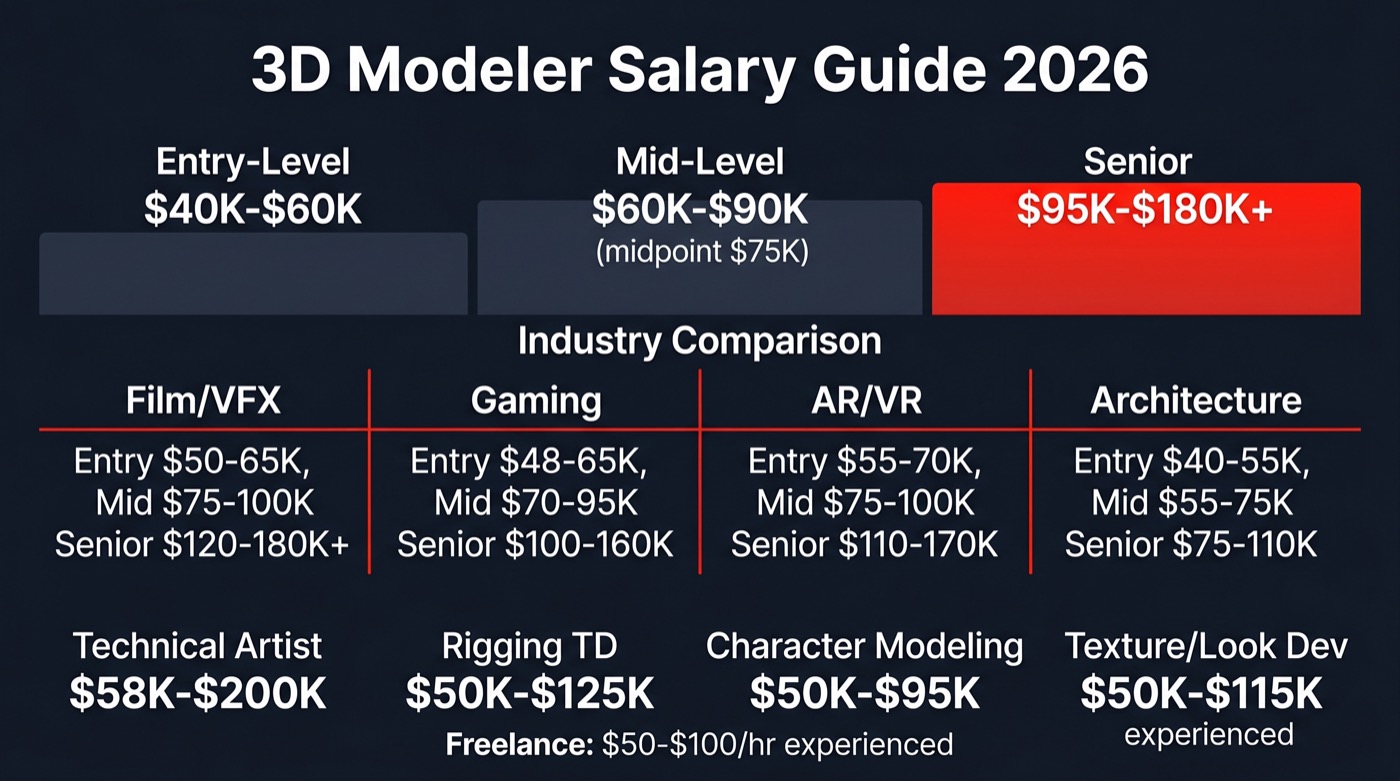
So, what does a 3D modeler earn? In the United States, most 3D modelers earn between $60,000 and $99,000 per year, depending on experience, industry, and location. Entry-level roles start around $40,000 to $60,000, mid-level positions range from $60,000 to $90,000, and senior roles can reach $95,000 to $180,000 or more.
The challenge for most digital artists is that salary data is scattered, outdated, or wildly inconsistent across platforms. This guide cross-references data from the Robert Half 2026 salary report, the Bureau of Labor Statistics, and industry sources to give you verified, actionable numbers you can actually use.
3D Modeler Salary Ranges by Experience Level
Experience is the single biggest driver of your paycheck as a 3D modeler. Salaries can jump 50% to 100% as you move from junior to senior, and the gap widens even further at the supervisor level. Here is how the tiers break down in the US market for 2026.
Entry-Level (0 to 2 Years)
Entry-level 3D modelers typically earn between $40,000 and $60,000 per year. Robert Half’s 2026 data places the low end of the market at $60,000, while sources like Coohom note some roles starting closer to $40,000 in smaller markets or lower-paying industries like architecture. Building a strong portfolio in Maya, Blender, or ZBrush is the fastest way to move past this tier quickly.
Mid-Level (2 to 5 Years)
With two to five years of solid experience, most 3D modelers move into the $60,000 to $90,000 range. Robert Half’s 2026 midpoint benchmark sits at $75,000. At this stage, your specialization starts to matter significantly. A mid-level texture artist and a mid-level rigger in the same city can earn noticeably different salaries based on market demand.
Senior and Supervisor Level (5+ Years)
Senior 3D modelers command $95,000 to $180,000 or more, according to CG Spectrum’s career pathway data. The Bureau of Labor Statistics reported a median of $99,000 for multimedia artists and animators as of its most recent survey, with the top 10% earning over $140,000. Lead and supervisor-level roles at major studios routinely exceed $150,000 in competitive markets.
Salary Comparison by Industry and Specialization
Not all 3D modeling work pays the same. The industry you work in can shift your salary by tens of thousands of dollars. Understanding where the premium opportunities exist is one of the most valuable insights in any honest 3D modeler salary guide.
Industry Salary Breakdown
| Industry | Entry-Level | Mid-Level | Senior-Level |
|---|---|---|---|
| Film and VFX | $50,000 – $65,000 | $75,000 – $100,000 | $120,000 – $180,000+ |
| Gaming | $48,000 – $65,000 | $70,000 – $95,000 | $100,000 – $160,000 |
| Architecture / Visualization | $40,000 – $55,000 | $55,000 – $75,000 | $75,000 – $110,000 |
| AR / VR Development | $55,000 – $70,000 | $75,000 – $100,000 | $110,000 – $170,000 |
| Product / Industrial Design | $45,000 – $60,000 | $60,000 – $85,000 | $90,000 – $130,000 |
Film and gaming consistently pay the highest salaries for experienced modelers. Architecture and visualization tend to lag behind, though remote and freelance opportunities in those sectors are growing rapidly.
Specialization Salary Ranges
Your specific role within 3D production has a dramatic effect on earnings. Based on industry analysis, here are the key specializations and their US salary ranges:
- Character Modeling: $50,000 to $95,000
- Rigging and Rigging TD: $50,000 to $125,000 (high scarcity value)
- Technical Artist / Technical Director: $58,000 to $200,000 (top-tier earning potential)
- Texture Artist / Look Development: $50,000 to $115,000
- Environment / Prop Modeling: $48,000 to $95,000
Rigging and technical art roles stand out for their scarcity and portability across industries. If you are deciding which direction to specialize, these paths offer some of the strongest long-term salary growth in the field.
How Location Affects Your 3D Modeler Salary
Geography still plays a major role in compensation, even as remote work expands. The US market pays roughly double what most Asian markets offer, and European salaries vary widely by country. Here is a global overview to help you benchmark your situation accurately.
- United States: Average around $65,000 to $99,000, with higher pay in Los Angeles, San Francisco, and New York
- Europe: Ranges from roughly 21,000 euros in lower-cost markets to 50,000 euros or more in the UK, Germany, and the Netherlands
- Asia: Varies from $16,000 to $35,000 in markets like India and Bangladesh, with higher wages in Japan and South Korea
- Freelance Global Rates: Starting as low as $15 per hour, though experienced freelancers in the US routinely charge $50 to $100 per hour
Remote work has started to blur these lines for senior talent. A skilled US-based modeler working remotely for a European studio can sometimes command US-equivalent rates, making location negotiation a real lever in salary discussions.
How to Increase Your 3D Modeler Salary: A Step-by-Step Approach
Knowing the numbers is only half the equation. The other half is knowing exactly how to move your salary upward. Whether you are just starting out or pushing past the mid-level plateau, this roadmap applies directly to your career as a digital artist.
- Master one primary software deeply. Employers in film and gaming pay more for true expertise in Maya, Substance 3D Painter, or Houdini than they do for surface-level familiarity with five tools. Depth beats breadth at the hiring stage.
- Specialize in a high-demand niche. Rigging, technical art, and look development all command premium salaries. Identify which specialization aligns with your strengths and build toward it deliberately over one to two years.
- Build an industry-specific portfolio. A portfolio tailored to gaming studios will land you a gaming job faster than a general reel. Match your best work to the hiring standards of your target industry.
- Target high-paying markets and studios. Applying to top-tier film and gaming studios in major US cities or negotiating remote rates with high-paying international clients can add $20,000 to $40,000 to your annual salary compared to local mid-tier employers.
- Negotiate total compensation, not just base salary. Robert Half’s 2026 data notes that additional compensation such as bonuses averages around $12,000 per year for modelers. Always negotiate the full package, including bonuses, profit sharing, and remote work flexibility.
- Accumulate verifiable credits and experience. Named credits on shipped games or released films carry real weight in salary negotiations. Seek out projects that build your professional credit history alongside your portfolio.
Freelance vs. Salaried: Which Pays More?
This is one of the most common questions digital artists ask, and the answer depends heavily on your experience level and client base. Freelancing offers higher hourly ceilings but comes with income instability, self-employment taxes, and unpaid downtime between projects.
A salaried mid-level modeler earning $75,000 per year receives that income reliably, plus benefits, employer tax contributions, and often health insurance. A freelancer billing at $60 per hour for 40 hours a week grosses over $120,000 annually, but realistically, most freelancers bill far fewer hours once you account for admin time, client acquisition, and project gaps.
For artists early in their careers, salaried roles typically offer better income stability and faster skill development through team environments. Experienced senior modelers with strong networks are often the ones who thrive most in the freelance market.
Key Factors That Influence a 3D Modeler’s Salary
Beyond experience and location, several additional variables shape your total compensation in meaningful ways. Understanding these factors helps you make smarter career decisions year over year.
- Software proficiency: Mastery of industry-standard tools like Maya, Houdini, and ZBrush correlates directly with higher pay offers
- Industry demand cycles: Gaming and streaming-driven film production are currently in high demand, boosting salaries for experienced modelers in those pipelines
- AI tool integration: Artists who can work alongside AI-assisted workflows are increasingly valued, particularly at studios adopting production automation
- Remote work flexibility: The ability to work remotely expands your employer pool dramatically, giving you access to higher-paying studios regardless of your physical location
- Bonus and equity structures: Larger studios and some game companies offer annual bonuses, project completion bonuses, and in some cases equity or royalties that meaningfully boost total compensation
Conclusion
Navigating your earning potential as a 3D modeler in 2026 requires more than glancing at a single salary website. Here are the four key takeaways from this 3D modeler salary guide every digital artist should keep in mind:
- US salaries range from $40,000 at entry level to $180,000 or more at the senior and supervisor tiers, with a reliable mid-market benchmark around $75,000
- Industry matters enormously: film, gaming, and AR/VR pay significantly more than architecture and visualization for comparable experience levels
- Specializations like rigging and technical art offer the strongest long-term salary growth due to high scarcity and cross-industry demand
- Location and remote work negotiation are powerful levers, especially for senior modelers with strong portfolios and studio credits
The best investment you can make right now is to identify your target industry, align your portfolio to it, and pursue the specialization that matches both your strengths and the market’s highest demand. Your next salary jump is closer than you think.
Frequently Asked Questions
What is the average salary for a 3D modeler in the US in 2026?
The average 3D modeler salary in the US ranges from approximately $65,000 to $99,000 per year in 2026. Robert Half places the market midpoint at $75,000 for experienced modelers, while the Bureau of Labor Statistics previously reported a median of $99,000 for multimedia artists and animators. Actual earnings vary based on industry, location, and specialization.
How much do entry-level 3D modelers make?
Entry-level 3D modelers in the US typically earn between $40,000 and $60,000 per year. Robert Half’s 2026 data places the low end of the market at $60,000 for modelers with limited experience. Artists in smaller markets or lower-paying industries like architecture may start closer to $40,000 to $45,000.
Which industry pays 3D modelers the most?
Film, visual effects, and gaming consistently offer the highest salaries for 3D modelers. Experienced modelers in these industries can earn $100,000 to $180,000 or more at the senior level. AR and VR development is also emerging as a high-paying sector. Architecture and visualization tend to pay significantly less for comparable experience levels.
Do 3D modelers make more money freelancing or working full-time?
Freelance 3D modelers can earn higher hourly rates, with experienced professionals charging $50 to $100 or more per hour. However, full-time salaried roles offer income stability, employer benefits, and consistent work. Most artists find that salaried positions provide better income security early in their careers, while experienced senior modelers with strong networks earn more through freelancing.
What specialization pays the most for 3D modelers?
Technical artists and rigging TDs earn the highest salaries among 3D modeling specializations. Technical artists can earn between $58,000 and $200,000 depending on experience and industry, while riggers earn $50,000 to $125,000. These roles command premium pay because of their scarcity in the job market and their demand across both film and gaming pipelines.
How does location affect a 3D modeler’s salary?
Location has a significant impact on 3D modeler pay. US-based modelers earn roughly double what artists in Asian markets like India or Bangladesh typically make. Within the US, cities like Los Angeles, San Francisco, and New York offer the highest salaries. Remote work opportunities have started to reduce this gap for senior modelers who can negotiate competitive rates with global studios.
What skills or software knowledge increase a 3D modeler’s salary?
Proficiency in Maya, ZBrush, Houdini, and Substance Painter is strongly associated with higher salaries, particularly in film and gaming. Artists who combine modeling skills with rigging, look development, or technical art capabilities consistently earn more. The ability to integrate AI-assisted tools into production workflows is increasingly valued by studios investing in automation and efficiency.