Picture this: a $550 billion global gaming industry bursting with opportunities, yet 74% of aspiring game artists feel pessimistic about their career prospects. This stark contradiction defines the game art landscape in 2026, where explosive market growth collides head-on with AI disruption, industry layoffs, and fierce competition.
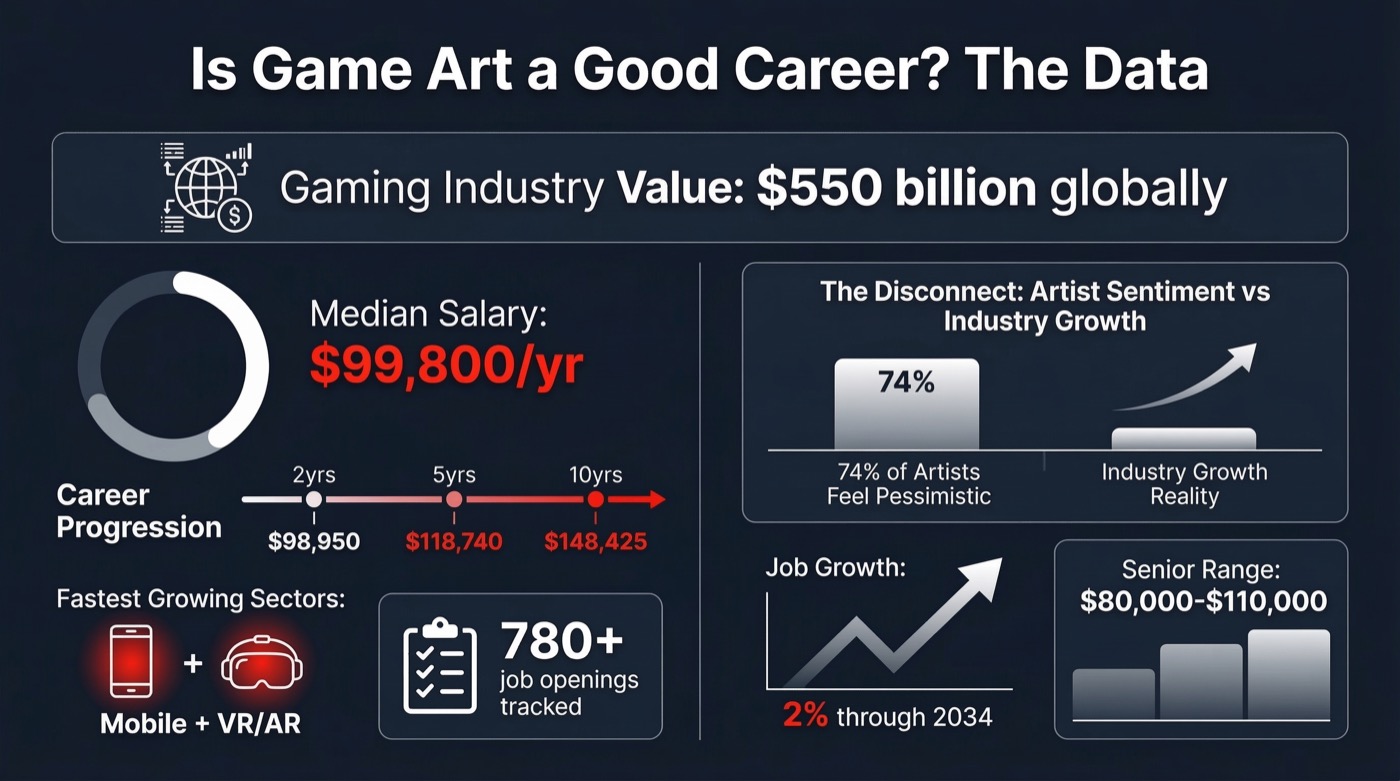
Is game art a good career in 2026? Yes, but with important caveats. Game artists earn a median salary of $99,800 annually with steady demand in mobile, VR/AR, and live-service games. However, job growth projections sit at just 2% through 2034, slower than average, while AI tools and recent layoffs have intensified competition for entry-level positions.
If you are considering a career in game art, you need more than passion for gaming and creativity. You need a realistic understanding of the opportunities, challenges, and strategies that separate thriving artists from those struggling to break in. This guide cuts through the hype to deliver the balanced 2026 reality check based on the latest Game Developers Conference survey data and Bureau of Labor Statistics projections.
The Financial Reality: What Game Artists Actually Earn
Money matters, especially when you are investing years in education and portfolio development. The good news? Game artists command respectable salaries that reward experience and specialization.
According to the U.S. Bureau of Labor Statistics, multimedia artists and animators (the category encompassing game artists) earned a median annual wage of $99,800 as of May 2024. But this number tells only part of the story.
Game Artist Salary Breakdown by Experience Level
| Experience Level | Annual Salary Range | Career Stage |
|---|---|---|
| Junior Artist | $69,265 – $84,108 | 0-2 years |
| Mid-Level Artist | $98,950 | 3-5 years |
| Senior Artist | $118,740 – $138,530 | 6-10 years |
| Principal Artist | $148,425+ | 10+ years |
Geographic location significantly impacts earning potential. California leads with a median salary of $114,750 for game artists, followed by Washington, Texas, and New York. These states host major gaming hubs and approximately 780 job openings each annually.
Mid-career game artists typically earn between $80,000 and $110,000, with certifications like AWS Certified Solutions Architect potentially boosting compensation by $5,000 to $15,000. The key takeaway? Financial rewards exist, but they require patience, skill development, and strategic career positioning.
Job Market Projections: Growth Slower Than You Think
Here is where the optimism meets reality. While the gaming industry continues expanding, job growth for game artists lags behind other tech professions significantly.
The Bureau of Labor Statistics projects only 2% employment growth for multimedia artists and animators from 2024 to 2034. This translates to approximately 5,000 job openings annually, with most positions arising from workers leaving the occupation rather than industry expansion.
Comparing Game Art to Related Tech Careers
- Software Developers: 15% projected growth (2024-2034) with 400,000 new jobs and $131,450 median salary
- Game Artists: 2% projected growth with 5,000 annual openings and $99,800 median salary
- Video Game Designers: Current workforce of 127,775 growing to 137,311 in five years (approximately 1.4% annual growth)
What explains this slower growth? Industry consolidation, automation through AI tools, and efficiency improvements allow studios to produce more content with fewer artists. The 2026 reality demands that aspiring artists enter with eyes wide open.
Despite modest projections, demand persists in specific niches. Mobile gaming, virtual and augmented reality experiences, and live-service games continue expanding, creating specialized opportunities for artists who develop relevant skills.
The AI Elephant in the Digital Room
No discussion about game art careers in 2026 is complete without addressing artificial intelligence. And the industry sentiment? Overwhelmingly cautious.
The Game Developers Conference 2026 survey revealed that 52% of game industry professionals view generative AI negatively, up dramatically from 30% the previous year. Among visual and technical artists specifically, negativity reaches 64%, the highest of any discipline.
Why Game Artists Fear AI More Than Others
This concern is not unfounded paranoia. AI tools now generate concept art, texture variations, and even 3D models from text prompts. Students cite AI displacement as their top career concern when considering game art.
However, the relationship between AI and game artists is more nuanced than simple replacement. Many studios integrate AI as a productivity tool, allowing artists to focus on creative direction, refinement, and the human touch that algorithms cannot replicate. Executives show more optimism, with 19% seeing AI benefits for workflow enhancement.
The survival strategy? Embrace AI as a tool while developing skills that machines cannot easily replicate: artistic vision, storytelling through visuals, understanding player psychology, and creative problem-solving within technical constraints.
Industry Volatility: Layoffs and Competition
The 2026 game industry faces turbulence that directly impacts aspiring artists. Recent waves of layoffs have flooded the entry-level market with experienced professionals seeking new positions.
This creates a challenging environment where junior positions attract candidates with three to five years of experience willing to accept lower salaries for stability. The GDC 2026 survey captured this anxiety: 74% of students express pessimism about career prospects in game development.
Industry pain points include tight deadlines, crunch periods before major releases, and project cancellations that can eliminate positions overnight. Game studios operate in a hit-driven business where a single underperforming title can trigger restructuring.
How to Build a Successful Game Art Career in 2026
Despite challenges, thousands of game artists thrive by approaching their careers strategically. Success requires more than artistic talent alone.
Step 1: Choose Your Educational Path
Most game artists hold a Bachelor’s degree in fields like Game Art, Digital Media, or Fine Arts with a digital focus. This four-year investment provides foundational skills, networking opportunities, and credential recognition. Alternative paths include specialized bootcamps (three to six months) or self-directed learning through online platforms, though these require exceptional self-discipline and portfolio development.
Step 2: Build a Killer Portfolio
Your portfolio matters more than your degree. Include finished game-ready assets, demonstrate understanding of technical constraints, and showcase diverse styles. Employers want evidence you can deliver production-quality work under real-world conditions. For detailed guidance on creating a standout portfolio, check out our comprehensive guide on how to build a game art portfolio.
Step 3: Gain Practical Experience
Internships, game jams, and personal projects prove your capabilities. Contributing to indie games or mod communities demonstrates collaboration skills and passion beyond academic requirements. Many successful artists break in through contract work or freelance gigs that build both portfolio and professional connections.
Step 4: Specialize Strategically
Generalists struggle in competitive markets. Develop expertise in high-demand areas like environment art for VR/AR, character modeling for mobile games, or UI/UX design for live-service platforms. Understanding whether to specialize or generalize can be crucial for your career trajectory. Specialization makes you indispensable rather than interchangeable.
Step 5: Network Relentlessly
Most opportunities come through professional connections rather than job boards. Attend industry events like GDC, participate in online communities, and maintain relationships with classmates who become industry colleagues. Your network often determines your next opportunity.
Where the Opportunities Actually Exist
Not all game art positions face equal headwinds. Understanding where demand concentrates helps you position yourself strategically.
Mobile gaming continues explosive growth, requiring artists who understand performance optimization and engaging visuals on smaller screens. Virtual and augmented reality platforms need specialists who can create immersive environments while managing technical limitations. Live-service games demand ongoing content creation, providing steadier employment than project-based AAA titles.
Top employers include major tech companies like Google, Microsoft, and Amazon, alongside dedicated game studios. Remote work opportunities have expanded access beyond traditional gaming hubs, though California, Washington, Texas, and New York still concentrate the majority of positions.
Indie studios offer another pathway. While typically offering lower salaries initially, they provide broader creative control, diverse experience, and potential profit-sharing arrangements that AAA studios rarely match.
The Balanced Verdict on Game Art Careers
So, is game art a good career in 2026? The honest answer depends on your expectations, resilience, and strategic approach.
Game art offers creative fulfillment, respectable compensation at mid to senior levels, and the satisfaction of contributing to entertainment experiences enjoyed by millions. The industry’s $550 billion valuation confirms gaming is not disappearing. Demand exists for skilled artists who adapt to evolving tools and specialize in growth areas.
However, you must enter prepared for slower job growth than other tech fields, AI-driven workflow changes, industry volatility, and intense competition. Success requires continuous learning, networking, and the ability to navigate uncertain periods between projects or positions.
The artists who thrive in 2026 combine technical proficiency with business awareness, treat their careers as entrepreneurs rather than employees, and maintain financial buffers for industry downturns. If you approach game art with realistic expectations and strategic career management, opportunities definitely exist. Professional tools like Adobe Photoshop and specialized software such as Substance 3D Painter have become essential for creating industry-standard assets that meet professional expectations.
Frequently Asked Questions About Game Art Careers
What qualifications do I need to become a game artist?
Most game artists hold a Bachelor’s degree in Game Art, Digital Media, Animation, or related fields, though formal education is not absolutely required. What matters most is a strong portfolio demonstrating game-ready assets, understanding of industry-standard software like Maya, Blender, or Substance Painter, and the ability to work within technical constraints. Certifications are optional but can boost earning potential by $5,000 to $15,000 annually.
How long does it take to become a professional game artist?
Expect four years for a traditional Bachelor’s degree plus six to twelve months of intensive portfolio building and job searching. Alternative paths like bootcamps require three to six months of training followed by extensive self-directed portfolio development. Most artists land their first junior position within one to two years of focused effort, though breaking in during periods of industry layoffs may take longer due to competition from experienced professionals.
Can game artists work remotely in 2026?
Yes, remote work has expanded significantly in game development, allowing artists to access opportunities beyond traditional gaming hubs. Many studios adopted hybrid or fully remote models during recent years and maintained these arrangements. However, junior positions more frequently require in-office presence for mentorship and collaboration, while senior artists with proven track records enjoy greater remote flexibility. Geographic salary adjustments may apply for remote positions.
Will AI replace game artists completely?
No, AI will not completely replace game artists, but it will transform workflows and reduce demand for purely execution-focused roles. The 2026 industry uses AI as a productivity tool for generating variations, automating repetitive tasks, and accelerating concept exploration. Artists who master AI tools while developing irreplaceable skills like creative direction, artistic vision, and understanding player psychology will remain valuable. Focus on becoming an AI-assisted creative director rather than a manual asset producer.
What is the job security like for game artists?
Job security varies significantly by studio type and specialization. AAA studios operate on project cycles with potential layoffs between major releases or after underperforming titles. Live-service games and mobile studios offer more stability through ongoing content needs. Indie studios provide variable security depending on funding and project success. Overall, game art offers less security than many tech professions, requiring artists to maintain financial reserves, diverse skills, and professional networks to navigate transitions.
Which game art specialization has the best career prospects?
Environment art for VR and AR platforms shows strong growth as these technologies expand. UI/UX artists for mobile and live-service games enjoy steady demand due to ongoing content updates. Technical artists who bridge art and programming remain highly sought after with limited competition. Character artists face the most competition and AI disruption. Specializing in growing platforms and developing technical skills alongside artistic abilities provides the strongest career prospects. For a full breakdown, read our guide on what does a character artist do.
How does game art salary compare to other creative careers?
Game artists earn competitively compared to traditional creative fields. The $99,800 median for game artists exceeds graphic designers ($57,990 median), fine artists ($54,560 median), and most illustration positions. However, game artists earn less than software developers ($131,450 median) and other technical roles. Within creative industries, game art sits in the upper tier for compensation, especially at senior levels exceeding $119,000 annually, though requiring stronger technical skills than traditional art careers.
See real numbers: the game artist salary guide breaks down pay by role, seniority and city.
Looking for work? Browse open game artist jobs on ArtBlast, updated daily.