Did you know some illustrators earn as little as $26,420 a year while others pull in over $200,000 in commissions alone? That gap is not a typo. It reflects a creative field where your portfolio, niche, and negotiation skills matter just as much as raw talent. Whether you are just starting out or ready to level up your rates, this Illustrator Salary Guide gives you the real numbers, the honest context, and the actionable steps to land where you deserve.
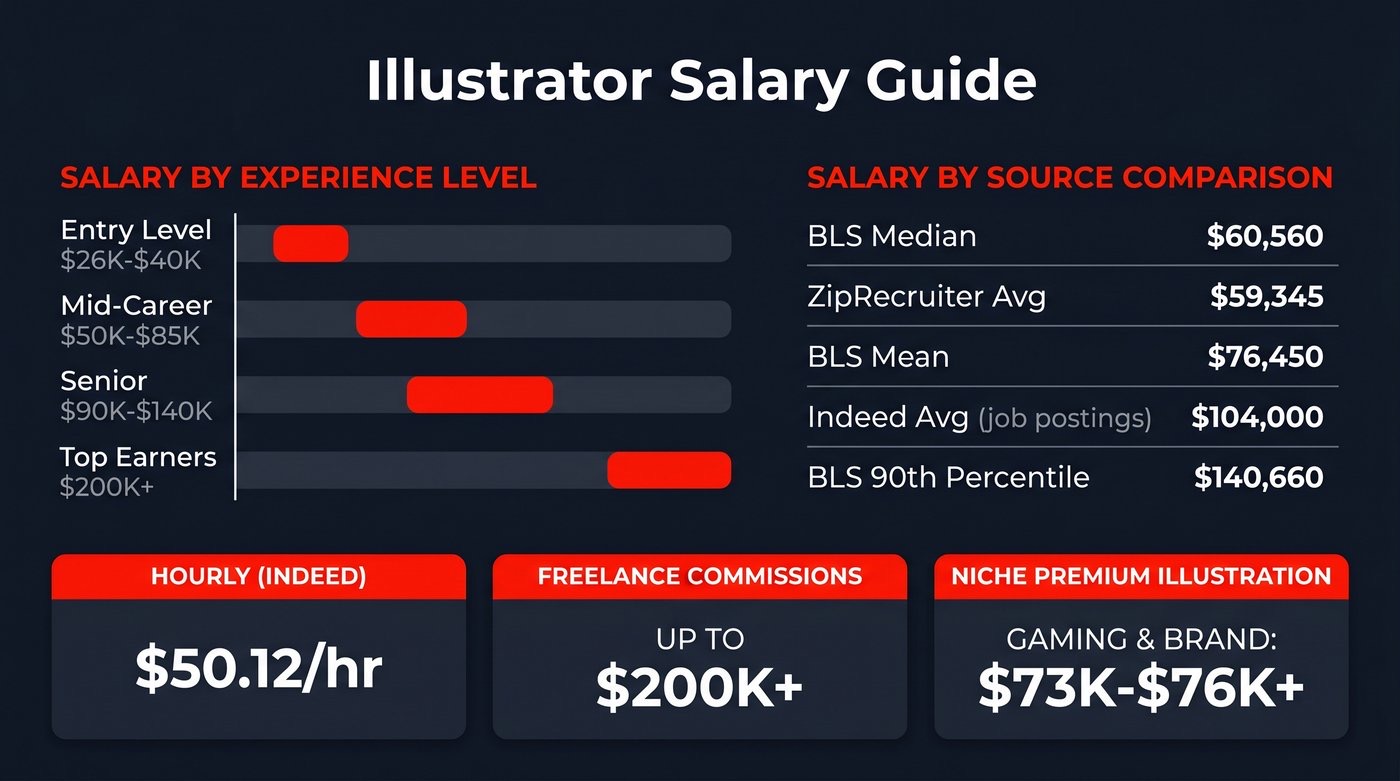
According to the U.S. Bureau of Labor Statistics, the national median illustrator salary is $60,560 per year ($29.12/hour). Entry-level illustrators typically earn $26,420 to $40,000, mid-career professionals earn $50,000 to $85,000, and senior illustrators with 8-plus years of experience can reach $90,000 to $140,660 annually.
The frustrating part? Most generic salary articles stop at the average and leave you guessing. This guide goes further. You will find percentile breakdowns, location data, freelance scaling stories, and a clear roadmap to increase your earning potential in 2025 and beyond.
National Salary Benchmarks: What Illustrators Actually Earn
Salary data for illustrators varies widely depending on the source, and understanding why is key to interpreting the numbers correctly. Government data leans conservative. Job platform aggregators like Indeed and ZipRecruiter reflect active market demand. Together, they tell a more complete story.
Indeed reports an average of $50.12 per hour based on 786 real job postings (updated September 2025), which translates to roughly $104,000 annually for full-time roles. ZipRecruiter (July 2025) puts the average closer to $59,345 per year. The BLS median sits at $60,560, with a mean of $76,450 due to high-earning outliers pulling the number upward.
Here is a clear side-by-side view of what the data actually shows:
| Percentile / Source | Annual Salary | Hourly Rate |
|---|---|---|
| 10th Percentile (BLS) | $26,420 | — |
| 25th Percentile (ZipRecruiter) | $38,500 | $19.00 |
| Median (BLS) | $60,560 | $29.12 |
| Average (ZipRecruiter) | $59,345 | $28.53 |
| 75th Percentile (ZipRecruiter) | $68,000 | — |
| Average (Indeed, job postings) | ~$104,000 | $50.12 |
| 90th Percentile (BLS) | $140,660 | — |
ZipRecruiter notes a 295% pay range variance among illustrators. That figure alone tells you this is not a one-size-fits-all career. Your specialization, location, and client base shape your income more than almost any other factor.
How Experience and Specialization Drive Your Illustrator Salary
Experience is the single biggest lever you can pull. The jump from entry-level to senior is not just a few thousand dollars. It can be the difference between $30,000 and $140,000 per year.
Salary by Career Stage
- Entry-Level (0-2 years): $26,420 to $40,000. Most roles at this stage involve assisting senior artists, building a client base, or working in-house at agencies and publishers.
- Mid-Level (3-7 years): $50,000 to $85,000. Illustrators here typically hold a stable client roster or a full-time salaried position with room for negotiation.
- Senior-Level (8+ years): $90,000 to $140,660. Many senior illustrators also take on art direction responsibilities, which significantly boosts earning potential.
Salary by Specialization
Not all illustration work pays equally. The industry you serve and the skills you bring to the table directly affect your rate. Digital and motion-focused roles consistently outperform general illustration work.
- 2D Game Artist: ~$73,000/year
- Motion Graphics / Digital Illustrator: $76,000 and above
- Freelance Illustrator (general average): ~$47,000, though top freelancers earn $200,000+
- Graphic Designer (overlap role): $46,000 to $78,000
Gaming, advertising, and digital media currently offer the strongest salaries for illustrators. Publishing tends to pay below average, while software companies and tech-adjacent agencies lead the pack.
Where You Live Matters: Top-Paying Locations for Illustrators
Geography plays a significant role in illustrator pay. California continues to dominate, with cities like Scotts Valley and Redwood City averaging around $73,000 per year. Pennsylvania, Ohio, and Virginia also surface as surprising leaders, with some metro areas hitting $83,000 or more according to ZipRecruiter data.
It is worth factoring in cost of living. A $75,000 salary in San Francisco has far less purchasing power than the same salary in Columbus, Ohio. When evaluating location-based pay, always adjust for local housing, taxes, and living costs before making career decisions.
Freelance vs. Salaried: Which Path Pays More?
This is one of the most debated topics among digital artists, and the honest answer is: it depends entirely on how you build your freelance business.
Salaried roles offer stability, benefits, and predictable income growth. A full-time illustrator at a gaming studio or agency typically earns $55,000 to $90,000 with health insurance and paid time off included. Freelancers, on the other hand, absorb all business costs but keep full control of their rates and client list.
The freelance upside is real. A well-documented case on Reddit’s MoneyDiaries community described a freelance illustrator who scaled from $12,000 to $205,000 in a single year through high-value commissions and a permalance contract at $45 per hour. That is not a typical outcome, but it illustrates what is possible with the right niche, portfolio, and repeat client base.
The risks are equally real. Freelance income is inconsistent, self-employment taxes add 15.3% on top of your earnings, and benefits must be funded independently. Most successful freelancers treat their illustration work like a business, not a side hustle.
How to Increase Your Illustrator Salary: A Step-by-Step Approach
Whether you are negotiating a raise or raising your freelance rates, the same core strategies apply. Here is a practical roadmap to grow your income as an illustrator.
- Audit your current portfolio: Remove weak pieces and replace them with work that targets your ideal client or industry. Specialized portfolios consistently command higher rates than generalist ones.
- Identify your highest-value niche: Gaming, tech, and advertising pay more than editorial or nonprofit work. Research job postings in your target niche to understand what skills they prioritize.
- Benchmark your rate against current job data: Use Indeed and ZipRecruiter to check live postings in your location. If your rate falls below the 50th percentile for your experience level, you have room to raise it.
- Negotiate with data, not feelings: When discussing salary, reference BLS medians, industry averages, and current job postings. Employers respond better to market benchmarks than personal need.
- Build repeat client relationships: Freelancers who rely on one-time projects earn far less than those who secure ongoing contracts. Prioritize clients who have long-term project pipelines.
- Add adjacent skills: Motion graphics, UI/UX illustration, and AI-assisted workflows are in high demand. Each skill set you add widens your rate ceiling and client pool.
AI, Market Shifts, and the Future of Illustrator Pay
AI image generation tools have entered every conversation about creative careers. The concern is understandable, but the data tells a more nuanced story. While AI tools are automating basic, repetitive illustration tasks, they are simultaneously increasing demand for highly customized, style-specific work that algorithms cannot replicate.
Senior illustrators with distinct visual styles and deep industry experience are not being replaced. They are being sought out specifically because their work cannot be generated by a prompt. The roles facing real pressure are entry-level, generic stock-style positions. That makes early specialization more important than ever.
Professional illustrators who master both traditional techniques and modern digital tools like Adobe Photoshop or Clip Studio Paint often command the highest rates in today’s competitive market.
The outlook for experienced illustrators in gaming, advertising, and digital media remains positive heading into 2026. Demand for original character design, brand illustration, and editorial work continues to grow. The key is positioning yourself as a specialist, not a generalist.
Conclusion: Your Next Step in the Illustrator Salary Guide
The data is clear. Illustrator salaries span a remarkable range, from $26,420 at the low end to $140,660 and beyond for top earners, with freelancers occasionally exceeding $200,000. This Illustrator Salary Guide shows that the gap between those outcomes is not luck. It is driven by specialization, location strategy, client relationships, and a willingness to negotiate with confidence.
Here are the key takeaways to carry forward:
- The national median sits at $60,560, but job platform data suggests active market rates are significantly higher for skilled professionals.
- Experience, niche, and industry matter more than any single factor. Gaming and tech pay more; editorial and nonprofit pay less.
- Freelancing can surpass salaried work, but only with a deliberate business strategy and repeat client focus.
- AI will not eliminate strong illustrators. It will eliminate weak positioning. Specialization is your best career insurance.
Start by benchmarking your current rate against active job postings in your niche. Then identify one skill or specialization you can develop in the next 90 days. Small, deliberate moves compound quickly in a field where the pay range spans nearly $115,000.
If you’re interested in exploring other creative career paths with similar earning potential, check out our Concept Artist Salary Guide or learn more about 2D Artist career opportunities.
Frequently Asked Questions
What is the average illustrator salary in the US?
The average illustrator salary in the US ranges from $59,000 to $104,000 depending on the data source. The BLS reports a median of $60,560 per year, while Indeed job postings (updated September 2025) show an average of $50.12 per hour, or roughly $104,000 annually for full-time roles. ZipRecruiter places the average at $59,345. Variance depends heavily on experience level, location, and whether the role is salaried or freelance.
How much do freelance illustrators make per year?
Freelance illustrators earn anywhere from $12,000 to over $200,000 per year, depending on their client base, niche, and rate structure. The general freelance average hovers around $47,000, but this figure is skewed downward by part-time freelancers. Full-time freelancers with established clients and specialized skills routinely earn $80,000 to $120,000, and outliers in high-demand niches like gaming or brand illustration have reported $200,000-plus years.
What factors affect illustrator salary the most?
The biggest factors affecting illustrator salary are experience level, industry specialization, geographic location, and freelance versus salaried status. Senior illustrators with 8-plus years of experience earn $90,000 to $140,000. Working in gaming, tech, or advertising pays significantly more than editorial or nonprofit sectors. Location also matters, with California and select northeastern cities offering the highest compensation overall.
Is illustration a good career financially in 2025 and 2026?
Yes, illustration remains a financially viable career, especially for specialists. The BLS reports a 90th percentile salary of $140,660, and active job platforms show strong demand in gaming, digital media, and advertising. While AI tools are reshaping some entry-level work, they are increasing demand for custom, style-specific illustration. Illustrators who specialize early and build strong portfolios are well-positioned for income growth through 2026.
How much do entry-level illustrators earn?
Entry-level illustrators typically earn between $26,420 and $40,000 per year according to BLS and ZipRecruiter data. This range reflects the 10th to 25th percentile of all illustrator wages. Entry-level pay is most common in publishing, nonprofit, and junior in-house design roles. Freelancers at this stage often earn less due to inconsistent client volume, but building a niche portfolio quickly can accelerate pay growth within one to two years.
Which cities pay illustrators the most?
California leads in illustrator pay, with cities like Scotts Valley and Redwood City averaging around $73,000 annually. Certain cities in Pennsylvania, Ohio, and Virginia also rank highly, with some metro areas reaching $83,000 or more per year. When evaluating city-based salaries, always factor in cost of living. A mid-range salary in a lower-cost city can provide more financial stability than a higher nominal salary in an expensive urban market.
How can illustrators increase their salary?
Illustrators can increase their salary by specializing in high-demand niches like gaming, brand illustration, or motion graphics, which command $73,000 to $76,000 or more. Building a focused portfolio, securing repeat freelance clients, adding skills in adjacent areas like UI illustration or animation, and negotiating with current market data rather than past experience are the most effective strategies. Transitioning into hybrid roles such as art director can also push earnings above $100,000.