Senior gameplay animators are pulling in a median salary of $156,400 based on 2026 job posting data — yet most online salary guides lump them in with generalist animators earning far less. If you have been using outdated numbers to evaluate your worth or plan your next career move, this Gameplay Animator Salary Guide will set the record straight.
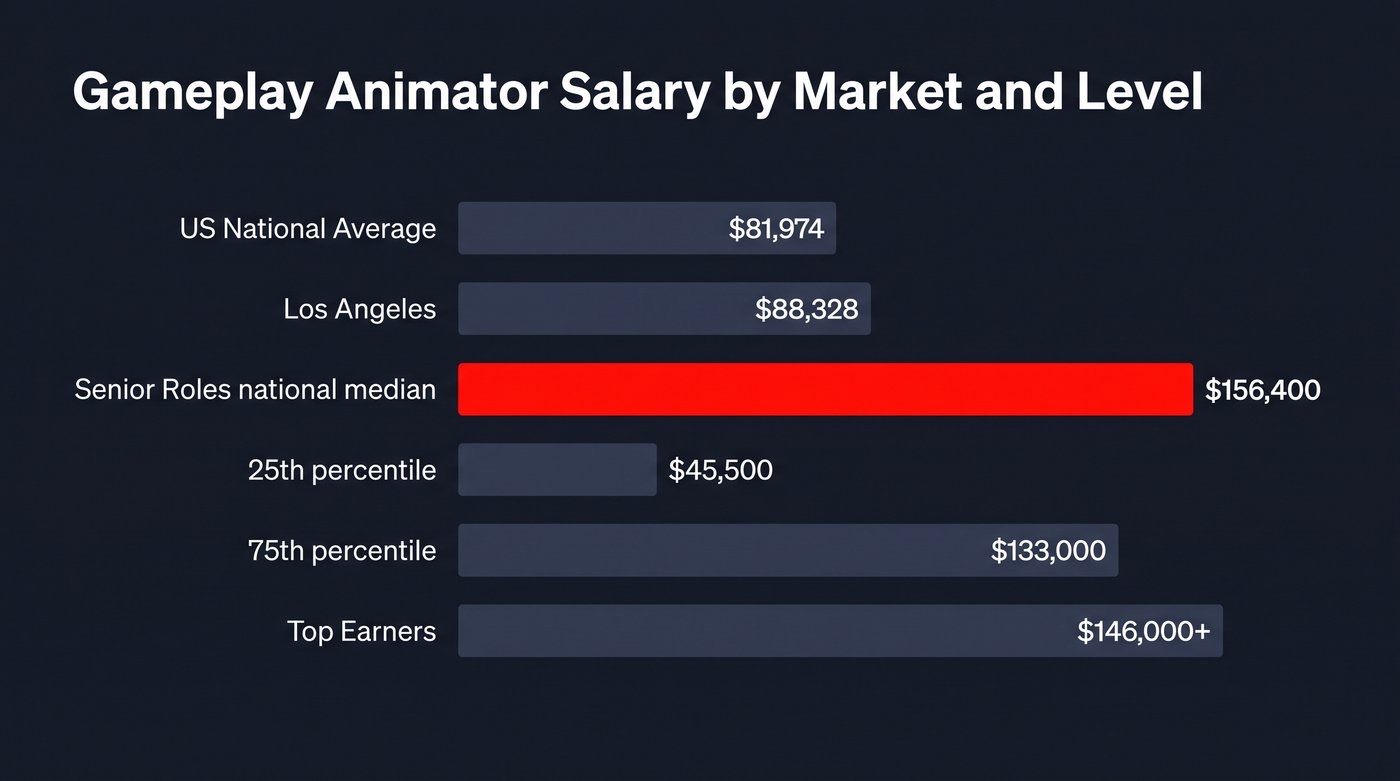
So, what does a gameplay animator actually earn? In the U.S., gameplay animators typically earn between $80,000 and $105,000 per year across all experience levels, with senior and lead specialists reaching $130,000 to $160,000 in major markets. Entry-level roles start around $45,000 to $50,000.
The problem is that most salary resources either rely on outdated Bureau of Labor Statistics data or treat gameplay animation as identical to general video game animation. This guide fixes that. You will find granular pay bands by experience level, location-based premiums, a skill-to-salary breakdown, and actionable negotiation tactics — all grounded in the most current data available.
Key Findings: Gameplay Animator Salary
- US gameplay animators average $81,974, with the middle band running $45,500 to $133,000.
- Senior gameplay animator roles carry a national median of $156,400.
- Los Angeles averages $88,328, with top earners reaching $157,316.
- Top earners nationally clear $146,000+.
- Engine skills (Unreal, Unity), state machines, and gameplay feel work push animators into the top band.
What Does a Gameplay Animator Do?
Before diving into numbers, it helps to understand why gameplay animators command a premium. Unlike cinematic animators who focus on cutscenes and story moments, gameplay animators are responsible for how characters feel to control — every jump, attack, idle, and transition that a player experiences hundreds of times per session.
According to CG Spectrum’s gameplay animator career guide, core responsibilities include keyframing and motion-capture editing, integrating animation assets directly into the game engine, implementing NPC movements driven by AI systems, and collaborating closely with programmers and game designers throughout production. That hybrid technical-creative skill set is precisely what drives salaries above the general animation median.
Gameplay Animator Salary by Experience Level
Experience is the single biggest driver of pay in this field. The range between an entry-level animator and a senior gameplay specialist can span more than $110,000 per year. Here is how the career ladder breaks down.
Entry-Level (0 to 3 Years)
New graduates and career-changers entering gameplay animation typically earn between $35,000 and $50,000 per year. Animators with under three years of professional experience average around $45,000, according to salary data compiled by the Academy of Interactive Entertainment (AIE). At this stage, the focus is on building a strong in-engine portfolio and developing core body mechanics skills.
Mid-Level (3 to 6 Years)
With three to six years of experience, gameplay animators move into a more comfortable earning range. AIE data places the average salary for this tier at approximately $57,500. Animators at this level are typically owning full character move sets, contributing to animation systems, and requiring less oversight from leads.
Senior Level (6+ Years)
This is where gameplay specialization really pays off. General senior animator roles average around $75,000, while senior gameplay-specific roles command significantly more. Hollylist’s 2026 career research data — drawn from live job postings — shows a median salary of $156,400 for senior gameplay animators, with the 10th percentile at $115,100 and the 90th percentile at $159,974.
Lead, Principal, and Director Roles
Leads and technical artists average around $85,000, while art directors in the games industry average approximately $110,000, based on AIE’s career benchmarks. At the principal and director level — especially at AAA studios — total compensation frequently exceeds $130,000 when factoring in bonuses and profit-sharing.
Gameplay Animator Salary by Location
Where you work has a dramatic effect on your paycheck. Metro game-development hubs offer meaningful premiums over the national average, and understanding those differences is key to making smart career decisions.
| Market | Average Annual Salary | 25th Percentile | 75th Percentile | Top Earners |
|---|---|---|---|---|
| U.S. National Average | $81,974 | $45,500 | $133,000 | $146,000+ |
| Los Angeles, CA | $88,328 | $49,000 | $143,300 | $157,316 |
| Senior Roles (National) | $156,400 (median) | $115,100 | $159,974 | $160,000+ |
| India (all levels) | ~$9,600 USD equiv. | ~$8,400 USD equiv. | ~$12,000 USD equiv. | Varies |
Los Angeles consistently outperforms the national average, with top earners reaching $157,316 according to ZipRecruiter data updated as of August 2025. The gap between the 25th and 75th percentiles in both markets spans roughly 45%, which highlights just how much experience and specialization matter within a single geography.
Remote roles have begun to blur metro and non-metro pay scales, but many AAA studios still anchor compensation to their headquarters location. Negotiating a metro-rate salary for a remote position is entirely possible — especially for senior candidates with strong engine implementation experience.
Which Skills Drive the Highest Gameplay Animator Salaries
Not all animation skills are valued equally. Certain technical and creative competencies are directly linked to the upper salary bands, and building them strategically is the fastest path to higher compensation.
- Game engine implementation: Animators who can integrate assets directly into Unity Pro or Unreal — not just hand them off — are more valuable to production pipelines and command higher pay at every level.
- Motion-capture editing and cleanup: Studios running mocap pipelines need animators who can work with raw performance data and polish it for real-time use, a skill that Hollylist identifies as common among senior gameplay animator job postings.
- Systemic and AI-driven animation: Designing animation systems that respond to AI-driven NPC behavior is an advanced skill that bridges animation and gameplay programming, pushing animators into lead and principal pay brackets.
- Hand-keyed character animation: Strong keyframe fundamentals remain foundational. Employers consistently list this as a core requirement across all experience levels.
- Cross-discipline collaboration: Animators who can communicate effectively with designers and programmers reduce production friction. That soft skill is increasingly reflected in senior-level job descriptions and compensation.
How to Move Up the Salary Bands: A Step-by-Step Approach
Understanding the numbers is only half the battle. Here is a practical roadmap for moving from the 25th percentile to the 75th percentile — or beyond.
- Audit your portfolio for in-engine clips. Showreels that demonstrate gameplay responsiveness and in-engine integration signal immediately that you are a production-ready animator, not just a motion artist. This single change has the highest return on investment for entry and mid-level candidates. Learn more about building a game art portfolio that showcases technical skills alongside artistic ability.
- Develop engine-side skills intentionally. Spend time in Unreal Engine’s animation blueprint system or Unity’s Animator Controller. Even a working knowledge differentiates you from candidates who only work in DCC tools like Maya.
- Research location and remote pay benchmarks before negotiating. Use ZipRecruiter’s localized data and Salary.com’s employer-oriented benchmarks together to build a realistic anchor range. Arriving at a negotiation with two credible data sources is far more effective than citing a single number.
- Target your title specifically. Applying to roles listed as “Gameplay Animator” rather than “Animator” or “Character Animator” positions you within the higher-paying gameplay-specific salary range from the start.
- Build visible specialization. Contributing to public game jams, open-source game projects, or tutorials that demonstrate animation system knowledge raises your professional profile and supports requests for above-average offers.
Gameplay vs. Cinematic vs. Technical Animator: How Salaries Compare
One of the most common mistakes animators make is benchmarking their salary against the wrong role. Here is a quick comparison to clarify where gameplay animation sits in the broader field.
General video game animators — a broader category that includes cinematic and UI animators — average $102,886 per year according to October 2025 data from AFTA/ArtsUSA, with the bottom 10% at $78,480 and the top 10% above $116,800. Gameplay-specific animators at the senior level significantly exceed those ceilings, with median senior salaries of $156,400 based on Hollylist’s 2026 job posting analysis.
Technical animators, who focus on rigging and pipeline tools, often earn at or above senior gameplay animator rates due to their programming-adjacent skills. Art directors sit at the top of the studio hierarchy at around $110,000 on average, though gameplay leads at AAA studios can rival or exceed that figure with performance bonuses. To understand the full spectrum of animation career paths, check out our comprehensive animator career path guide.
The takeaway is clear: specialization in gameplay animation consistently outperforms general animation benchmarks, particularly at the senior and lead levels.
Conclusion
This Gameplay Animator Salary Guide shows that the difference between a $45,000 entry-level role and a $156,400 senior position is not luck — it is a deliberate combination of specialization, engine skills, portfolio strategy, and location awareness. Here are the four key takeaways to carry forward:
- The typical U.S. gameplay animator earns $80,000 to $105,000 across all levels, with senior specialists reaching $115,000 to $160,000.
- Location matters significantly — Los Angeles adds roughly $6,000 to $10,000 above the national average, with top earners exceeding $157,000.
- In-engine skills and systemic animation knowledge are the clearest drivers of above-average compensation at every career stage.
- Always benchmark against gameplay-specific data, not general animation or multimedia artist averages, which consistently understate your earning potential.
Whether you are negotiating your first studio offer or planning a move into a senior role, knowing your real market value is the most powerful tool you have.
Frequently Asked Questions
What is the average gameplay animator salary in the U.S.?
The average gameplay animator salary in the U.S. is approximately $81,974 per year, according to ZipRecruiter data updated in July 2025. The typical range spans from $45,500 at the 25th percentile to $133,000 at the 75th percentile. Salary.com places the range slightly tighter at $83,012 to $104,974, making $80,000 to $105,000 a reliable working benchmark for all experience levels.
How much do senior gameplay animators earn?
Senior gameplay animators earn significantly more than general animators. Hollylist’s 2026 career research data, based on live job postings, shows a median salary of $156,400 for senior gameplay animators. The 10th percentile starts at $115,100 and the 90th percentile reaches $159,974. These figures reflect the premium studios place on experienced specialists who can influence game feel and own complex animation systems.
Does location affect a gameplay animator’s salary?
Yes, location has a meaningful impact on pay. Gameplay animators in Los Angeles earn an average of $88,328 per year compared to the national average of $81,974, with top earners in the LA market reaching $157,316. Major game-development hubs like Los Angeles, San Francisco, and Seattle typically offer 10 to 20 percent above national averages, while remote roles may blend metro and non-metro pay scales depending on the studio.
What skills help gameplay animators earn more?
The skills most strongly linked to higher gameplay animator salaries include game engine implementation (Unreal, Unity), motion-capture editing and cleanup, designing AI-driven NPC animation systems, and strong hand-keyed character animation fundamentals. Senior job postings consistently list Maya proficiency, creature animation, and keyframe animation as core requirements. Animators who bridge creative and technical disciplines — particularly those who can work directly inside the game engine — consistently reach the upper salary quartiles.
How does a gameplay animator salary compare to a cinematic animator salary?
Gameplay animators, especially at the senior level, typically out-earn cinematic and generalist animators. The broader video game animator category averages $102,886 per year, while senior gameplay specialists earn a median of $156,400. Cinematic animators bring important storytelling skills, but gameplay animators own interactive responsiveness — a quality that directly impacts player retention — which studios compensate accordingly in AAA and live-service game environments.
What is an entry-level gameplay animator salary?
Entry-level gameplay animators with little to no professional experience typically earn between $35,000 and $50,000 per year. Candidates with under three years of experience average around $45,000. Breaking into the higher ranges early requires a strong in-engine portfolio, demonstrable body mechanics skills, and familiarity with at least one major game engine. Studios hiring juniors are specifically looking for production readiness, not just artistic ability.
Are there gameplay animator salary differences between AAA and indie studios?
Yes, studio size significantly affects total compensation. AAA studios in major hubs typically offer the highest base salaries, along with bonuses, profit-sharing, and in some cases stock or RSU packages. Mid-sized (AA) studios may offer slightly lower base pay but more creative ownership. Indie studios often pay below market rate on base salary but may compensate through revenue-sharing arrangements or equity. ZipRecruiter’s wide pay dispersion — nearly 45% between quartiles — reflects this variation across studio types. For more insights on different studio environments, explore which game studios pay the most to make informed career decisions.