Did you know a vehicle artist’s salary can swing by more than $90,000 depending on the industry, seniority level, and city they work in? If you’ve been comparing your pay to a generic online average, there’s a good chance you’re looking at the wrong number entirely. This vehicle artist salary guide breaks down what artists actually earn, why the title matters more than people think, and what you can do to push your income higher.
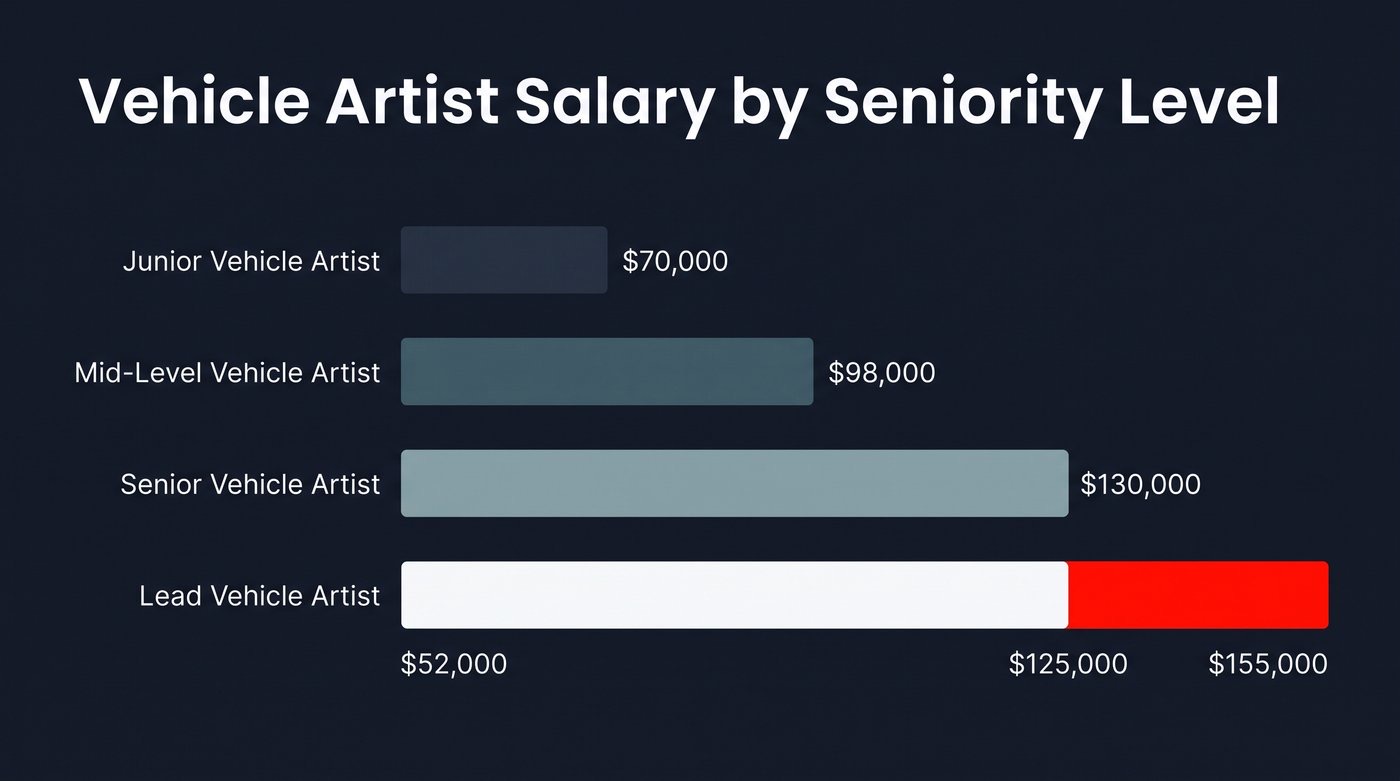
So, how much does a vehicle artist make? In the U.S., vehicle and automotive artists earn between $42,000 and $135,000 per year depending on role, experience, and employer. Game industry vehicle artists typically start around $52,000 and reach $155,000 at the lead level, while traditional automotive design roles average closer to $80,897 annually.
The core problem is that most salary pages lump every vehicle-adjacent role into one vague number. That leaves you either underselling yourself in negotiations or setting unrealistic expectations. This guide fixes that by separating the titles, the industries, and the real factors that move pay up or down.
Key Findings: Vehicle Artist Salary
- Junior vehicle artists earn $52,000 to $70,000; mid-level earn $70,000 to $98,000.
- Senior vehicle artists earn $95,000 to $130,000; leads reach $125,000 to $155,000.
- Pay can swing by more than $90,000 based on industry, seniority, and city.
- Racing, simulation, and AAA open-world studios pay at the top of the band.
- Hard surface mastery plus real-time optimization is the highest-paid combination.
Why Your Job Title Determines Your Vehicle Artist Salary Range
The single biggest source of confusion in this field is title fragmentation. “Vehicle artist” can mean at least four distinct roles, and each one carries its own salary band. Before you benchmark your pay, you need to know exactly which role you hold.
Here is how the most common titles break down in terms of scope and pay potential:
- 3D Vehicle Artist (Games): Builds real-time vehicle assets for game engines; strong demand in AAA and mid-tier studios.
- Automotive Design Artist: Creates concept visuals and production renders for car manufacturers; often requires formal industrial design education.
- Automotive Artist (Broad): A catch-all term used by career aggregators that blends both categories above.
- Hard Surface / Vehicle Modeler: Focuses on high-poly and baked-down geometry; often freelance or contract-based.
According to Arts USA’s career guide, the average U.S. automotive artist salary sits at $80,897, with the bottom 10% earning around $42,112 and the top 10% reaching $135,000. Those numbers look reasonable until you compare them to the game-industry breakdown, which tells a noticeably different story.
Vehicle Artist Salary by Experience Level: The Full Breakdown
Experience is the most reliable predictor of salary growth in this field. The jump between junior and senior pay is not incremental. It is substantial, often doubling your starting income within eight to ten years. Here is what current industry data shows across both major employment tracks.
Game Industry Vehicle Artist Salary Ranges
The game industry offers some of the most clearly structured career ladders for vehicle artists. Based on current role data from the vehicle artist jobs market, U.S. ranges by seniority look like this:
| Seniority Level | Annual Salary Range (U.S.) |
|---|---|
| Junior Vehicle Artist | $52,000 – $70,000 |
| Mid-Level Vehicle Artist | $70,000 – $98,000 |
| Senior Vehicle Artist | $95,000 – $130,000 |
| Lead Vehicle Artist | $125,000 – $155,000 |
Automotive Design Artist Salary Ranges
Traditional automotive design roles follow a slightly different curve. Entry points are comparable to game junior roles, but the ceiling in manufacturing is shaped more by company size and location than by title progression alone.
- Entry-Level: $50,000 to $70,000 per year
- Mid-Level: $70,000 to $90,000 per year
- Senior-Level: $80,000 to $100,000 and above per year
The overlap between mid and senior ranges in this track reflects how much individual company pay structures vary. Large OEMs in Detroit tend to pay above the average, while smaller studios or regional design consultancies often sit closer to the mid-range floor.
How Location and Remote Work Affect Your Earnings
Geography still plays a significant role in total compensation, even as remote roles become more common. Major automotive hubs like Detroit and Los Angeles consistently offer higher salaries than smaller markets, partly due to cost-of-living adjustments and partly because of concentrated employer competition.
For fully remote vehicle artist positions, ZipRecruiter data as of June 2025 shows an average hourly rate of $24.65, with most remote workers earning between $17.55 and $27.88 per hour. Top earners in remote roles reach up to $40.38 per hour, which annualizes to roughly $84,000 at full-time hours.
Remote work has narrowed some geographic gaps, but it has not eliminated them. Artists working remotely for studios based in high-cost cities tend to earn more than those working for regional employers. If you are negotiating a remote role, always anchor your ask to the employer’s location, not your own.
What Skills Actually Increase a Vehicle Artist’s Pay
Generic salary advice tells you to “get more experience.” That’s true, but it misses the specific skill investments that produce the biggest pay gains in this field. Here is a step-by-step view of how to build toward higher compensation deliberately.
- Master hard-surface modeling precision. Clean topology, proper edge flow, and production-ready meshes are baseline expectations at senior level. Artists who deliver these without revision cycles command more.
- Learn real-time engine workflows. Proficiency in Unity Pro for vehicle asset pipelines is increasingly expected in games and simulation-adjacent roles. This skill alone can shift you from mid-level to senior consideration.
- Develop advanced texturing and shading skills. PBR material creation, damage states, livery systems, and LOD management are differentiators that directly affect your hireability at higher pay bands. Professional tools like Substance 3D Painter are industry standard for this work.
- Build an engineering-aware design vocabulary. Artists who understand how real vehicles are built, including mechanical systems and manufacturing constraints, produce more credible work for automotive clients and get paid accordingly.
- Switch jobs strategically. Community sentiment among working artists consistently points to job changes as the fastest route to meaningful salary increases, often outpacing internal raises by a significant margin.
Game Studios vs. Automotive Manufacturers: Which Pays More?
This is one of the most practical questions in any vehicle artist salary guide, and the honest answer depends on your career stage. At junior level, both tracks start in a similar range. The divergence happens at senior and lead levels, where AAA game studios tend to offer higher ceilings, particularly when total compensation includes bonuses and royalties.
Automotive manufacturers offer different advantages. Benefits packages at large OEMs are often more comprehensive, job security tends to be higher, and the work is less subject to the volatile production cycles that affect game studio hiring. Freelance and contract vehicle artists working across both industries report the widest income variance, with top earners well above the salaried senior range and lower-earning freelancers falling below the junior floor.
Your choice between industries should factor in not just the salary ceiling but also the type of work, the stability you want, and where your existing portfolio is strongest. Understanding 3D artist career paths can help you make more informed decisions about which track aligns with your goals.
How Portfolio Quality Changes the Salary Offer You Receive
Most salary pages skip this entirely. Your portfolio is not just a hiring requirement. It is a compensation signal. Hiring managers at studios and manufacturers use portfolio quality to decide which salary tier to offer before they ever discuss numbers with you.
A portfolio that demonstrates the following qualities tends to generate higher initial offers:
- Real-time renders alongside high-poly source work, showing full pipeline understanding
- Vehicles with visible material complexity such as weathering, wear, and reflective surfaces handled accurately
- At least one project that shows production context, meaning it shipped or was part of a shipped title or product
- Breakdown sheets that show topology, UV layout, and texture maps, not just beauty renders
Formal education in design, such as an industrial design or concept art degree, also correlates with higher entry offers in the automotive manufacturing track. However, in the game industry, portfolio quality consistently outweighs credentials when studios set initial compensation. Learning how to build a game art portfolio can give you a significant advantage in negotiations.
Conclusion: Key Takeaways From This Vehicle Artist Salary Guide
Understanding your earning potential as a vehicle artist starts with knowing which role you actually hold and which industry employs you. Here are the four things to carry forward from this guide:
- U.S. vehicle and automotive artist salaries range from roughly $42,000 to $155,000, and the spread is driven by title, seniority, and industry track, not just experience years.
- Game industry roles offer higher ceilings at senior and lead levels, while automotive manufacturing roles offer more stability and stronger benefits packages.
- Remote vehicle artist roles average around $24.65 per hour in the U.S., but anchoring your negotiation to your employer’s location matters more than your own.
- The fastest route to higher pay combines real-time engine skills, hard-surface precision, and strategic job movement rather than waiting for internal promotions.
Use this vehicle artist salary guide as your baseline when entering salary discussions, evaluating offers, or planning your next skill investment. Know your title, know your market, and negotiate from a position of real data.
Frequently Asked Questions
How much does a vehicle artist make per year in the U.S.?
U.S. vehicle artists earn between $42,000 and $155,000 annually depending on their specific title and seniority level. The average for broad automotive artist roles sits around $80,897 per year, while game industry vehicle artists at the lead level can exceed $125,000 to $155,000. Entry-level positions in both tracks typically start between $50,000 and $70,000 per year.
Do vehicle artists get paid more in games or automotive design?
At senior and lead levels, game studio vehicle artists generally earn more, with ranges reaching $130,000 to $155,000. Automotive design roles at large manufacturers top out closer to $100,000 to $135,000 but often include stronger benefits and greater job stability. At junior level, both tracks are comparable, typically ranging from $50,000 to $70,000 annually.
What skills raise a vehicle artist’s salary the most?
Real-time engine proficiency in tools like Unreal Engine, advanced PBR texturing, hard-surface modeling precision, and engineering-aware design knowledge are the skills most consistently linked to higher pay. Artists who combine technical pipeline understanding with clean production-ready assets are frequently hired at senior level faster and receive stronger initial offers than those with beauty-render-only portfolios.
How much do senior vehicle artists make?
Senior vehicle artists in the U.S. game industry earn between $95,000 and $130,000 per year. In automotive design and manufacturing, senior-level pay ranges from $80,000 to $100,000 or more depending on the employer and location. Major hubs like Detroit and Los Angeles tend to push senior automotive design salaries toward the higher end of that range.
Is a vehicle artist a good career choice?
Yes, for artists with genuine interest in mechanical design and 3D production, it is a strong career path. Demand remains consistent across games, automotive manufacturing, simulation, and film. The salary ceiling is competitive, particularly for those who develop real-time workflow skills. Career growth is clear, moving from junior through senior and lead roles, and specialization consistently produces pay premiums over generalist positions.
How much does a remote vehicle artist make per hour?
As of June 2025, remote vehicle artists in the U.S. average $24.65 per hour according to ZipRecruiter data. Most remote positions fall between $17.55 and $27.88 per hour, while top earners in remote roles reach up to $40.38 per hour. When negotiating remote pay, anchoring your rate to the employer’s geographic market rather than your own location typically produces better outcomes.
What is the difference between a vehicle artist and an automotive design artist salary?
A vehicle artist title is most common in the game industry and refers to specialists who build real-time 3D assets. An automotive design artist typically works in manufacturing or concept development for car brands. Vehicle artists at senior game studio levels often earn more ($95,000 to $130,000) than mid-level automotive design artists ($70,000 to $90,000), though both tracks converge at the top end around $130,000 to $135,000.