
3D Artist Career Path: Roles, Salaries & Hidden Opportunities in 2026
There are 5,436 open 3D artist jobs in the US right now, and most creative professionals have no idea the field pays an average of $74,721 per year - with certain specialists earning far more. If you have ever wondered whether the 3D artist career path is worth pursuing in 2026, the answer is a resounding yes. But the real opportunity lies in knowing which roles to target.
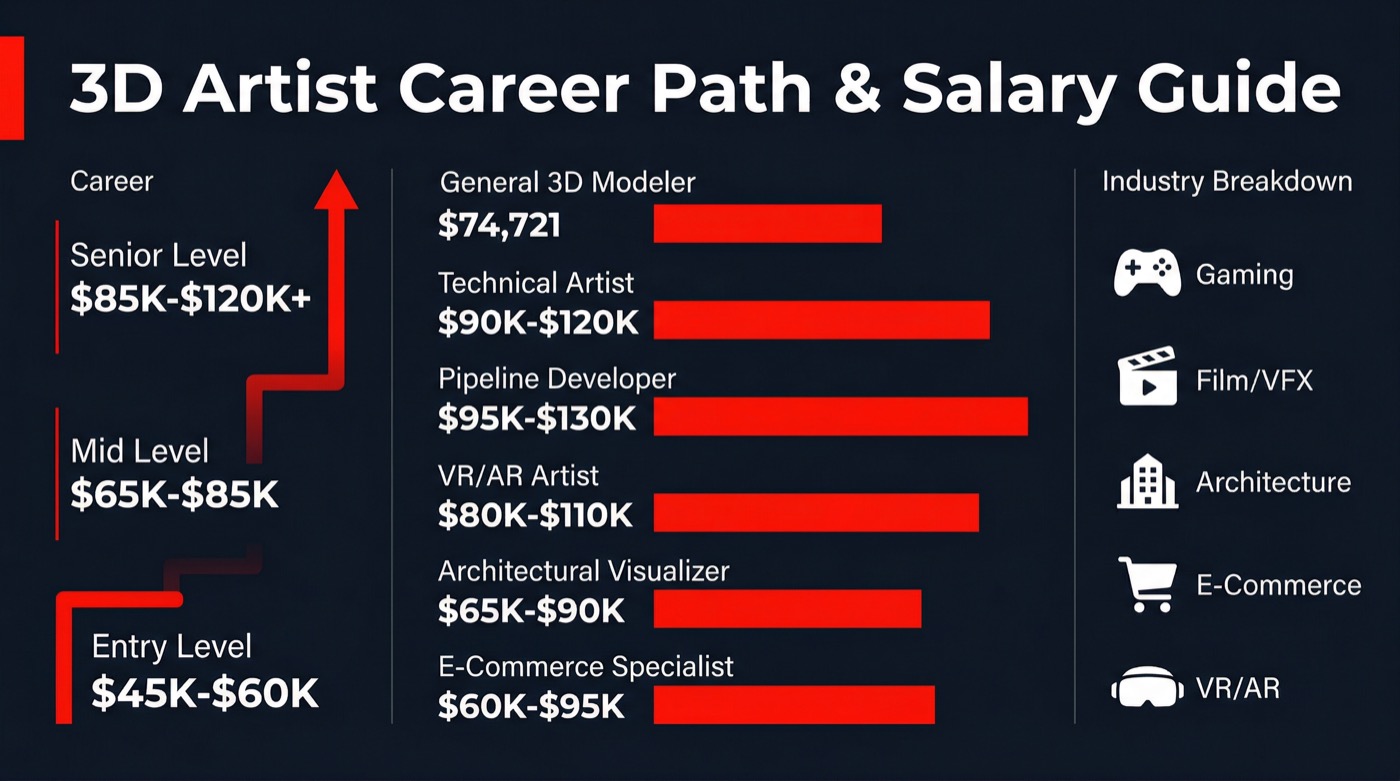
The 3D artist career path is a professional journey that begins with mastering 3D modeling and visualization software, then branching into specialized industries such as gaming, film, architecture, e-commerce, or VR/AR. Artists build portfolios, develop technical skills, and often advance into high-value niches like technical artistry or pipeline development - no degree required.
The challenge most aspiring artists face is thinking "3D artist" means only one thing: modeling characters or props. In reality, the field spans dozens of roles across vastly different industries, and the highest-paying positions are the ones nobody talks about. This guide breaks down every layer of the career path, the salary data behind each route, and a practical roadmap to get started - even from zero.
What Does a 3D Artist Actually Do?
A 3D artist uses specialized software to create three-dimensional digital assets for use across media, products, and interactive environments. The day-to-day work varies enormously depending on the industry, but the core skills - modeling, texturing, lighting, and rendering - form the shared foundation.
Here is what makes this field unique in 2026: demand is no longer concentrated in just gaming and film. According to M3DS Academy, industries from furniture retail to medical simulation to metaverse development now actively hire 3D artists, creating a diversified job market that insulates the career from any single sector slowdown.
The main industries hiring 3D artists right now include:
- Gaming and interactive media - character modeling, environment art, props, UI assets
- Film and animation - VFX, character rigging, scene rendering
- Architecture and real estate - photorealistic visualizations, walkthroughs, floor plan renders
- E-commerce and product design - 3D product renders replacing photoshoots for brands like Amazon sellers, furniture companies, and shoe brands
- VR, AR, and the metaverse - immersive environment creation, avatar design, interactive asset optimization
- Training and simulation - defense, medical, and industrial sector visualizations
The Full 3D Artist Career Path: Roles and Progression
Understanding the career ladder helps you make smarter decisions about where to specialize early. Most artists follow a trajectory from generalist learner to industry-specific specialist, then optionally into technical or leadership roles.
Entry-Level Roles (0 to 2 Years)
At this stage, your portfolio matters more than your resume. Junior 3D artists and modeling assistants focus on executing defined tasks - retopology, asset cleanup, UV unwrapping - under senior supervision. Salaries at this level are competitive for creative fields, especially in gaming and archviz studios.
The good news: you do not need a degree. Tools like Blender (free and industry-relevant) make self-learning accessible, and hiring managers consistently prioritize portfolio quality over credentials.
Mid-Level Roles (2 to 5 Years)
This is where specialization becomes critical. Mid-level artists pick a lane - character art, hard-surface modeling, architectural visualization, product rendering - and develop deep expertise. Remote work opportunities expand significantly at this stage, with global freelance platforms like Sketchfab and TurboSquid opening international revenue streams.
Senior and Specialist Roles (5 or More Years)
Senior artists lead projects, mentor junior team members, and often cross into hybrid technical roles. This is also where the salary ceiling rises sharply. Industry, location, and portfolio strength all influence compensation, but specialists consistently outperform generalists at this level.
Hidden High-Pay Roles Most Artists Overlook
Here is the insight that separates thriving 3D careers from stagnant ones: technical artists and pipeline creators earn more than most modelers, and the market for them is far less saturated.
Technical Artist
A technical artist bridges the gap between art and engineering. They build shader libraries, optimize asset pipelines, automate repetitive workflows, and ensure visual quality holds up in real-time engines like Unreal or Unity. Studios treat these professionals as force multipliers - one technical artist can improve the output of an entire team. Because the skill set is rare, compensation reflects that scarcity.
Pipeline and Tool Developer
Pipeline developers create the custom tools and scripts that studios use to streamline their 3D production workflows. This role is arguably the most AI-resistant in the entire field. While AI can generate basic meshes or textures, designing and maintaining the proprietary systems a studio runs on requires deep contextual knowledge no generative tool currently replicates.
E-Commerce and Product Visualization Specialist
Brands selling furniture, footwear, electronics, and consumer goods are rapidly replacing expensive product photoshoots with 3D renders and AR configurators. This shift is accelerating in 2026 as platforms like Amazon incentivize interactive 3D product listings. Freelancers in this niche report steady project pipelines with strong per-asset rates.
3D Artist Salary and Job Market Data (2026)
Let us put real numbers on the table. Salary varies significantly by role, experience, and industry, but the baseline is stronger than most people assume.
| Role / Niche | Avg. US Salary (2026) | Demand Level | AI Risk |
|---|---|---|---|
| General 3D Modeler | $74,721 | High | Medium |
| Technical Artist | $90,000 to $120,000+ | Very High | Low |
| Pipeline / Tool Developer | $95,000 to $130,000+ | High | Very Low |
| Architectural Visualizer | $65,000 to $90,000 | High | Medium |
| Game Character Artist | $70,000 to $100,000 | High | Medium |
| VR / AR Environment Artist | $80,000 to $110,000 | Very High | Low |
| E-Commerce 3D Specialist | $60,000 to $95,000 | Rapidly Growing | Medium |
The Bureau of Labor Statistics projects 2% growth for multimedia artists and animators through 2034 - slower than average overall, but the field generates approximately 5,000 job openings annually due to consistent turnover and replacement needs. Meanwhile, independent data from Zippia shows a stronger 5% growth rate through 2028, reflecting the surge from emerging tech sectors not fully captured in BLS categories.
How to Start Your 3D Artist Career Path: A Step-by-Step Roadmap
Whether you are starting from scratch or pivoting from another creative field, the following roadmap reflects what actually works in 2026 - not what worked a decade ago.
- Choose your software and commit to it. Start with Blender. It is free, industry-recognized, and has a massive learning community. Avoid jumping between tools early on - depth beats breadth at the beginner stage.
- Master the fundamentals before specializing. Spend the first three to six months on core skills: polygon modeling, UV unwrapping, basic texturing, and scene lighting. These transfer across every niche.
- Pick one industry to target. Gaming, archviz, product rendering, and VR each have distinct aesthetics and technical requirements. Research which aligns with your interests and has accessible entry points near you or remotely.
- Build a focused portfolio of three to five pieces. Quality beats quantity at every stage. Each portfolio piece should demonstrate mastery of a specific skill relevant to your target industry - not just that you can model a generic object.
- Seek mentorship or structured feedback. Self-learning has limits. One-on-one critique from a working professional accelerates growth faster than any tutorial library. Look for mentorship programs, Discord communities, or platforms connected to active studios.
- Develop one technical skill alongside your art skills. Learn basic scripting in Python for Blender, or understand real-time optimization for game engines. This positions you for the higher-paying technical roles as you advance.
- Launch on freelance platforms early. Do not wait until you feel "ready." Platforms like TurboSquid (asset sales), Upwork (project-based freelance), and CGarchitect (archviz-specific) let you build real-world experience and income simultaneously.
How AI Is Reshaping the 3D Artist Career Path in 2026
AI is not replacing skilled 3D artists - it is redefining which skills command premium pay. Repetitive tasks like basic mesh generation, texture creation from reference images, and simple prop modeling are increasingly automatable. Artists who anchor their value to those tasks alone face growing pressure on rates.
However, AI has simultaneously created entirely new high-value roles. Artists who understand how to integrate AI tools into production pipelines, build custom workflows that leverage generative models, or optimize AI-generated assets for real-time rendering are in short supply. The floor is rising for generalists; the ceiling is rising faster for specialists.
The safest and highest-earning positions in 2026 are those where human creative judgment, technical context, and studio-specific knowledge are irreplaceable - which describes technical artists and pipeline developers almost perfectly.
Conclusion: Is the 3D Artist Career Path Right for You?
The 3D artist career path in 2026 rewards those who think strategically, not just those who practice the longest. Here are the four takeaways that matter most:
- The average US salary of $74,721 is a floor, not a ceiling - specialists in technical artistry, VR, and pipeline development consistently earn $90,000 to $130,000 or more.
- No degree is required, but a strong, focused portfolio is non-negotiable regardless of the route you take.
- AI is not an industry threat for skilled artists - it is a career accelerant for those who learn to work with it rather than against it.
- The highest-opportunity roles in 2026 are the ones most candidates overlook: technical artists, pipeline developers, and e-commerce visualization specialists.
If you are a digital artist evaluating your next move, the question is not whether 3D is a viable career. The question is which corner of this expanding field aligns with your strengths and where you want to be in five years. Start there, build deep, and the market will meet you.
Also see: Technical Artist Career Path: The Complete Guide
Looking for a 3D artist job? ArtBlast curates 10-60+ game art jobs daily, including 3D artist roles across gaming, film, and VFX. Subscribe at artblast.co/subscribe/?src=site and apply while the role is still fresh.
New to the field? Read the complete guide on how to become a 3D artist for a step-by-step starting roadmap.
Frequently Asked Questions
How long does it take to become a 3D artist?
Most self-taught 3D artists build a hirable portfolio within 12 to 24 months of consistent practice, depending on their starting skill level and the niche they target. Structured mentorship or formal training programs can compress that timeline to six to twelve months. Commitment to daily practice and deliberate portfolio building matters more than total time spent.
Do you need a degree to pursue a 3D artist career path?
No. The 3D art industry is one of the most portfolio-driven fields in creative work. Employers and clients evaluate your work samples, not your credentials. Many working professionals are entirely self-taught using free tools like Blender. A degree in fine arts or computer graphics can be helpful for networking, but it is not a requirement for employment or freelance success.
What is the best software for beginner 3D artists?
Blender is the top recommendation for beginners in 2026. It is completely free, continuously updated, and widely used across gaming, archviz, animation, and product visualization. It also has the largest free tutorial ecosystem of any 3D software. Once you master Blender fundamentals, transitioning to industry-specific tools like Maya, ZBrush, or Cinema 4D becomes significantly easier.
What are the highest-paying 3D artist jobs in 2026?
Technical artists and pipeline developers consistently earn the highest salaries, often ranging from $95,000 to $130,000 or more in the US. VR and AR environment artists follow closely, driven by surging demand from immersive tech companies. E-commerce product visualization and game character artistry also offer strong compensation, particularly for freelancers with niche expertise and a proven portfolio.
Is freelancing a viable option on the 3D artist career path?
Yes, and it is increasingly attractive in 2026. Global platforms like TurboSquid, Sketchfab, and Upwork give 3D artists access to international clients across e-commerce, architecture, gaming, and training simulation. The outsourcing trend in furniture visualization and architectural rendering has created particularly steady freelance demand. Many mid-level artists earn more freelancing than they would in comparable studio roles.
How is AI affecting 3D artist job opportunities?
AI automates repetitive low-complexity tasks like basic mesh generation and reference-based texturing, which puts pressure on generalist modelers competing purely on speed. However, AI has also created new high-value roles for artists who can build AI-integrated pipelines, optimize AI-generated assets, and oversee quality control in automated workflows. Specialists and technical artists remain highly sought-after regardless of AI adoption.
What industries hire the most 3D artists in 2026?
Gaming remains the largest employer of 3D artists, followed by film and broadcast, architectural visualization, and e-commerce product design. Emerging sectors including VR and AR development, metaverse platform creation, and medical or defense simulation are among the fastest-growing sources of new job openings. The diversification of hiring industries makes the 3D artist career path more resilient than it has ever been.
Related Articles
See also: How to Become a 3D Artist: The Complete Guide | Vehicle Artist Jobs