
Character Artist Career Path: The Complete Guide
The global gaming industry now generates over $200 billion in annual revenue, and behind every hero, villain, and creature in those games stands a character artist. If you have ever wondered whether this creative career is right for you, the timing has never been better. The character artist career path is evolving faster than most people realize, and those who start now are positioned to ride one of the most exciting waves in entertainment history.
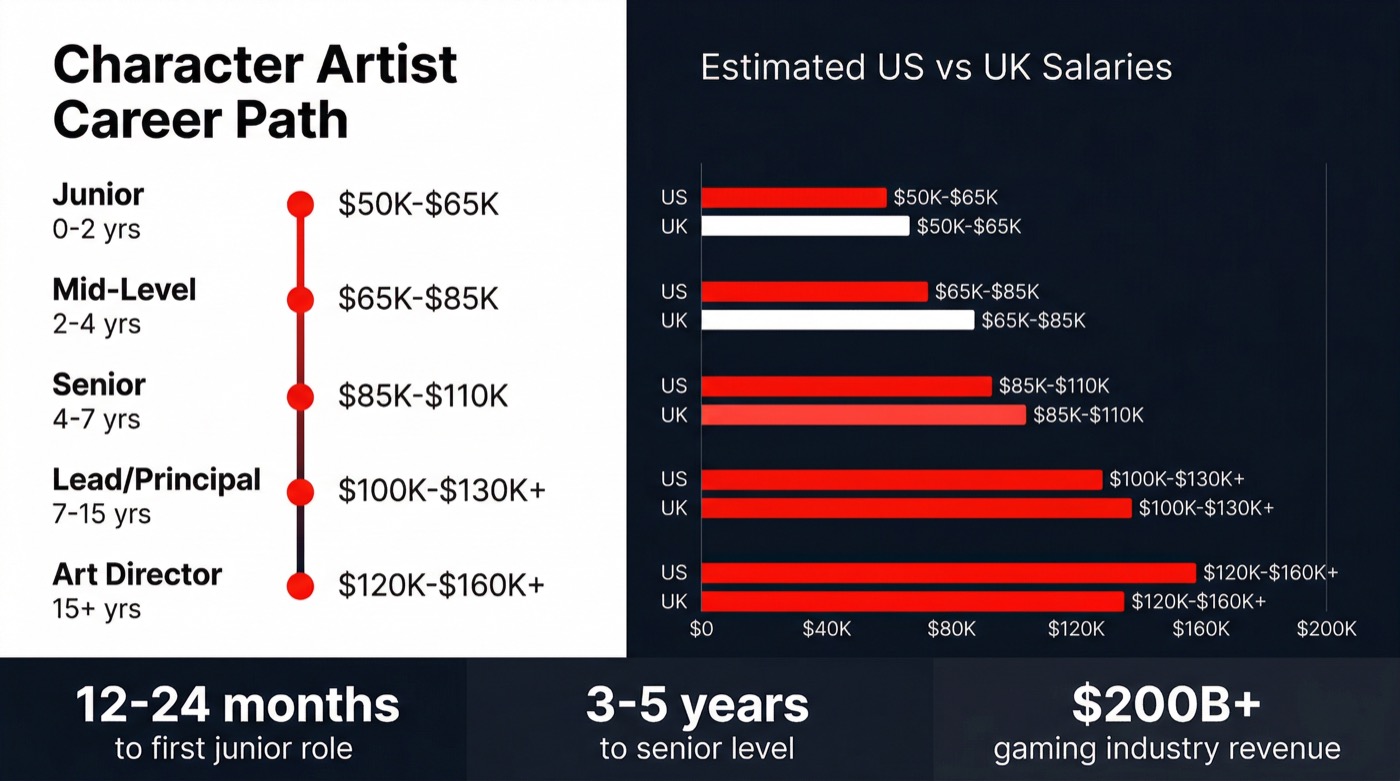
So what exactly does this career look like from day one to the top? A character artist career path progresses from Junior Artist (0-2 years) handling basic models and textures, through Senior Artist (4-7 years) delivering hero assets, to Lead or Art Director (7-15+ years) shaping entire project visions. Entry typically requires 12-24 months of focused practice and a portfolio of 3-5 polished pieces.
Whether you are a student, a hobbyist ready to go professional, or a digital artist looking to specialize, this guide covers everything you need: the full career ladder, salary expectations, must-have tools, portfolio strategy, and how AI is reshaping the role. Browse open character artist jobs on ArtBlast.
New to the field? Start with the complete beginner guide: How to Become a Character Artist.
What Does a Character Artist Actually Do?
Character artists create the 3D models of people, creatures, and characters used in games, film, and animation. The work spans concept interpretation, high-poly sculpting, retopology, UV unwrapping, PBR texturing, and engine integration. It is a role that blends artistic sensitivity with disciplined technical execution.
Unlike concept artists who draw ideas, character artists build them in three dimensions. A single game-ready character can take anywhere from a few days for a background NPC to several weeks for a hero asset, depending on complexity and fidelity requirements.
The discipline sits at the intersection of anatomy study, material science, and real-time rendering logic. According to CG Spectrum, a strong understanding of the full pipeline from modeling to texturing is one of the most common differentiators between candidates who land roles and those who do not.
The Character Artist Career Path: Stage by Stage
Career progression in this field is fairly well-defined, though the pace depends heavily on the quality of your practice and the feedback loops you build into your workflow. Here is a breakdown of each stage.
Junior Character Artist (0-2 Years of Experience)
At the junior level, you will work under supervision producing low-poly models, UV layouts, and basic texture sets. You are not expected to operate independently, but you are expected to iterate quickly on feedback. Most studios assign juniors to supporting characters, props with character elements, or specific parts of a larger asset pipeline.
The most common path into a junior role involves either a structured degree program, a focused online curriculum, or 12-24 months of disciplined self-directed study with consistent critique from a community like Polycount. Internships and freelance contracts for indie studios are the most reliable on-ramps.
Mid-Level Character Artist (2-4 Years of Experience)
At this stage, you work with greater autonomy. You are expected to own assets from brief to delivery, communicate effectively with art directors, and problem-solve within pipeline constraints. Topology quality, texture optimization, and engine compatibility become your daily metrics of success.
This is also where specialization begins to pay off. Artists who develop a recognizable strength in either realistic characters or stylized characters start to command better project selection and higher rates.
Senior Character Artist (4-7 Years of Experience)
Senior artists carry full responsibility for hero character assets, the most complex and visible models in a production. You contribute to style guides, mentor juniors, and often collaborate directly with directors and leads on design decisions. The expectation here is not just technical mastery but taste and judgment.
Shipping successful titles is the clearest milestone at this level. Studios look for artists who have shipped and can point to their work in released products.
Lead, Principal, and Art Director (7-15+ Years of Experience)
Leadership roles shift the focus from making to enabling. Lead and Principal artists manage pipelines, review team output, and solve the hardest technical or creative problems. Art Directors define the visual language of an entire project, approving every character's look and directing the broader artistic team.
These roles demand strong communication and organizational skills in addition to deep craft knowledge. Artists who resist developing those soft skills often plateau at the senior level despite exceptional technical ability.
Salary Ranges Across the Character Artist Career Path
Compensation varies significantly by experience, studio size, and geography. The table below gives a realistic picture of what you can expect at each stage, based on current industry data.
| Career Stage | Years of Experience | US Salary Range | UK Salary Range |
|---|---|---|---|
| Junior Character Artist | 0-2 years | $50,000 - $65,000 | £25,000 - £35,000 |
| Mid-Level Character Artist | 2-4 years | $65,000 - $85,000 | £35,000 - £48,000 |
| Senior Character Artist | 4-7 years | $85,000 - $110,000 | £48,000 - £65,000 |
| Lead / Principal Artist | 7-15 years | $100,000 - $130,000+ | £60,000 - £80,000+ |
| Art Director | 15+ years | $120,000 - $160,000+ | £75,000 - £100,000+ |
US salaries run notably higher than UK and Danish equivalents, though cost of living and remote work opportunities are shifting those comparisons. Freelance rates can exceed staff salaries at the senior level, especially for artists with niche specializations or strong networks.
Core Skills and Tools You Must Master
The technical toolkit for character artists is fairly stable, but the depth of mastery required keeps rising. Studios in 2026 expect fluency across several interconnected disciplines, not just competence in one tool.
Essential Software
- ZBrush: Industry-standard sculpting tool for high-poly detail work, creature design, and surface refinement.
- Autodesk Maya: Primary package for polygon modeling, rigging basics, and animation-ready mesh preparation.
- Substance Painter: Leading PBR texturing application used across games and VFX pipelines globally.
- Marvelous Designer: Cloth simulation tool widely adopted for realistic costume and fabric creation.
- Unreal Engine or Unity: Real-time engine familiarity is increasingly mandatory, not optional, even for non-technical artists.
Foundational Knowledge Areas
- Human and creature anatomy for believable proportions and movement-ready forms
- Retopology principles for clean, deformation-friendly meshes
- PBR material theory including roughness, metalness, and subsurface scattering
- UV mapping and texel density management for efficient texture atlases
- Rigging fundamentals to understand how meshes will deform in animation
- Stylization techniques for both realistic and exaggerated aesthetics
How to Build a Portfolio That Gets You Hired
Your portfolio is your most important career asset, and the rules here are clear and consistent across the industry. Quality always beats quantity. A portfolio with three exceptional characters will outperform one with fifteen mediocre pieces every single time.
Step-by-Step Portfolio Building Plan
- Choose a clear style direction. Decide whether you are pursuing realistic characters, stylized characters, or creatures. Mixing all three weakens your signal to hiring managers looking for a specific fit.
- Select 3-5 pieces to develop fully. Each piece should demonstrate the complete pipeline: concept reference, high-poly sculpt, game-ready mesh, UV maps, textured render, and an in-engine or real-time capture if possible.
- Study and copy before you create. Spend time recreating characters from shipped games to understand professional standards. This trains your eye before your hands.
- Post work in progress, not just finals. Platforms like ArtStation reward process breakdowns. Hiring managers want to see how you think, not just what you produced.
- Seek structured critique relentlessly. Post on Polycount forums and join Discord communities. Unreviewed work improves slowly. Critiqued work improves fast.
- Update your portfolio every 3-6 months. Replace your weakest piece regularly. A portfolio should never feel static.
AI and the Future of the Character Artist Career Path in 2026
The arrival of AI tools in creative pipelines has generated anxiety in some corners of the industry. The reality, based on current hiring trends and studio workflows, is more nuanced and frankly more interesting.
AI in 2026 primarily handles repetitive, time-consuming tasks such as concept variation generation, texture tiling, photogrammetry cleanup, and procedural prop generation. This frees character artists to focus on the work that requires genuine human judgment: storytelling through design, subtle emotional expressiveness, cultural authenticity, and stylistic coherence.
Studios using procedural generation pipelines in AAA productions are actually increasing their demand for artists who understand how to art-direct AI outputs rather than just execute tasks manually. The artists who thrive will be those who treat AI as a collaborator and develop the taste and leadership skills to guide it effectively.
There is no current data suggesting net job displacement. In fact, the complexity of characters in modern games, combined with the growing number of studios, suggests the opposite trajectory.
Alternative Paths and Pivot Options from Character Art
The character artist career path does not have to be linear. Many experienced character artists successfully transition into adjacent roles that leverage their existing skills while opening new opportunities.
- Technical Artist: Bridges art and engineering, optimizing pipelines, writing shaders, and solving real-time rendering challenges. A natural pivot for artists with strong engine knowledge.
- Rigging Artist: Specializes in the skeleton and control systems that bring characters to life. Character artists with rigging fundamentals have a head start.
- Art Director: The leadership track within character art itself, ideal for those who develop strong visual judgment and communication skills over time.
- Freelance Consultant: Senior artists with strong networks often move into project-based freelancing, trading employment security for greater creative control and higher hourly rates.
- Educator or Mentor: Platforms and schools actively recruit experienced character artists to teach. This path suits those who find fulfillment in developing other artists.
Conclusion
The character artist career path rewards patience, structured practice, and a willingness to seek honest feedback. Here are the four things to carry with you from this guide:
- Entry is achievable in 12-24 months of focused work, but professional-level quality realistically takes 3-5 years of deliberate practice.
- Salaries range from $50,000 at the junior level to $130,000 and beyond at the lead and director levels, with meaningful variation by region.
- AI is not a threat to this career; it is a tool that shifts the value of human artists toward creative direction, taste, and leadership.
- Your portfolio, your network, and your consistency in seeking critique will do more for your career than any single course or tool.
The industry is growing. The demand is real. The only question is whether you are willing to put in the structured, deliberate work that separates professional artists from hobbyists.
Also see: Technical Artist Career Path: The Complete Guide
Looking for a character artist job? ArtBlast curates 10-60+ game art jobs daily. Subscribe at artblast.co/subscribe/?src=site and apply while the role is still fresh.
Frequently Asked Questions
How long does it take to become a character artist?
Most artists land their first junior role after 12-24 months of focused, full-time practice combined with consistent portfolio development and community critique. Reaching professional-level quality that meets AAA studio standards typically takes 3-5 years of dedicated work, regardless of whether you follow a formal degree program or a self-directed curriculum.
What software do character artists use?
The core toolkit includes ZBrush for sculpting, Autodesk Maya for polygon modeling, Substance Painter for PBR texturing, and Marvelous Designer for clothing and fabric. Familiarity with real-time engines like Unreal Engine or Unity is increasingly expected even at the junior level, as studios want artists who understand how assets will perform in production.
How much do character artists earn?
In the United States, character artist salaries range from approximately $50,000 for junior roles to $130,000 and above for leads and principals. Art Directors can earn $160,000 or more at large studios. UK salaries run lower, typically ranging from £25,000 at entry level to £80,000 or more in senior leadership positions. Freelance rates at the senior level often exceed staff compensation.
Do I need a degree to become a character artist?
A degree is not strictly required, but structured education significantly shortens the learning curve by providing curriculum guidance, peer feedback, and industry connections. Many successful character artists are self-taught, but they typically compensate by building rigorous self-directed schedules, seeking mentorship, and engaging heavily with communities like Polycount and ArtStation to simulate the feedback loops a formal program provides.
What is the difference between a character artist and a character designer?
A character designer typically works in 2D, creating the concept art, silhouettes, and visual language of a character before production begins. A character artist then takes that 2D concept and builds it as a fully realized 3D model optimized for games, film, or animation. In some studios, especially smaller ones, a single artist may perform both roles, but in larger productions these are distinct specializations.
Is the character artist career path affected by AI?
AI tools are being integrated into character art pipelines for tasks like concept variation, texture generation, and photogrammetry cleanup. However, current industry trends show no net displacement of character artists. Instead, demand is growing for artists who can art-direct AI outputs and apply human creative judgment. Artists with strong taste, leadership skills, and pipeline understanding are better positioned in an AI-augmented industry, not worse.
What makes a strong character artist portfolio?
A strong portfolio contains 3-5 fully finished character pieces that each demonstrate the complete pipeline from sculpt to textured, engine-ready asset. Quality matters far more than quantity. Each piece should show your process through breakdowns, and your portfolio should reflect a clear stylistic direction, whether realistic, stylized, or creature-focused, rather than attempting to cover every possible aesthetic equally.
See also: Character Artist Career Path: The Complete Guide
See also: What Does a Texture Artist Do? Roles, Tools & Career Guide