
Graphic Designer Salary Guide: What You'll Really Earn
Here is a surprising number: the difference between what a junior graphic designer earns and what a senior UX-focused designer takes home can exceed $70,000 per year, working in the same country. If you have ever wondered whether your paycheck reflects your actual market value, you are not alone. Compensation in creative fields has historically been opaque, and that gap hurts working designers most.
These are ArtBlast's own numbers, from the real graphic designer job postings we track across 600+ studio job boards. You will not find them anywhere else.
- 915 graphic designer openings tracked across 759 studios
- 23% of those roles were remote
- Only 11% of postings disclosed a salary range, the rest hid the number
- Most active markets: United States, India, United Kingdom
Source: ArtBlast game art job tracking, 2026. Using these figures? Please cite ArtBlast and link to this page.
This graphic designer salary guide gives you a clear, current picture of what designers earn across experience levels, industries, cities, and countries, so you can negotiate confidently, plan your next career move, or benchmark your team's offers against real data.
Quick Answer: According to the U.S. Bureau of Labor Statistics, the median U.S. graphic designer salary is $61,300 per year ($29.47/hour) as of May 2024. Most designers earn between $49,000 and $73,000, with higher pay in tech, major metros, and UX/UI specializations.
Key Findings: Graphic Designer Salary
- The official BLS median for US graphic designers is $61,300.
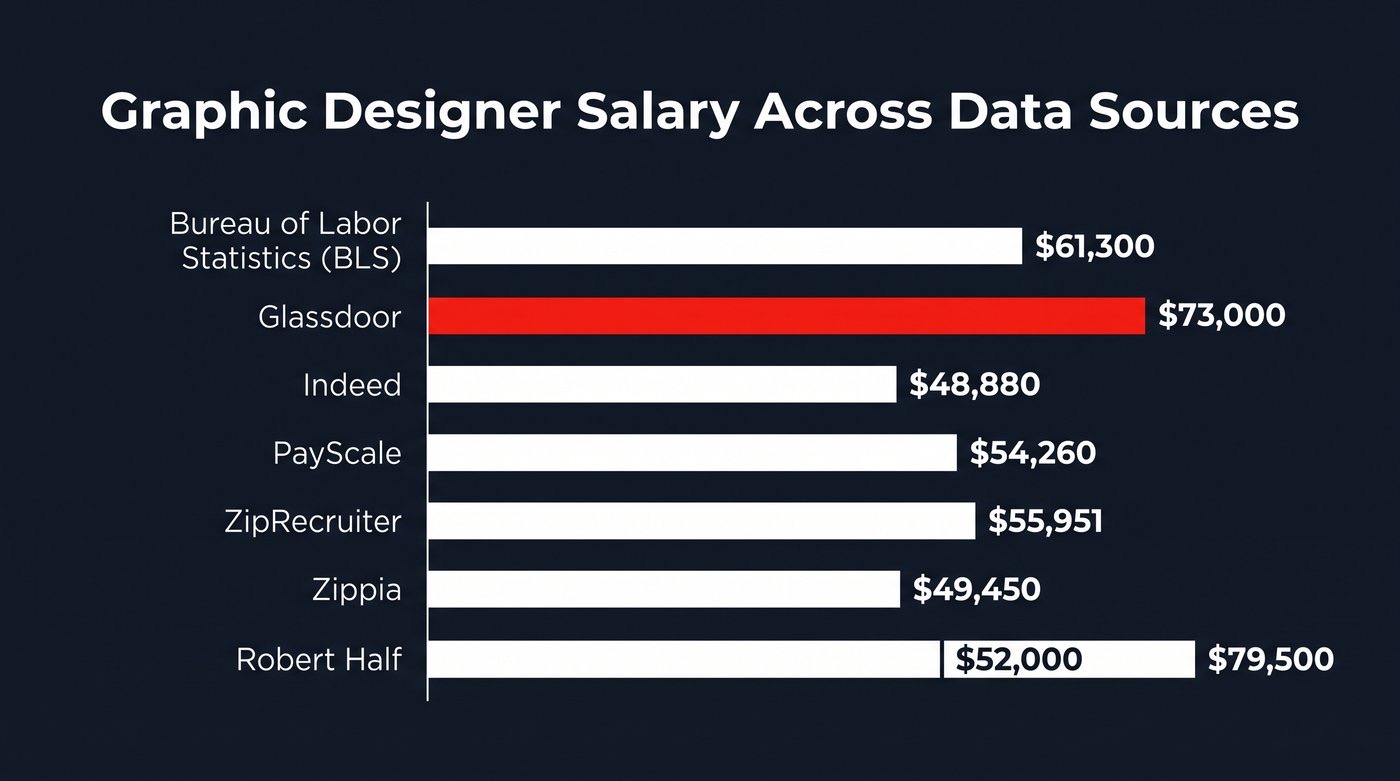
- Source averages range from $48,880 (Indeed) to $73,000 (Glassdoor).
- Robert Half benchmarks 2026 hiring at $52,000 to $79,500.
- The junior-to-senior UX-focused gap can exceed $70,000 per year.
- Motion, UX, and brand-system skills lift designers past the generalist ceiling.
U.S. Graphic Designer Salary Benchmarks for 2026
Salary data varies depending on the source, because different platforms use different methodologies. Some rely on employer-posted job listings, others on self-reported surveys, and others on government payroll records. Looking at multiple sources together gives you the most accurate picture.
Here is how the major platforms compare for a general U.S. graphic designer role in 2026:
| Source | Average / Median Annual Salary | Methodology |
|---|---|---|
| BLS (May 2024) | $61,300 | Official government payroll data |
| Glassdoor | $73,000 | Employee self-reported |
| Indeed | ~$48,880 ($23.50/hr) | Employer-posted and employee-reported |
| PayScale | $54,260 | User-reported compensation data |
| ZipRecruiter | $55,951 | Job posting aggregation |
| Zippia | $49,450 | Resume and job listing data |
| Robert Half (2026) | $52,000 to $79,500 | Recruiter and employer benchmarks |
The spread between these figures is wide, but that reflects real variation in the job market. Glassdoor data tends to skew toward larger employers and coastal cities, while Zippia captures a broader range of markets. The BLS median remains the most statistically reliable anchor point.
Salary Ranges by Experience Level
Experience is the single strongest predictor of graphic designer pay. As you build your portfolio, demonstrate results, and expand your skill set, your earning potential climbs significantly. Here is a realistic breakdown across career stages:
Entry-Level Graphic Designer (0 to 2 Years)
Most entry-level roles land between $39,000 and $55,000 annually. PayScale places the true entry-level average closer to $44,255, while BLS percentile data shows the bottom 10% of all designers earning around $35,430. Starting salaries are heavily influenced by location and whether you land an in-house or agency role.
Mid-Level Graphic Designer (3 to 5 Years)
With a few years of experience and a stronger portfolio, mid-level designers typically earn $56,000 to $75,000. PayScale reports early-career averages around $51,073, while Dice's tech-sector data puts experienced mid-level talent closer to the upper end of this band. This is also the stage where specialization starts to pay off significantly.
Senior and Lead Graphic Designer (6 or More Years)
Senior designers in strong markets can earn $76,000 to $95,000 or more. BLS data shows the top 10% of graphic designers earning above $100,920. Reaching this tier typically requires either deep specialization, leadership responsibilities, or both.
How Industry and Sector Affect Your Paycheck
Where you work matters just as much as how long you have worked. Industry sector creates some of the largest salary gaps in design, often independent of skill level or years of experience.
- Tech, software, and e-commerce: Consistently the highest-paying sectors. UI/UX designers embedded in product teams often earn $85,000 to $112,000, well above the general graphic design median.
- Agencies and creative studios: Pay varies widely by agency size and client roster, typically ranging from mid-$50,000s to low-$80,000s for experienced designers.
- Non-profits and publishing: These sectors tend to lag despite requiring comparable skills. AIGA survey data shows non-profit visual arts roles averaging around $60,000, versus $65,000 in comparable for-profit positions. Museum roles often fall in the $45,000 to $78,000 range.
- In-house corporate roles: Generally offer more stability and benefits packages that offset slightly lower base pay compared to tech.
If maximizing salary is your priority, the data strongly points toward tech and digital product companies, particularly if you are willing to develop UX or motion design skills alongside traditional graphic design.
Top U.S. Cities for Graphic Designer Pay
Geography creates a 25 to 40 percent pay gap between designers working in major metros and those in rural markets, according to Dice. New York and San Francisco consistently lead national averages. Zippia data highlights these cities as top earners in the U.S.:
- Washington, D.C.: ~$63,052
- Boston, MA: ~$58,402
- Seattle, WA: ~$57,758
Keep in mind that higher nominal salaries do not always mean higher purchasing power. A $73,000 salary in San Francisco delivers far less in real terms than the same number in a mid-size Midwest city. Always factor cost of living into your comparison, especially if you are weighing remote opportunities.
Freelance Graphic Designer Rates: What to Expect
Freelancing introduces significant income variability, but it also creates the potential to out-earn salaried peers, especially when you specialize and build a strong client base. For those considering this path, understanding the journey of a freelance artist can provide valuable insights into building a sustainable creative business.
Typical Freelance Rate Ranges
Dice reports the average freelance graphic designer rate at approximately $35 per hour, with a realistic range of $25 to $100 or more depending on expertise. Generalist designers tend to cluster at the lower end, while specialists in motion graphics, brand identity systems, or design operations can command premium rates.
How to Estimate Realistic Annual Freelance Income
Hourly rates do not translate directly to annual income because freelancers also spend unpaid time on business development, admin, and between-project gaps. A practical rule of thumb is to assume 60 to 70 percent billable utilization across a full year. At $50 per hour with 60 percent utilization over 2,080 working hours, your effective annual income is roughly $62,400, close to the BLS median but with significantly more variability and overhead.
UK Graphic Designer Salaries for 2026
If you are working or hiring in the United Kingdom, the benchmarks look quite different. Creative Boom's 2026 salary guide reports an average graphic designer salary of approximately £29,000 in the UK, correcting older data that still cited a 2017 ONS figure of around £25,900.
Here is a practical breakdown of UK salary bands by level:
- Junior Designer: ~£24,000
- Mid-Level Designer: ~£33,000
- Senior Designer / Art Director: £39,000 to £42,000
- Creative Director (London or large agency): £50,000 and above
London roles carry a notable premium, but also come with higher living costs. Designers in regional UK cities like Manchester, Bristol, and Edinburgh earn meaningful salaries in the £28,000 to £38,000 range without the capital's cost-of-living burden.
How to Increase Your Graphic Design Salary: A Step-by-Step Approach
Data is only useful if you act on it. Here is a practical sequence for moving your compensation upward, whether you are employed or freelancing:
- Audit your current rate. Use at least three salary sources (BLS, Glassdoor, and Dice are good anchors) to establish your market range by experience level, city, and industry. Do this before any negotiation conversation.
- Identify a high-value specialization. UX/UI, motion design, design systems, and design operations consistently command higher pay than general graphic design. Even a foundational certification or portfolio addition in one of these areas signals upskilling to employers.
- Document your business impact. Salary increases stick when tied to outcomes. Track metrics like conversion rate improvements from redesigned assets, time saved through template systems, or brand consistency wins. Numbers make your case for you.
- Time your ask strategically. Annual reviews are table stakes. Stronger moments for negotiation include after delivering a successful high-visibility project, when accepting a role with expanded scope, or when you have a competing offer in hand.
- Build your network actively. Creative Boom's salary experts emphasize that referral-based opportunities frequently come with higher starting salaries and more negotiating flexibility than cold applications.
- Consider strategic job moves. PayScale data consistently shows that job changers out-earn those who stay put at the same employer. A well-timed move every two to three years remains one of the most reliable ways to accelerate income growth in design.
Job Outlook: What the Numbers Mean for Your Career
The BLS projects 2 percent employment growth for graphic designers between 2024 and 2034, slower than the national average across all occupations. That number sounds cautious, but context matters. The projection still translates to roughly 20,000 job openings per year, driven primarily by replacement of designers who retire, change careers, or move into adjacent roles.
AI tools are reshaping parts of the workflow, particularly for repetitive production tasks, basic layout work, and stock asset generation. But expert commentary from Dice and Creative Boom consistently points to the same conclusion: designers who develop skills in UX strategy, interactive design, motion, and AI-assisted workflows are not losing ground. They are moving into higher-value positions that general automation cannot replicate. Professional design tools like Adobe Photoshop continue to evolve with AI features that enhance rather than replace designer capabilities.
Specialization, not generalism, is the career hedge against slower overall market growth.
Key Takeaways from This Graphic Designer Salary Guide
Here is a summary of the most important points to carry forward:
- The current U.S. median is $61,300 (BLS, May 2024), with a realistic market range of $49,000 to $73,000 across most platforms.
- Experience level, industry sector, and city tier each independently drive significant pay variation; tech roles in major metros consistently lead the market.
- UX/UI designers regularly earn $85,000 to $112,000, demonstrating the premium that digital product specialization commands over generalist work.
- Freelancers average around $35 per hour, but effective annual income depends heavily on utilization and niche positioning.
- Active negotiation, portfolio-level specialization, and strategic career moves remain the most reliable levers for salary growth, regardless of overall market conditions.
Use this graphic designer salary guide as a living reference. Bookmark the BLS Occupational Outlook Handbook and revisit platforms like Glassdoor and PayScale each year, because the market moves, and so should your expectations.
Frequently Asked Questions
What is the average graphic designer salary in the U.S. in 2026?
The most reliable anchor is the BLS median of $61,300 per year as of May 2024. Across major salary platforms, the typical range sits between $49,000 and $73,000, depending on experience, location, and industry. Tech-sector and UX-focused roles push significantly higher, often exceeding $85,000 for experienced designers.
How much does an entry-level graphic designer make?
Entry-level graphic designers typically earn between $39,000 and $55,000 per year in the U.S. PayScale places the average starting salary around $44,255. Location and employer type have an outsized effect at this stage, with tech companies and coastal cities offering notably higher starting pay than non-profits or smaller regional markets.
Do graphic designers earn more working in-house or at an agency?
Neither consistently out-earns the other by a large margin, but the type of company matters more than the structure. In-house roles at tech companies often pay more than most agencies. Traditional creative agencies tend to offer mid-range salaries with strong portfolio-building opportunities, while non-profit in-house roles typically pay the least across all comparable experience levels.
What is the graphic designer salary in the UK?
The average UK graphic designer salary is approximately £29,000 in 2026, according to Creative Boom's industry guide. Junior designers start around £24,000, mid-level roles average £33,000, and senior designers or art directors earn between £39,000 and £42,000. Creative directors at London agencies can earn £50,000 or more.
How much do freelance graphic designers charge per hour?
Freelance graphic designers in the U.S. typically charge between $25 and $100 or more per hour, with an average around $35 per hour according to Dice. Rates depend heavily on specialization, experience, and client type. Motion designers, brand strategists, and UX-adjacent freelancers tend to command rates at the higher end of that range.
Is graphic design a good career in terms of pay and job growth?
Graphic design offers stable but modest growth, with the BLS projecting 2 percent job growth through 2034 and roughly 20,000 openings per year. Pay is competitive at mid-career and above, especially with specialization. Designers who add UX/UI, motion, or design systems skills regularly cross into salary bands of $85,000 to $112,000, making career trajectory more important than baseline entry-level pay.
Which graphic design specializations pay the most?
UX/UI design consistently pays the most among design-adjacent roles, with salaries ranging from $85,000 to $112,000. Motion graphics, product design, and design operations also command premiums above the general graphic design median. Specializations that connect design work directly to measurable business outcomes, such as conversion rate optimization or product growth, tend to attract the highest compensation across all sectors.