The game industry has hit $200+ billion in revenue and keeps growing. And here’s the thing most art schools won’t tell you: you don’t need a degree to break in as a game artist. Studios care about one thing above all else: your ability to create great art. Credentials come second.
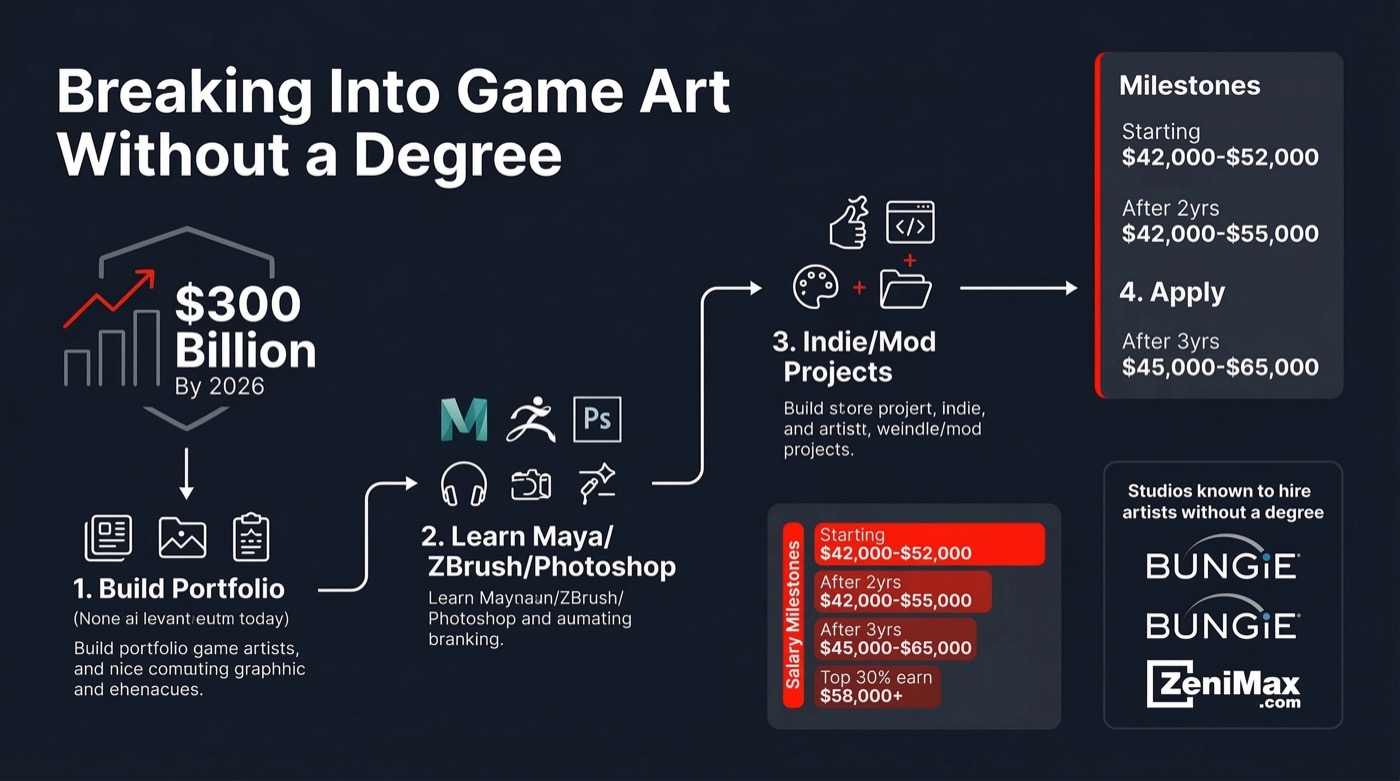
You can break into game art without a degree by building a professional portfolio showcasing your mastery of industry-standard tools like Maya, ZBrush, and Photoshop, combined with hands-on experience from indie projects or modding communities. Studios like Bungie and ZeniMax regularly hire talented artists based purely on demonstrated skill.
This guide reveals the exact pathways self-taught artists are using right now to land roles as 3D character artists, environment artists, and VFX specialists. Whether you’re 18 or 40, the game art field rewards talent over diplomas, and the demand has never been higher.
Why Game Art Is the Most Accessible Path in Gaming
Game art stands out as the most merit-based career path in the entire gaming industry. Unlike programming or production roles that often prefer formal education, art positions prioritize what you can create over where you learned to create it.
According to industry hiring data, studios assess candidates almost exclusively through online portfolios. Bungie’s Associate 3D Character Artist posting lists zero degree requirements, focusing instead on demonstrable skills in anatomy, texturing, and collaboration.
The numbers tell the story. Entry-level game art positions start around $42,000 annually, with clear advancement paths to specialized roles earning significantly more. As one industry insider put it: “If you can make the art, you can have the job.”
Essential Skills and Tools You Need to Master
Success in game art without a degree requires focused skill development in specific areas. Studios evaluate your technical proficiency through your portfolio, so understanding what to learn is critical.
Core Software Proficiencies
Industry-standard tools form the foundation of any game artist’s skillset. Mastering these applications signals to hiring managers that you can integrate seamlessly into their production pipelines.
- 3D Modeling Software: Maya and 3ds Max remain industry standards for creating characters, props, and environments
- Sculpting Tools: ZBrush dominates for high-resolution character and organic modeling work
- Texturing Applications: Substance Painter and Photoshop for creating realistic surface details and materials
- Game Engines: Unreal Engine or Unity knowledge demonstrates you understand how art functions in-game
Technical Knowledge Beyond Software
Raw software skills only tell half the story. Understanding production pipelines separates hobbyists from hireable professionals.
Learn the high-to-low poly workflow, where you create detailed models then optimize them for real-time game performance. Master UV mapping for proper texture application. Understand PBR (Physically Based Rendering) principles that modern games rely on for realistic lighting.
For character artists specifically, anatomy knowledge is non-negotiable. Studios expect you to create believable human and creature forms without constant reference checking.
How to Build a Portfolio That Gets You Hired
Your portfolio is your degree replacement, your resume, and your interview combined. It needs to prove you can deliver professional-quality work that fits into existing game projects.
What Studios Actually Look for in Portfolios
Quality crushes quantity every time. Five exceptional pieces outperform twenty mediocre ones, so focus your energy on creating portfolio work that showcases specific skills studios need.
Include only your absolute best work. Each piece should demonstrate technical competence, artistic vision, and understanding of game art constraints like polygon budgets and texture resolution limits.
Step-by-Step Portfolio Building Process
Building a professional portfolio follows a systematic approach that self-taught artists can implement immediately:
- Choose Your Specialization: Focus on character art, environment art, or VFX rather than trying to showcase everything
- Create 3-5 Hero Pieces: Develop fully realized assets that demonstrate your complete workflow from concept to final presentation
- Show Your Process: Include wireframes, texture sheets, and work-in-progress shots that prove you understand technical requirements
- Build a Demo Reel: Create a 60-90 second video showcasing your work with professional presentation and pacing
- Optimize for Online Viewing: Host on ArtStation or a personal website with fast loading times and mobile compatibility
- Update Regularly: Replace weaker pieces as your skills improve, keeping only work that represents your current ability level
Common Portfolio Mistakes to Avoid
Self-taught artists often sabotage their chances with preventable errors. Never include student work, fan art of copyrighted characters (unless exceptionally executed), or projects that don’t align with your target role.
Avoid generic fantasy characters and sci-fi soldiers unless they bring something genuinely unique. Studios see thousands of these and they rarely stand out.
Self-Taught Learning Paths That Actually Work
The internet has democratized game art education, making world-class training accessible without tuition costs. Strategic self-education can prepare you for professional work in 12-24 months of focused effort.
Free and Low-Cost Learning Resources
YouTube hosts thousands of hours of professional tutorials covering every game art discipline. Channels run by industry veterans provide insights that rival expensive courses.
Blender offers a completely free alternative to Maya for 3D modeling, with a massive community creating tutorials and plugins. While Maya dominates professionally, Blender skills transfer easily and prove you understand 3D fundamentals.
Free trials of Substance Painter, ZBrush, and other professional tools let you learn industry-standard software before committing financially. Many educational licenses offer deep discounts for self-directed learners.
Structured Learning vs. Tutorial Hopping
Random tutorial consumption creates knowledge gaps. Instead, follow structured learning paths that build skills sequentially from foundations to advanced techniques.
Dedicate your first 2-3 months to software fundamentals before attempting portfolio pieces. Master basic modeling, then texturing, then lighting in isolation before combining them.
Gaining Real Experience Without a Job
Experience creates a chicken-and-egg problem for newcomers, but game art offers unique opportunities to build genuine professional experience outside traditional employment.
Indie Game Projects and Modding Communities
Indie developers constantly seek artists for passion projects and small-budget games. While many don’t pay initially, they provide real production experience and portfolio pieces with context.
Modding communities for games like Skyrim, Fallout, or popular multiplayer titles offer immediate opportunities to create assets that thousands of players will actually use. This demonstrates both skill and ability to work within existing art styles.
Artists have landed positions at major studios like Blizzard after gaining recognition through fan communities and mod work. The key is treating these projects with professional seriousness.
Game Jams and Collaborative Projects
48-hour game jams force you to work under real production constraints with actual deadlines. Participating in events like Ludum Dare or Global Game Jam builds your network while creating finished projects for your portfolio.
These experiences teach you to scope work appropriately, collaborate with programmers and designers, and deliver functional assets under pressure—all skills studios value highly.
Understanding Different Game Art Career Paths
Game art encompasses multiple specializations, each with distinct skill requirements and career trajectories. Choosing your focus early accelerates your learning and portfolio development.
| Role | Primary Skills | Entry Salary Range | Portfolio Focus |
|---|---|---|---|
| 3D Character Artist | Anatomy, ZBrush, texturing | $42,000-$55,000 | 3-5 complete characters with expressions |
| Environment Artist | Architectural modeling, world-building | $40,000-$52,000 | Fully realized game environments |
| VFX Artist | Particle systems, shader work | $45,000-$59,000 | Demo reel of effects in-engine |
| Technical Artist | Scripting, optimization, pipeline | $50,000-$65,000 | Tools created, optimization examples |
3D Character Artists
Character artists create the heroes, villains, and NPCs that players interact with throughout games. This specialization demands strong anatomy knowledge and the ability to convey personality through form and texture.
Your portfolio should showcase different body types, ages, and styles. Include facial expressions and demonstrate you can work within technical constraints like polygon budgets for real-time rendering.
Environment Artists
Environment artists build the worlds players explore, from post-apocalyptic ruins to alien landscapes. This role combines architectural knowledge with natural environment creation and strong composition skills.
Portfolio pieces should tell environmental stories and demonstrate lighting knowledge. Show you understand how to guide player attention through visual design.
Visual Effects Artists
VFX artists create explosions, magic spells, weather effects, and all the dynamic visual elements that bring games to life. This specialization requires understanding of particle systems, timing, and how effects read during gameplay.
A VFX artist broke into the industry at 26 with no art degree by creating a strong demo reel through self-directed learning. Demo reels matter even more than static portfolios for this role since effects only shine in motion.
Networking and Breaking into the Industry
Technical skills open doors, but relationships often determine which doors you walk through. The game industry values community connections and proven collaboration ability.
Online Communities and Discord Servers
Active participation in game art communities provides feedback, mentorship, and job leads. ArtStation, Polycount, and specialized Discord servers connect you with working professionals who remember being in your position.
Share work-in-progress shots and accept critique graciously. Professionals notice artists who demonstrate growth mindset and willingness to improve.
Social Media Strategy for Artists
Twitter and LinkedIn aren’t just for sharing finished work—they’re for building your professional brand. Studios actively recruit through social media, and recruiters search hashtags for emerging talent.
Post regularly, engage with other artists’ work authentically, and participate in art challenges like #MaySketchADay or #Sculptober to increase visibility.
The Application Process Without a Degree
Applying to game studios without a degree requires strategic positioning that emphasizes your strengths while addressing the credential gap proactively.
Crafting Your Artist Resume
Your resume should emphasize portfolio link placement, technical skills, and relevant experience over education. List software proficiencies prominently and quantify achievements when possible.
Include indie projects, freelance work, and significant mod contributions as professional experience. Frame these accurately but confidently as legitimate production work.
Writing Cover Letters That Work
Strong cover letters demonstrate knowledge of the studio’s games and explain how your specific skills address their needs. Research their art style and mention specific aspects you admire or could contribute to.
Acknowledge your non-traditional path briefly, then pivot immediately to how your self-directed learning demonstrates initiative and passion. Studios value driven artists who stay current with industry trends.
Target the Right Opportunities
Entry-level positions and associate roles explicitly welcome candidates building their careers. ZeniMax’s Associate Producer posting prioritized 1-2 years of hands-on experience over formal education, a pattern common across art-adjacent roles.
Smaller studios and indie developers often prove more accessible than AAA giants for your first role. The experience gained translates fully when you’re ready to level up.
Overcoming Common Challenges
How to get into game art without a degree presents specific obstacles that preparation and persistence can overcome. Understanding these challenges in advance helps you navigate them strategically.
Handling the Credential Question
Some studios still list degree requirements in postings despite hiring non-degreed artists regularly. These often represent HR defaults rather than actual hiring manager requirements.
Apply anyway if your portfolio meets the technical requirements. Hiring managers care about capability, and exceptional portfolios override checkbox criteria consistently.
Managing Low Entry Salaries
Entry-level game art salaries around $42,000 may seem modest compared to other tech fields. However, rapid advancement potential and the value of industry experience make this initial investment worthwhile.
Many artists see 20-30% salary increases within 2-3 years as they specialize and build shipped game credits. Art directors and senior specialists earn six-figure salaries at major studios.
Dealing with Imposter Syndrome
Self-taught artists often doubt their legitimacy compared to traditionally educated peers. Remember that studios hired you for your demonstrable skills, not your educational pedigree.
Industry veterans confirm that portfolios trump degrees universally. Your work speaks for itself regardless of where you learned to create it.
Future-Proofing Your Game Art Career
The game industry evolves rapidly, with new tools and techniques emerging constantly. Continuous learning isn’t optional—it’s the price of staying relevant and competitive.
Staying Current with Industry Trends
Follow major studios on social media to see what techniques they’re showcasing. Attend GDC (Game Developers Conference) talks through free virtual options. Study AAA game releases for cutting-edge visual approaches.
Universities often lag behind industry trends, giving self-taught artists an advantage if you learn from current working professionals rather than academic curricula.
Building Toward Specialization
Generalists struggle to compete at higher levels. Develop deep expertise in character faces, hard-surface modeling, organic sculpting, or other niches that studios specifically seek.
Rare talent in specialized areas commands premium salaries and job security. Game designers note that exceptional design and art talent is far scarcer than programming skills.
Conclusion
Breaking into game art without a degree is not only possible—it’s increasingly common as the industry prioritizes demonstrable skill over credentials. The video game market’s explosive growth to $300 billion by 2026 creates unprecedented opportunities for self-taught artists willing to build professional portfolios and gain hands-on experience.
Success requires mastering industry-standard tools like Maya and ZBrush, creating a focused portfolio of exceptional work, and gaining real experience through indie projects or modding communities. Studios like Bungie and ZeniMax actively hire based on capability rather than education, making merit-based game art careers accessible to anyone with talent and dedication.
Start building your portfolio today, engage with artist communities, and remember that how to get into game art without a degree ultimately comes down to proving you can create the art that games need. Building a strong game art portfolio will speak louder than any diploma ever could.
Frequently Asked Questions
Can you really get a game art job without any degree?
Yes, game art is the most merit-based field in gaming, where portfolios matter far more than degrees. Studios like Bungie list no degree requirements for Associate 3D Character Artist positions, focusing instead on demonstrable skills with tools like Maya, ZBrush, and Photoshop. Industry hiring managers consistently state that if you can create professional-quality art, you can get hired regardless of educational background.
How long does it take to learn game art skills as a self-taught artist?
Most dedicated self-taught artists can build a hireable portfolio within 12-24 months of focused learning and practice. This timeline assumes 20-30 hours weekly spent learning software fundamentals, studying industry techniques, and creating portfolio pieces. Your first 2-3 months should focus on mastering basic 3D modeling and texturing before attempting complete portfolio projects. Consistent practice and structured learning accelerate progress significantly compared to casual tutorial consumption.
What is the starting salary for entry-level game artists without degrees?
Entry-level game art positions typically start around $42,000 annually for roles like junior 3D artists or associate environment artists. VFX artists often command slightly higher starting salaries around $45,000-$59,000 due to specialized technical requirements. While these salaries seem modest initially, game artists frequently see 20-30% increases within their first 2-3 years as they develop specializations and ship game titles, with senior artists and art directors earning six-figure salaries. For detailed compensation information across different specializations, check out our game artist salary guide.
Which game art specialization is easiest to break into without a degree?
Environment art and prop modeling offer relatively accessible entry points because they require less specialized knowledge than character work, which demands strong anatomy understanding. VFX artist roles also welcome self-taught artists who build strong demo reels, as one VFX artist successfully broke into the industry at 26 with no art degree through self-directed learning. However, choose your specialization based on genuine interest rather than perceived ease, since passion sustains the intensive learning required.
Do I need to know programming to work as a game artist?
No, game artists do not need programming knowledge for most art roles, contrary to common assumptions. While technical artists benefit from scripting skills and basic programming for tool creation and optimization work, pure art roles like character artist, environment artist, and even VFX artist focus on visual creation rather than code. Understanding how game engines like Unreal or Unity work helps you implement your art effectively, but this requires no actual programming ability.
What software should I learn first for game art?
Start with Blender for 3D modeling since it’s completely free and teaches fundamental 3D concepts that transfer to industry-standard tools like Maya. Once comfortable with 3D basics, learn Substance Painter for texturing and explore free trials of ZBrush for character sculpting. Finally, gain basic familiarity with either Unreal Engine or Unity to understand how your art functions in actual games. This progression builds skills sequentially without overwhelming financial investment while you’re learning.
How important is networking for getting a game art job without a degree?
Networking significantly impacts your chances of landing game art positions, especially without a degree to catch recruiter attention automatically. Many artists have secured positions at studios like Blizzard through connections made in modding communities, game jams, and online art forums. Active participation on platforms like ArtStation, Polycount, and game art Discord servers provides feedback, mentorship, and direct job leads from working professionals. Combine a strong portfolio with genuine community engagement for maximum effectiveness.
Looking for work? Browse open game artist jobs on ArtBlast, updated daily.