
Motion Graphics Salary Guide 2026: What You Should Actually Earn
The average motion graphics designer earns anywhere from $39,000 to over $150,000 per year in the U.S., yet most salary articles still cite outdated figures that lump interns alongside creative directors. If you have been lowballing your rate or accepting offers without context, this guide changes that.
These are ArtBlast's own numbers, from the real motion graphics artist job postings we track across 600+ studio job boards. You will not find them anywhere else.
- 913 motion graphics artist openings tracked across 655 studios
- 26% of those roles were remote
- Only 13% of postings disclosed a salary range, the rest hid the number
- Most active markets: United States, India, United Kingdom
Source: ArtBlast game art job tracking, 2026. Using these figures? Please cite ArtBlast and link to this page.
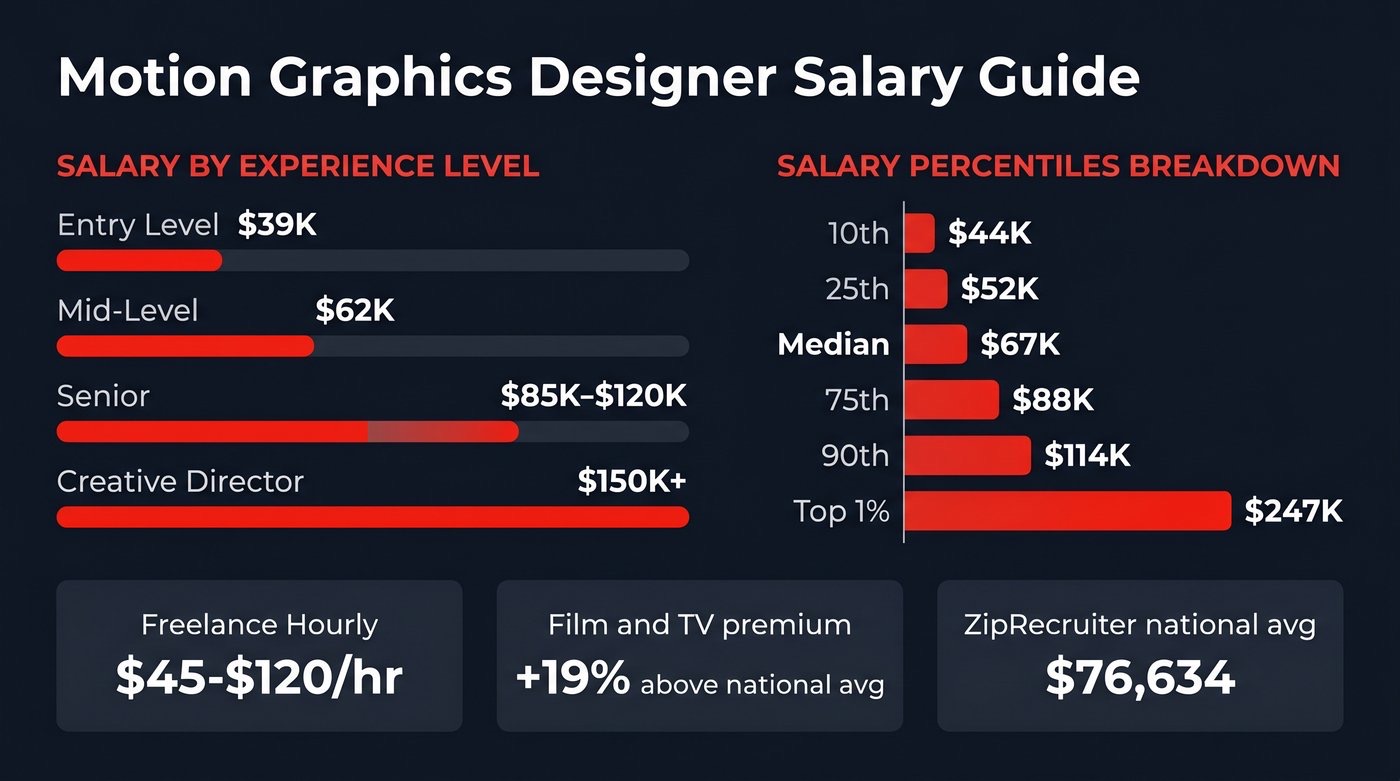
This motion graphics salary guide pulls from verified 2025 and 2026 data across ZipRecruiter, Zippia, LatHire, and Designity to give you accurate benchmarks by experience level, city, industry, and employment type. Whether you are freelance or full-time, entry-level or senior, you will find the exact numbers you need to negotiate with confidence.
Quick answer: In 2026, the typical U.S. motion graphics designer earns between $62,000 and $77,000 annually. Entry-level roles start near $39,000, senior designers earn $85,000 to $120,000+, and top-tier freelancers command $80 to $120 per hour.
The problem is that most salary aggregators blend wildly different roles into a single number. A junior contractor and a lead motion designer at a streaming studio are not the same job. This guide breaks down the real data so you can see exactly where you stand and what levers you can pull to earn more.
Motion Graphics Salary Benchmarks: The 2026 Numbers
Let's start with the core data. Multiple authoritative sources show a consistent range once you filter by role specificity. ZipRecruiter's June 2025 data puts the national average at $76,634 per year, while Zippia's October 2025 report lands at $62,558. The gap exists because ZipRecruiter weighs active job listings more heavily, skewing toward posted salaries at larger companies.
LatHire, which cross-references Bureau of Labor Statistics data with verified compensation reports, reports a median of $77,000 and a total compensation average of $146,000 for top earners, reaching as high as $247,000 when bonuses, equity, and benefits are included. Those top-tier numbers are not outliers. They reflect senior creative directors at major studios and software companies.
Salary Percentiles at a Glance
- 10th percentile: $44,000 per year
- 25th percentile: $52,000 per year
- Median (50th): $62,000 to $67,000 per year
- 75th percentile: $74,000 to $88,000 per year
- 90th percentile: $87,000 to $114,000 per year
- Top 1% (total comp): $150,000 to $247,000+
These figures tell a clear story. The median is a useful floor, not a ceiling. If you have specialized skills or work in a high-demand industry, sitting at the median means you are likely underpaid.
Salary by Experience Level: From Entry-Level to Creative Director
Experience is the single biggest driver of your salary as a motion graphics professional. The jump from entry-level to senior is not incremental. It can nearly triple your annual income within seven years.
| Experience Level | Years of Experience | Annual Salary Range | Hourly Rate |
|---|---|---|---|
| Entry-Level | 0 to 3 years | $39,000 to $60,000 | $19 to $29/hr |
| Mid-Level | 3 to 6 years | $55,000 to $90,000 | $26 to $43/hr |
| Senior Designer | 7+ years | $85,000 to $120,000 | $41 to $58/hr |
| Lead / Creative Director | 10+ years | $120,000 to $150,000+ | $60 to $120/hr |
Source: Zippia (Oct 2025), Designity (2026), LatHire (2025). Ranges reflect full-time employment before bonuses.
One insight that most guides skip: the mid-level range is the widest in the field. A three-year designer at a small agency in Idaho and a five-year designer at a software firm in Seattle can both call themselves mid-level, yet their salaries can differ by $35,000 or more. Your title means less than your industry and location.
Motion Graphics Salaries by City and State
Geography still commands a massive premium in this field, even as remote work expands. Washington State holds the top spot for average motion graphics pay, followed closely by California and Oregon. At the lower end, Georgia, South Carolina, and Idaho lag significantly behind national averages.
Top-Paying Cities for Motion Graphics Designers
- San Francisco, CA: $85,000 average, with a range of $56,000 to $147,000
- Seattle, WA: Among the highest state averages in the U.S.
- Los Angeles, CA: $64,000 average, with strong access to film and TV premium roles
- New York, NY: Competitive rates driven by advertising and media industry density
The San Francisco figure deserves context. At $85,000 average, SF salaries look impressive until you factor in cost of living. A designer earning $64,000 in a mid-sized city may carry more purchasing power than one earning $85,000 in San Francisco. If you are negotiating a remote role, use cost-of-living adjusted benchmarks, not raw city averages.
Salary by Industry: Where the Real Money Is
Your industry matters almost as much as your city. Motion graphics designers who move into film, TV, or software development consistently out-earn those in generalist agency roles.
Industry Salary Comparison
- Film and TV: $92,000 median, representing a 19% premium over the national average (LatHire, 2025)
- Software and Tech: $82,000 average
- Advertising: $74,000 average
- Media and Broadcasting: $71,000 average (CBS Sports, SiriusXM benchmark data)
- Generalist / Agency: $60,000 to $65,000 average
Specialized roles also command higher pay within these industries. A 2D Character Designer averages $83,000 annually, while a Head of Motion Design at a streaming company can push well past $120,000. Niche expertise pays in this field.
Freelance vs. Full-Time: Which Pays More in 2026?
Freelancing has surged since 2022, and that trend is accelerating. The post-pandemic shift toward contract work has pushed freelance motion graphics rates up significantly, especially for senior talent. According to Designity's 2026 outlook, senior freelancers now command $80 to $120 per hour, representing an increase driven partly by talent shortages and partly by the rising cost of specialized AI-integrated workflows.
How to Calculate Whether Freelance Beats Full-Time for You
- Identify your target hourly rate. Take your desired annual salary and divide by 1,040 (billable hours in a typical freelance year, accounting for downtime and admin). A $80,000 goal requires roughly $77 per hour.
- Add a 30% overhead buffer. Freelancers pay self-employment tax, health insurance, and software costs out of pocket. Your rate must account for these before it becomes equivalent to a salaried offer.
- Factor in your pipeline stability. A freelancer with consistent retainer clients in a high-demand city will out-earn most full-time salaries. One with irregular work will not.
- Compare total compensation, not just base pay. Full-time roles at major companies include equity, 401(k) matching, and benefits that can add $20,000 to $40,000 in real value annually.
The average freelance motion graphics designer earns around $65,000 per year, but that number masks wide variance. Top freelancers operating as independent studio owners bill $1,000 per hour or more for lead creative work. School of Motion describes the best-positioned freelancers as running full small businesses, not just taking gig work. For insights into building this type of career path, see our guide to The Journey of a Freelance Artist.
Skills That Boost Your Motion Graphics Salary
Not all tools are equal in the job market. Certain software specializations and creative skills carry measurable salary premiums in 2026. AI literacy is now one of the fastest-rising skill premiums in the field, as workflows shift and studios demand designers who can integrate generative tools without sacrificing craft quality.
- Cinema 4D proficiency: Pushes average salaries toward $66,000 to $83,000, outpacing After Effects generalists
- Interactive and UI motion design: Commands higher rates in software and product companies
- AI workflow integration: Increasingly required at creative director level, elevating senior comp packages
- Character animation: Specialized 2D/3D character work averages $83,000, a notable premium over standard motion roles
The takeaway is direct: generalist skills get you in the door. Specialized skills get you paid. If you are sitting at the median and want to move to the 75th percentile, adding a high-demand specialization is the most reliable path. For motion graphics work, Adobe After Effects remains the industry standard, though C4D skills command the highest premiums.
Conclusion: Know Your Worth and Negotiate Accordingly
This motion graphics salary guide exists because generic averages do not help you in a real salary negotiation. Here are the four key takeaways to carry forward.
- The national average of $62,000 to $77,000 is a starting point, not a ceiling. Senior designers and creative directors regularly earn $120,000 to $150,000+.
- Location and industry are your two biggest salary levers after experience. Film, TV, and software consistently pay more than generalist agencies.
- Freelancing can out-earn full-time work at the senior level, but only with a stable pipeline and proper rate calculation that accounts for overhead and taxes.
- Specialized skills in Cinema 4D, character animation, and AI-integrated workflows are the fastest path to above-median earnings in 2026 and beyond.
Use these benchmarks to enter your next negotiation prepared. The data is on your side. For comparison with related roles, check out our guides on Animation Artist Salary Guide and VFX Artist Salary Guide.
Frequently Asked Questions
What is the average motion graphics designer salary in the U.S. in 2026?
The average U.S. motion graphics designer salary in 2026 ranges from $62,000 to $77,000 per year, depending on the source and methodology. ZipRecruiter's most recent data cites $76,634, while Zippia reports $62,558. The difference comes from how each platform weights active job postings versus self-reported salaries. BLS-aligned sources place the overall median closer to $77,000.
How much do motion graphics designers earn as freelancers vs. full-time employees?
Full-time motion graphics designers earn $62,000 to $120,000+ annually depending on experience and industry. Freelancers average around $65,000 per year overall, but senior freelancers command $80 to $120 per hour. Freelancing pays more at the top end of the market, but full-time roles include benefits and equity that can add significant value to the total compensation package.
What skills increase a motion graphics designer's salary the most?
Cinema 4D, interactive motion design, AI workflow integration, and 2D character animation are among the highest-paying specializations in 2026. Designers with Cinema 4D expertise can earn between $66,000 and $83,000, outpacing After Effects generalists. AI literacy is increasingly valued at the creative director level, where it contributes to above-average total compensation packages exceeding $120,000.
What is the highest-paying city for motion graphics designers?
San Francisco is currently the highest-paying city for motion graphics work, with an average salary of $85,000 and a range stretching from $56,000 to $147,000. Washington State holds the top spot at the state level. However, cost-of-living adjustments can reduce San Francisco's real-world advantage significantly compared to lower-cost cities like Austin or Denver.
How much do entry-level motion graphics designers make?
Entry-level motion graphics designers with zero to three years of experience typically earn between $39,000 and $60,000 per year, or roughly $19 to $29 per hour. Location and industry affect starting salaries significantly. An entry-level designer at a tech company in Seattle will likely out-earn a peer at a regional agency, even at the same experience level.
Is motion graphics design a growing career field?
Yes. Demand for motion graphics talent is growing alongside the expansion of streaming platforms, social media video content, and digital advertising. The film and TV sector pays a 19% premium over national averages, and industry projections for 2026 forecast continued growth, particularly for senior freelancers and creative directors with AI-integrated skill sets and specialized animation expertise.
How much do senior motion graphics designers earn per year?
Senior motion graphics designers with seven or more years of experience earn between $85,000 and $120,000 annually in full-time roles. Leads and creative directors can exceed $150,000, with total compensation packages at top companies reaching $247,000 when bonuses and equity are included. Freelance senior rates range from $80 to $120 per hour based on Designity's 2026 industry projections.