What if the salary data you’ve been reading underestimates Technical Artist earnings by nearly $130,000? While generic job sites report averages around $70,000 to $78,000, verified profiles from leading gaming and tech companies reveal total compensation packages reaching $200,000 to $300,000 or more.
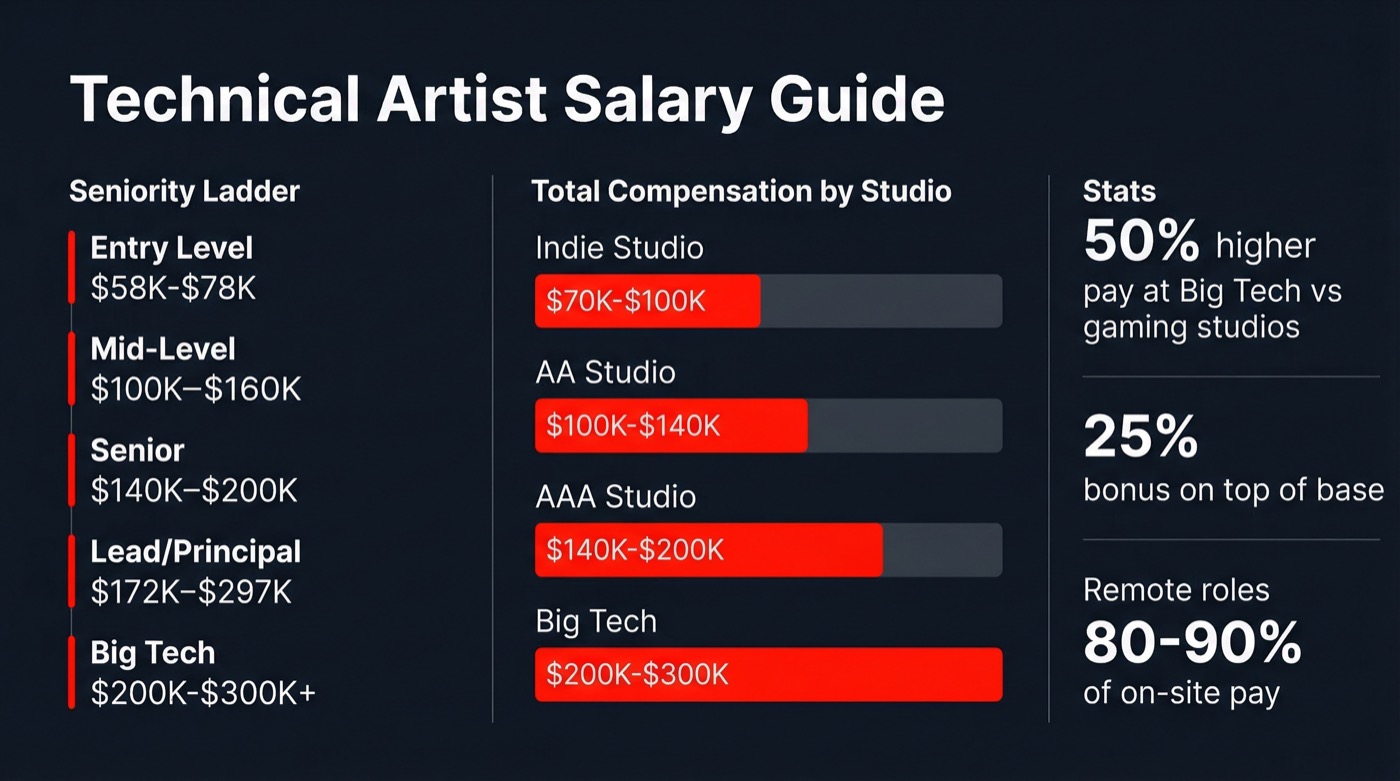
This Technical Artist Salary Guide cuts through outdated averages to reveal what professionals actually earn in 2026. Technical Artists who bridge art and engineering command premium pay in gaming, VFX, and Big Tech, where demand for hybrid skill sets has never been higher.
Whether you’re negotiating your first offer, considering a career switch, or recruiting top talent, understanding the full compensation picture including base salary, stock options, and bonuses is critical. According to verified industry data, the gap between entry-level and senior Technical Artists can exceed $200,000 in total compensation.
Understanding Technical Artist Compensation in 2026
The wide variance in reported Technical Artist salaries stems from a fundamental problem: most sources only track base salary while ignoring stocks, bonuses, and location premiums. This creates a distorted picture of actual earning potential.
Real compensation data from 31 verified Big Tech and gaming profiles shows the median total compensation sits at $216,000, with ranges from $173,000 to $301,000. Meanwhile, traditional salary aggregators report averages between $70,829 and $77,631, reflecting base-only figures from smaller studios and non-tech companies.
The difference matters enormously for career planning and negotiations. A Technical Artist at a FAANG-level company in Los Angeles might earn $229,000 in base salary alone, before adding $58,000 in annual stock vesting and $34,000 in performance bonuses.
Technical Artist Salary Ranges by Experience Level
Career progression for Technical Artists follows distinct compensation tiers. Understanding these benchmarks helps you gauge whether your current compensation is competitive or if you’re leaving money on the table.
Entry-Level Technical Artists (0-3 Years)
Starting Technical Artists with bachelor’s degrees typically earn between $100,000 and $160,000 in total compensation at tech and gaming companies. Base salaries start around $70,000 to $90,000 at smaller studios, but new graduates joining major gaming studios or tech companies can command $100,000+ base from day one.
Entry positions focus on asset optimization, shader development, and pipeline support. Even at this level, location dramatically impacts pay, with coastal tech hubs offering 30-50% premiums over other markets.
Mid-Level Technical Artists (4-7 Years)
With proven experience in pipeline development and cross-functional collaboration, mid-level Technical Artists see substantial compensation increases. Total compensation typically ranges from $140,000 to $200,000, with IC4 and IC5 level positions earning $133,000 to $172,000.
At this stage, professionals develop specialized expertise in areas like real-time rendering optimization, procedural content generation, or tool development. Stock compensation becomes more significant, often contributing 15-25% of total pay.
Senior and Lead Technical Artists (8+ Years)
Senior Technical Artists and leads command the highest compensation packages. Verified profiles show earnings from $167,000 to $297,000 in total compensation, with the top 10% exceeding $256,000 annually.
These roles involve architectural decisions, mentoring junior team members, and representing technical art needs in production planning. Masters degree holders in premium locations like Los Angeles and New York dominate this tier, often with total packages approaching or exceeding $300,000.
Geographic Impact on Technical Artist Salaries
Location remains one of the strongest predictors of Technical Artist compensation, even as remote work becomes more common. Tech hubs command significant premiums due to concentration of major studios and cost of living adjustments.
| Location | Base Salary Range | Typical Total Comp |
|---|---|---|
| Los Angeles, CA | $165,000 – $229,000 | $210,000 – $301,000 |
| New York, NY | $167,000 – $184,000 | $200,000 – $250,000 |
| San Francisco, CA | $133,000 – $180,000 | $190,000 – $280,000 |
| Seattle/Bellevue, WA | $113,000 – $157,000 | $150,000 – $220,000 |
| Cary, NC | $140,000 – $160,000 | $160,000 – $200,000 |
Los Angeles leads compensation due to its concentration of AAA gaming studios, major VFX houses, and entertainment tech companies. The city hosts multiple profiles earning above $200,000 in base salary alone.
Remote positions increasingly adopt location-adjusted pay scales, typically offering 80-90% of coastal salaries for candidates in lower cost-of-living areas. However, fully remote roles at top companies still pay competitively to attract the best talent regardless of location.
Breaking Down Total Compensation Packages
Understanding the components of Technical Artist compensation reveals why focusing solely on base salary misses the complete picture. Modern tech and gaming compensation includes multiple elements that significantly boost take-home value.
Base Salary
Base salary forms the foundation, ranging from $113,000 to $229,000 for professionals at established tech and gaming companies. This guaranteed annual income provides stability but represents only 50-70% of total compensation at higher levels.
Stock Compensation and Equity
Equity grants can add $0 to $58,000 annually in vested stock value. Public company Technical Artists receive Restricted Stock Units (RSUs) that vest over 3-4 years, while startup employees get stock options with potential for significant upside if the company succeeds.
Stock compensation becomes more substantial at senior levels and can create volatility in year-to-year earnings based on company performance. Top performers at FAANG-level companies often see equity refreshers that maintain or increase their stock income beyond initial grants.
Performance Bonuses
Annual bonuses typically range from $15,000 to $34,000, tied to individual performance and company profitability. Gaming studios often pay significant bonuses following successful game launches, while tech companies distribute bonuses based on quarterly or annual performance cycles.
These variable compensation elements mean actual year-to-year earnings can fluctuate 20-40%, with exceptional performance or successful projects driving total compensation well above base expectations.
How to Maximize Your Technical Artist Salary
Strategic career moves and skill development significantly impact earning potential. Here’s how to position yourself for top-tier compensation in this competitive field.
Step 1: Build Hybrid Technical Skills
Master both artistic tools (Maya, Blender, Substance 3D Painter) and programming languages (Python, C#, C++). Technical Artists who code custom tools and automate workflows command 20-30% salary premiums over those with art-only backgrounds.
Step 2: Specialize in High-Demand Areas
Focus on emerging technologies driving industry growth:
- Real-time rendering and optimization for Unity Pro and Unreal Engine 5
- AI integration for asset generation and workflow automation
- Procedural content generation using Houdini and node-based systems
- Shader development for next-generation visual effects
Step 3: Target Premium Employers and Locations
Geographic arbitrage creates opportunity. Relocating to Los Angeles, San Francisco, or New York can increase compensation by $50,000 to $100,000 compared to secondary markets. Remote positions at top-tier companies offer the best of both worlds when available.
Step 4: Negotiate Total Compensation, Not Just Base
When reviewing offers, evaluate the complete package. A $150,000 base salary with $40,000 in annual stock vesting and a $25,000 bonus ($215,000 total) beats a $170,000 base-only offer. Request detailed breakdowns showing:
- Base salary and review cycle expectations
- Initial equity grant, vesting schedule, and historical refresh practices
- Bonus structure, targets, and payout history
- Benefits value including health insurance, 401k matching, and perks
Step 5: Pursue Advanced Education Strategically
Masters degrees correlate with higher compensation at senior levels, particularly in computer science, technical art, or related fields. However, weigh the cost and time investment against 2-3 years of career progression and learning on the job.
Technical Artist vs. Related Roles: Salary Comparisons
Technical Artists occupy a unique position in the creative technology landscape. Understanding how compensation compares to adjacent roles helps clarify market value and career trajectory options.
Concept Artists average $77,800, focusing primarily on visual design without the technical pipeline responsibilities. VFX Artists earn approximately $77,000, specializing in effects creation but typically not handling tool development or optimization.
Character Artists command around $65,000 on average, working on asset creation without the engineering crossover that Technical Artists provide. The technical component and pipeline responsibilities clearly drive 30-40% salary premiums for Technical Artists compared to pure art roles.
On the engineering side, Graphics Programmers and Tools Engineers often earn similar or slightly higher compensation ($180,000 to $250,000 total comp), but require deeper computer science backgrounds and less artistic skill.
Industry Trends Shaping 2026 Compensation
Several converging factors are pushing Technical Artist salaries upward and reshaping the role itself. Understanding these trends helps you position for future opportunities.
AI Integration Driving Skill Premiums
Technical Artists who integrate AI tools into production pipelines command premium compensation. Skills in prompt engineering for generative AI, training custom models, and building AI-assisted workflows are increasingly valuable as studios race to adopt these technologies efficiently.
Talent Shortage in Gaming and VFX
The gaming market’s explosive growth has created sustained talent shortages. Companies compete aggressively for experienced Technical Artists, driving compensation increases of 15-25% for job changers with proven track records at successful studios.
Demographic data shows 16% of Technical Artists fall into the 26-31 age range and another 16% are 31-36, indicating a mid-career-heavy workforce. This age distribution suggests strong demand will continue as the field matures.
Remote Work Reshaping Geographic Pay
While premium locations still command highest salaries, remote work has expanded access to top-tier compensation. Technical Artists in lower cost-of-living areas can now access opportunities previously limited to coastal markets, though often at 10-20% discounts from full local rates.
Key Takeaways from This Technical Artist Salary Guide
Technical Artist compensation varies dramatically based on company type, location, and how you measure earnings. Generic salary sites showing $70,000 to $78,000 averages reflect base-only data from smaller studios, while verified Big Tech and gaming profiles reveal total compensation from $173,000 to $301,000.
Geographic location drives massive pay differences, with Los Angeles, New York, and San Francisco offering $100,000+ premiums over secondary markets. Premium positions include substantial stock compensation and bonuses that can add 30-50% to base salaries.
Career progression from entry-level to senior roles can triple total compensation, especially for professionals who develop deep technical skills, specialize in emerging technologies like AI integration, and target top-tier employers. Negotiating the complete compensation package rather than base salary alone is critical for maximizing earnings.
The field continues to grow as gaming, VFX, and real-time rendering expand. Technical Artists who bridge art and engineering will remain in high demand, with compensation trends pointing upward through 2026 and beyond.
Frequently Asked Questions
What is the average Technical Artist salary in the United States?
The average Technical Artist salary depends heavily on company type and location. Generic surveys report $70,000 to $78,000 base salary averages, but verified data from tech and gaming companies shows median total compensation around $216,000, including base salary, stock options, and bonuses. Entry-level positions start around $100,000 total comp, while senior roles reach $250,000 to $300,000+.
How much do Technical Artists make at top gaming studios?
Technical Artists at leading gaming studios and Big Tech companies earn substantially more than industry averages. Base salaries range from $113,000 to $229,000, with total compensation including stocks and bonuses reaching $173,000 to $301,000. The top 10% of earners exceed $256,000 annually, with premium locations like Los Angeles offering the highest packages.
What skills increase Technical Artist salary the most?
Programming ability creates the largest salary premium for Technical Artists. Proficiency in Python, C++, or C# for tool development and pipeline automation can boost compensation 20-30% over art-only skills. Additional high-value skills include real-time rendering optimization, procedural content generation, shader development, and AI integration for asset workflows. Masters degrees in technical fields also correlate with higher senior-level compensation.
Do Technical Artists earn more than regular 3D Artists?
Yes, Technical Artists typically earn 30-40% more than traditional 3D artists. While Character Artists average around $65,000 and Concept Artists earn approximately $77,800, Technical Artists command $100,000 to $300,000+ depending on experience level. The premium reflects their hybrid skill set bridging art and engineering, pipeline development responsibilities, and tool creation capabilities that pure art roles don’t require.
How does location affect Technical Artist salaries?
Location dramatically impacts Technical Artist compensation. Los Angeles offers the highest pay with base salaries from $165,000 to $229,000, followed by New York ($167,000-$184,000) and San Francisco ($133,000-$180,000). These coastal tech hubs pay 40-100% more than secondary markets. However, remote positions increasingly offer competitive compensation at 80-90% of full location rates, allowing geographic flexibility while maintaining strong earnings.
What’s included in Technical Artist total compensation?
Total compensation packages include base salary, stock options or RSUs, annual performance bonuses, and benefits. At tech and gaming companies, base salary represents 50-70% of total comp. Stock grants add $0-$58,000 annually in vested equity, while bonuses contribute $15,000-$34,000 based on performance. Benefits like health insurance, 401k matching (often 4-6%), and perks add additional value. Always negotiate the complete package rather than base salary alone.
Is Technical Art a good career in 2026?
Technical Art remains an excellent career choice in 2026 with strong growth prospects. The gaming market expansion, VFX industry growth, and increasing demand for real-time rendering across industries drive sustained need for Technical Artists. Compensation is competitive with software engineering while offering creative expression. AI integration is enhancing rather than replacing the role, with Technical Artists who adopt these tools commanding premium salaries. Talent shortages persist, giving skilled professionals significant negotiating power.
Looking for a technical artist job? ArtBlast curates 10-60+ game art jobs daily including technical artist jobs at top studios. Subscribe at artblast.co/subscribe and apply while the role is still fresh.