
Texture Artist Salary Guide: What You Can Really Earn
A senior texture artist at a AAA game studio can earn over $140,000 per year, yet some salary databases still list the average below $40,000. That gap is not a typo. It reflects how dramatically pay varies based on experience, specialization, and where you work. If you have ever searched for a reliable texture artist salary guide and walked away more confused than when you started, you are not alone.
These are ArtBlast's own numbers, from the real texture artist job postings we track across 600+ studio job boards. You will not find them anywhere else.
- 60 texture artist openings tracked across 36 studios
- 30% of those roles were remote
- Only 5% of postings disclosed a salary range, the rest hid the number
- Top hiring studios: Rodeo FX, Industrial Light & Magic, Creston Games, The Walt Disney Company, Ubisoft Toronto
- Most active markets: Canada, United States, United Kingdom
Source: ArtBlast game art job tracking, 2026. Using these figures? Please cite ArtBlast and link to this page.
A texture artist creates the surface detail that makes 3D models look real, stylized, or on-brand, including skin, fabrics, metals, and environmental wear, using tools like Substance Painter, Substance Designer, and Adobe Photoshop. In 2025, U.S. texture artist salaries range from roughly $48,000 for juniors to $140,000 for lead material artists, with an overall average near $82,000 to $87,000 depending on the data source.
This guide cuts through the conflicting numbers to give you a clear, role-specific breakdown. Whether you are just starting out, negotiating a raise, or hiring for your team, you will find the salary data, career variables, and skill-to-pay insights you actually need.
Key Findings: Texture Artist Salary
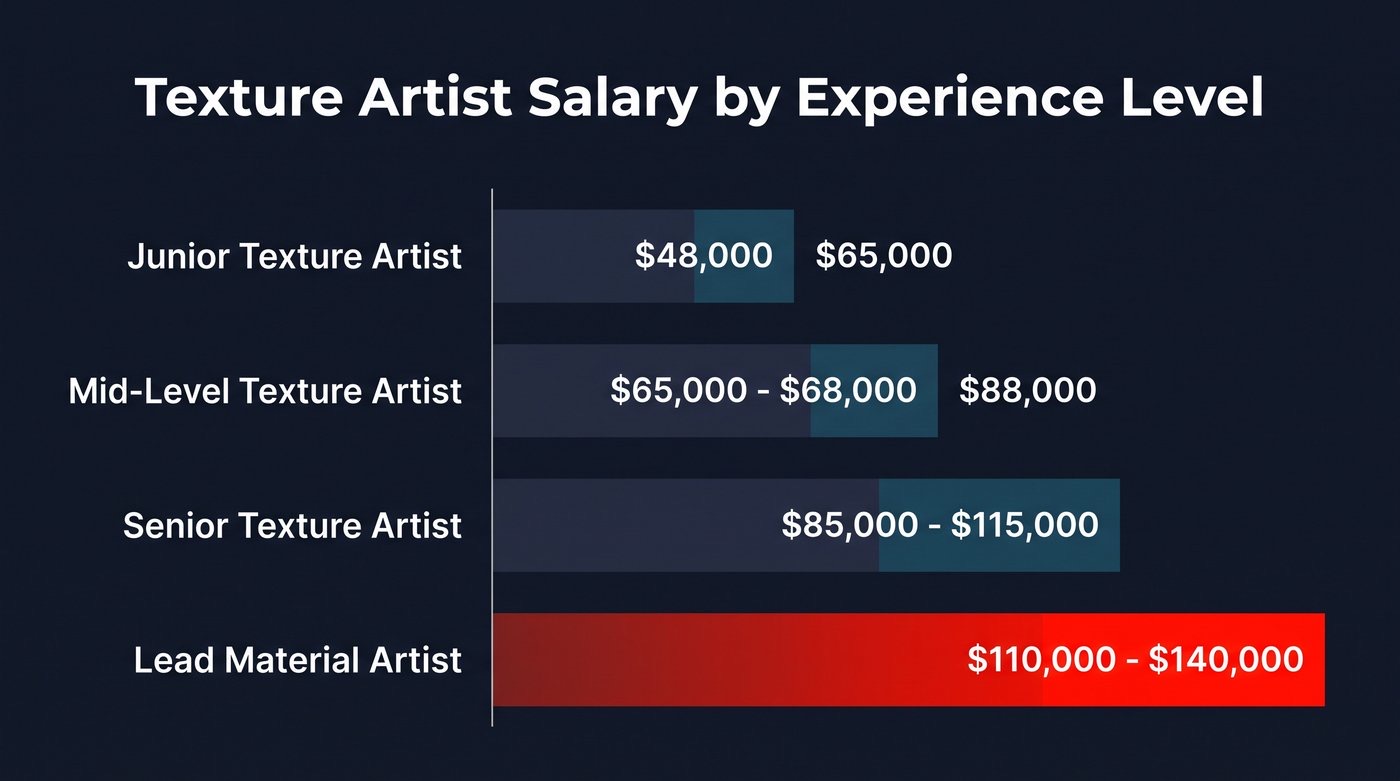
- Junior texture artists earn $48,000 to $65,000 in the US game industry.
- Mid-level earn $65,000 to $88,000; senior texture artists earn $85,000 to $115,000.
- Lead material artists reach $110,000 to $140,000.
- The US average sits between $82,000 and $87,200 depending on the data source.
- Substance Designer, real-time engine materials, and look development push artists to the top of the band.
What Does a Texture Artist Actually Do?
Before diving into the numbers, it helps to understand what the role covers, because job titles vary widely across studios. You may see the same work listed as texture artist, material artist, surfacing artist, or look development (look-dev) artist depending on the studio's pipeline.
At its core, a texture artist is responsible for all surface qualities of a 3D model. That includes UV mapping, painting color and detail maps, creating roughness and metalness data for physically based rendering (PBR), and researching real-world visual references for accuracy. They collaborate closely with modelers, lighters, VFX artists, and art directors to keep the look consistent across an entire production.
According to CG Spectrum, texture artists work across games, film, television, advertising, and architectural visualization. The tools may shift slightly by industry, but the core skill set, strong design fundamentals, deep color and material knowledge, and spatial awareness, remains consistent across all of them.
Texture Artist Salary Breakdown by Experience Level
Experience level is the single biggest driver of texture artist pay. The jump from junior to lead is not just incremental, it often represents a doubling of your base salary. Here is how the tiers break down using current U.S. game industry data from ArtBlast alongside broader market figures.
| Experience Level | U.S. Game Industry Range | Broader U.S. Market Range | Years of Experience (Typical) |
|---|---|---|---|
| Junior Texture Artist | $48,000 – $65,000 | $48,000 – $62,000 | 0 – 2 years |
| Mid-Level Texture Artist | $65,000 – $88,000 | $62,000 – $87,000 | 2 – 5 years |
| Senior Texture Artist | $85,000 – $115,000 | $87,000 – $112,000 | 5 – 9 years |
| Lead Material Artist | $110,000 – $140,000 | $100,000 – $131,000 | 8+ years |
ZipRecruiter's 2025 data for 3D texture artists confirms this spread, placing the 25th percentile at $56,500, the 75th percentile at $101,000, and top earners at $131,000 annually. Zippia's January 2025 report sets the overall U.S. average at $87,200, up from $79,100 in 2022, reflecting steady annual growth.
How Specialization and Skills Affect Your Salary
Not all texture artists earn the same at the same experience level. The tools you master and the workflows you specialize in can push your pay significantly higher within any given tier.
High-Value Skills That Command Premium Pay
- Substance Designer proficiency: Artists who build procedural materials from scratch, rather than painting by hand, are consistently noted by ArtBlast as earning toward the top of their salary band.
- Real-time engine expertise: Knowledge of Unreal Engine or Unity material systems, shader graphs, and performance optimization is increasingly required in games and interactive media.
- Look development (look-dev): Artists who own the full shading and lighting pipeline, not just texturing, are often reclassified into higher-paying look-dev or surfacing roles.
- Photorealistic material creation: Deep knowledge of PBR workflows, accurate surface micro-detail, and scan-based material integration is highly valued in film and AAA game productions.
- UV mapping and technical pipeline skills: Artists who can troubleshoot UV issues, optimize texture atlases, and support the broader technical art pipeline add measurable value beyond pure artistry.
The clearest path to a salary increase within texturing is to evolve from a painter into a material systems specialist. Studios increasingly need artists who understand both the artistic and the technical sides of surface creation, especially as real-time engines become the standard pipeline for film and games alike.
Salary Variations by Industry and Location
Industry Segment Comparison
Where you work matters as much as how long you have worked. The game industry, particularly AAA studios, offers the highest salary bands for texture and material artists. Film and VFX studios are competitive but often pay slightly less at the mid level. General 3D, advertising, and architectural visualization roles tend to fall lower, though freelance rates in those sectors can compensate.
- AAA Game Studios: Highest base salaries, structured career ladders, full benefits. Ranges align with ArtBlast's $48K to $140K game-specific data.
- Indie Game Studios: Lower base pay, often $40,000 to $70,000, but sometimes offset by profit sharing or equity at smaller companies.
- Film and VFX: Competitive mid-to-senior pay, often project-based or contract, with strong demand tied to the BLS-projected 16% job growth in special effects and animation.
- Advertising and Arch-Viz: More variable, often lower baseline than games, but high demand for photorealistic product and environment visualization.
Geographic Pay Differences
Location remains one of the most significant salary variables. U.S. hubs like Los Angeles, San Francisco, Seattle, and Austin pay premium rates for texture artists, especially near major game and VFX studios. ZipRecruiter notes that San Jose, CA consistently appears at the top of geographic pay data.
Outside the U.S., the picture shifts dramatically. PayScale reports the average UK texture artist salary at £24,500 per year in 2025, well below U.S. benchmarks. In India, AmbitionBox data shows texturing artist salaries averaging ₹4.7 lakhs per year (roughly $5,600 USD), with a range from ₹1.2 lakhs to ₹8.8 lakhs across industries and experience levels. Remote work is beginning to narrow this gap slightly, but studio location still drives the most significant pay differences globally.
How to Move Up the Salary Ladder as a Texture Artist
Understanding where the pay ceilings are is useful. Knowing how to break through them is more useful. Here is a practical step-by-step path to increasing your texture artist earnings over time.
- Build a specialization early. Rather than being a generalist texture artist, pick a niche, characters, environments, hard-surface, or organic materials, and develop a portfolio that demonstrates mastery in that area.
- Learn Substance Designer, not just Painter. Substance Painter is the industry baseline. Substance Designer, used to create procedural materials from scratch, is the skill that separates mid-level artists from senior and lead candidates.
- Get comfortable in a real-time engine. Add Unreal Engine or Unity to your workflow. Understanding material instances, shader complexity, and texture optimization budgets makes you valuable across both the art and technical sides of a team.
- Document your work with context. A portfolio piece is stronger when it shows your texture sheet, wireframe, reference research, and final render together. Studios want to see your problem-solving process, not just the result.
- Target your job search to industry segment. If salary is the priority, AAA game studios and major VFX houses offer the highest bands. Research specific studio pay ranges before negotiating, use tools like Glassdoor, Levels.fyi for game studios, and LinkedIn Salary to benchmark your offer against current market data.
- Negotiate on skills, not just years. Texture artist pay is heavily skill-driven. If you have Substance Designer, shader, or look-dev capabilities, make the case explicitly in your negotiation, these skills have a documented pay premium.
Why Salary Data for Texture Artists Varies So Widely
If you have Googled texture artist salaries before landing here, you have probably seen wildly different numbers. Comparably lists a U.S. average near $39,532. Zippia shows $87,200. ArtBlast's lead material artist band tops out at $140,000. All three are technically reporting on the same job. So what is going on?
The answer lies in data methodology. Platforms that aggregate self-reported salaries from all industries and company sizes tend to pull averages down because they include part-time roles, student positions, and non-entertainment 3D work. Role-specific platforms focused on the game industry, or job-posting aggregators like ZipRecruiter, reflect current market rates more accurately for full-time professional roles.
Salary data is also aging unevenly. Zippia's trend data shows texture artist pay grew 7.4% in 2022, 2.7% in 2023, 3.7% in 2024, and 3.1% in 2025, meaning figures from even two years ago can understate current pay by 10% or more. Always check the publication date of any salary source you reference during a job search or negotiation.
Conclusion: Know Your Worth as a Texture Artist
This texture artist salary guide covers a lot of ground because the role itself covers a lot of ground. Here are the key takeaways to keep with you:
- U.S. texture artist salaries in 2025 range from roughly $48,000 at entry level to $140,000 for lead material artists at AAA game studios.
- The overall U.S. average sits between $82,000 and $87,200 depending on the data source, and it has been rising consistently year over year.
- Specialization in Substance Designer, real-time engines, and look development is the most reliable way to access the upper salary bands.
- Job growth in the broader special effects and animation category is projected at +16% by the U.S. Bureau of Labor Statistics, demand for surface and material specialists is only increasing.
Whether you are benchmarking your first salary offer or planning your next career move, the data is clear: texture and material artists who develop technical depth alongside their artistic skills have strong earning potential and a growing number of high-paying opportunities waiting for them.
Frequently Asked Questions
How much does a texture artist make per year in the U.S.?
In 2025, U.S. texture artists earn an average of $82,000 to $87,200 per year depending on the data source. Entry-level roles start around $48,000, while senior texture artists earn $85,000 to $115,000. Lead material artists at AAA game studios can earn $110,000 to $140,000 annually. Location, industry segment, and specialization all significantly affect where within that range you fall.
What is the difference between a texture artist and a material artist?
The titles are often used interchangeably, but material artist typically implies a higher level of technical specialization. Material artists frequently work with procedural tools like Substance Designer and real-time engine shader systems, which require deeper technical knowledge. In game studios, the material artist or lead material artist title often reflects a more senior, higher-paying position within the same career track as texturing.
Do texture artists earn more in games or film?
AAA game studios generally offer the highest base salaries for texture and material artists, often exceeding VFX and film productions at the mid-to-senior level. Film and VFX roles are competitive and can pay very well at the top end, but they are frequently project-based or contract, which adds income variability. Game studios tend to offer more stable salaries with structured career ladders and consistent annual growth.
What skills increase a texture artist's salary the most?
Substance Designer proficiency, real-time engine material systems (Unreal Engine, Unity), and look development experience consistently push artists toward the top of salary bands. Technical pipeline skills like UV optimization and shader troubleshooting also add value. Artists who can work procedurally and understand rendering performance budgets are especially sought after in game and interactive media production environments.
Is texture artist a good career in 2025?
Yes. The U.S. Bureau of Labor Statistics projects 16% job growth for special effects artists and animators, the occupational category that includes texture artists, well above the average for all occupations. Studios are expanding real-time pipelines, streaming content, and 3D production at a rapid pace. Texture artists who develop material and look-dev expertise are well-positioned for long-term career growth and strong earning potential.
How much do junior texture artists earn compared to senior texture artists?
Junior texture artists typically earn $48,000 to $65,000 in the U.S. game industry, while senior texture artists earn $85,000 to $115,000. That is roughly a 70% to 80% salary increase over the course of a career, with the steepest jumps happening when artists develop specialized skills like procedural material creation and real-time engine proficiency. Mid-level artists fall between $65,000 and $88,000.
What does a texture artist earn in the UK and India?
In the UK, PayScale reports an average texture artist salary of £24,500 per year in 2025, which is substantially lower than U.S. market rates. In India, AmbitionBox data shows texturing artists earning an average of ₹4.7 lakhs per year (approximately $5,600 USD), with a range from ₹1.2 lakhs to ₹8.8 lakhs depending on experience and industry sector. Remote work for U.S. studios can significantly increase earnings for artists in these markets.