
Weapon Artist Salary Guide: What You Can Really Earn
Senior weapon artists at top-tier FPS studios are now pulling in over $150,000 per year, and even entry-level roles are breaking the $50K floor in major North American markets. If you have ever wondered whether specializing in 3D weapons is worth the grind, this weapon artist salary guide breaks down exactly what the market is paying, why the numbers keep climbing, and how you can land yourself at the top of every range.
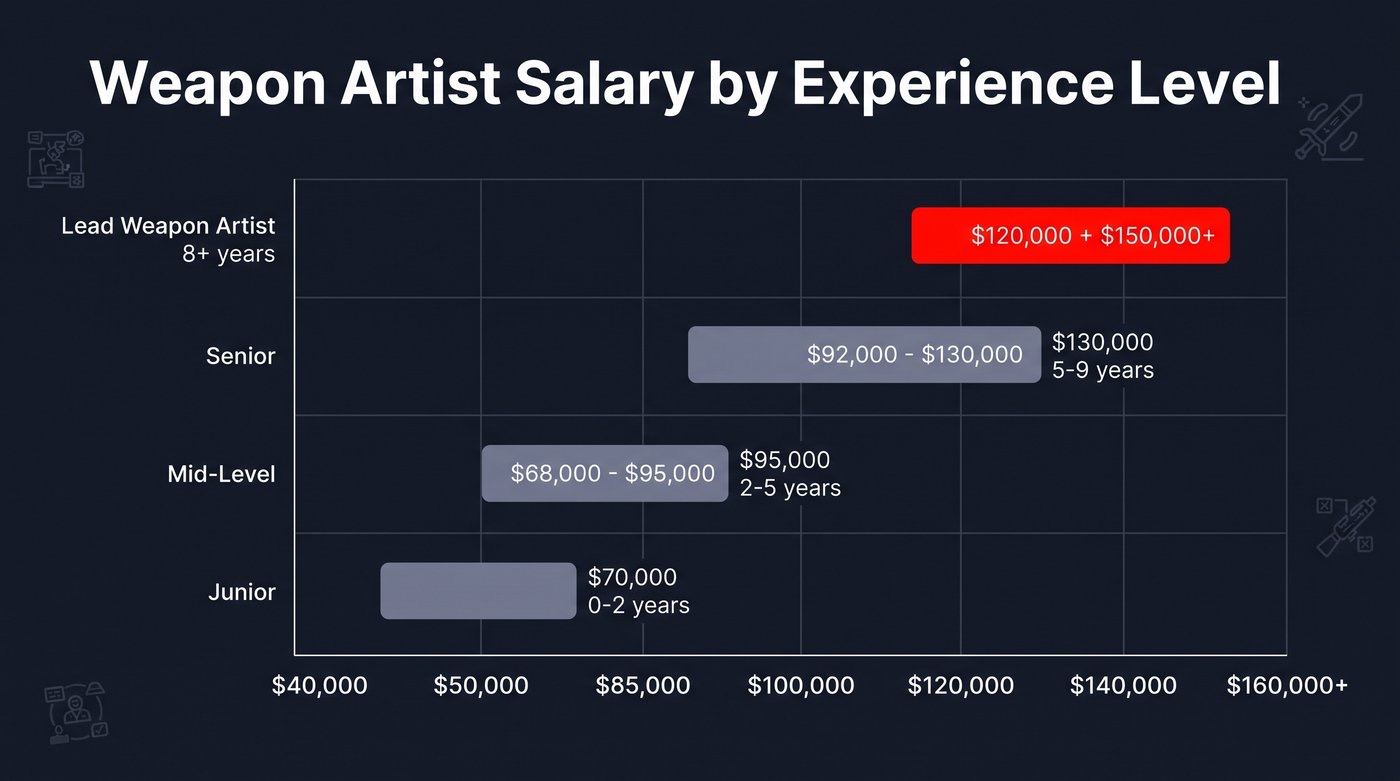
A weapon artist earns between $50,000 and $150,000+ per year in the United States, depending on experience level, studio type, and location. Freelance weapon artists typically charge $40 to $80 per hour. Senior and lead roles at AAA FPS studios consistently command the highest salaries due to demand for high-fidelity, first-person weapon view models.
The gap between a junior and a lead weapon artist paycheck is not just seniority points, it reflects a real scarcity of hard-surface specialists who understand PBR workflows, firearm mechanics, and engine integration at a production level. Whether you are mapping your own career path or trying to benchmark a competitive offer, the data below gives you a clear, current picture of the market.
Key Findings: Weapon Artist Salary
- Junior weapon artists earn $50,000 to $70,000 (0-2 years).
- Mid-level earn $68,000 to $95,000; senior weapon artists earn $92,000 to $130,000.
- Lead weapon artists reach $120,000 to $150,000+.
- Senior artists at top FPS studios clear $150,000.
- First-person asset fidelity, hard surface skill, and shipped FPS titles drive the premium.
Weapon Artist Salary by Experience Level
Experience is the single biggest factor in weapon artist compensation. Studios pay a steep premium for artists who can own a weapon pipeline end-to-end without supervision. Here is how the numbers stack up across career stages, based on 2024 to 2026 hiring data from ZipRecruiter's 3D Weapon Artist Hiring Guide and ArtBlast's 2026 salary tracker.
| Experience Level | Annual Salary Range (US) | Typical Years of Experience |
|---|---|---|
| Junior Weapon Artist | $50,000 to $70,000 | 0 to 2 years |
| Mid-Level Weapon Artist | $68,000 to $95,000 | 2 to 5 years |
| Senior Weapon Artist | $92,000 to $130,000 | 5 to 9 years |
| Lead Weapon Artist | $120,000 to $150,000+ | 8+ years |
Notice that the junior-to-lead pay range can more than double over a career. Community data from experienced 3D artists confirms that senior and principal-level specialists often earn twice what they made as juniors, and the biggest single salary jumps almost always come from switching studios rather than waiting for annual raises.
Junior Weapon Artist Salary
Junior roles typically sit between $50,000 and $70,000 per year. At this stage, studios prioritize portfolio quality and foundational skills in Maya, ZBrush, and Substance 3D Painter over years on a resume. A polished, focused portfolio of FPS-style weapon assets will consistently place you at the upper end of this band.
Mid-Level Weapon Artist Salary
Mid-level artists earning $68,000 to $95,000 are expected to work independently through the full modeling, UV, texturing, and engine-integration pipeline. At this stage, demonstrating PBR mastery and the ability to hit LOD targets without hand-holding is the minimum bar. Artists who also bring strong hard-surface silhouette design skills have real leverage to push toward the $90K ceiling.
Senior and Lead Weapon Artist Salary
Senior roles command $92,000 to $130,000, while lead positions frequently clear $120,000 to $150,000+. At these levels, studios expect ownership of weapon systems, mentorship of junior staff, and the ability to define pipeline standards. Specialists who add destruction simulation in Houdini, complex attachment systems, or realistic firearm mechanics knowledge are the candidates studios compete hardest to hire.
How Location Affects Weapon Artist Pay
Where you work, or where your employer is based, moves the needle significantly. High cost-of-living markets in California and British Columbia regularly exceed national averages by roughly 30 percent, according to ZipRecruiter's regional data. On the other end of the spectrum, remote roles show an average annual salary closer to $51,263, with top earners reaching around $72,000 depending on city and experience level.
Austin, Texas, has emerged as a particularly compelling market for weapon artists. Studios like ZeniMax, Certain Affinity, and EA BioWare Austin are actively hiring, and ArtBlast's Austin-specific data shows mid-level artists earning $65,000 to $95,000 and senior artists earning $95,000 to $135,000. Texas has no state income tax, which effectively increases take-home pay compared to equivalent salaries in California or New York.
- High-pay markets: Los Angeles, San Francisco, Seattle, Vancouver (BC) - often 20 to 30 percent above national averages
- Strong mid-tier hubs: Austin, Raleigh, Montreal - competitive salaries with lower cost of living
- Remote roles: National average around $51,263, with significant variation by employer location policy
Freelance Weapon Artist Rates and Earning Potential
Freelancing offers flexibility and, for experienced specialists, higher effective hourly earnings than salaried roles. Weapon artists with strong portfolios typically charge between $40 and $80 per hour, with rates climbing toward the top of that range for FPS specialists and artists with realistic firearm knowledge. So what does that translate to annually?
- At $40/hr with 40 billable hours per week: approximately $83,000 per year before taxes and expenses
- At $60/hr with 35 billable hours per week: approximately $109,000 per year
- At $80/hr with 30 billable hours per week: approximately $124,000 per year
The key word there is billable. Freelancers need to account for unbillable time spent on client acquisition, admin, and project gaps. Realistically, most full-time freelance weapon artists should plan for 60 to 75 percent billable utilization when projecting annual income. With strong referral networks and a niche portfolio, top freelancers can consistently outpace even senior staff salaries. To learn more about establishing yourself in this career path, check out our comprehensive guide on the journey of a freelance artist.
Skills That Push Your Salary to the Top of the Range
Not all weapon artists earn the same at a given level, and skill stack is the clearest differentiator. Understanding which capabilities studios currently pay a premium for is one of the most actionable insights in any weapon artist salary guide.
Baseline Skills Every Weapon Artist Needs
- Hard-surface modeling in Maya, 3ds Max, or Blender
- High-poly sculpting and detailing in ZBrush
- PBR texturing in Substance Painter and Substance Designer
- Engine integration in Unreal Engine or Unity
- Clean UV unwrapping and LOD pipeline management
Advanced Skills That Command Premium Pay
Beyond the baseline, a handful of specializations consistently appear in high-salary job postings and are mentioned explicitly in premium hiring guides. Adding even one or two of these to your toolkit can shift you from the midpoint to the upper bound of your experience tier.
- Destruction simulation in Houdini: Highly sought after by studios building destructible environments and weapon interactions
- Complex attachment and modular weapon systems: Critical for modern military shooters with extensive customization features
- Realistic firearm mechanics knowledge: A direct differentiator for AAA military and tactical FPS titles
- Strong silhouette and design skills for fantasy/sci-fi: Expands your appeal beyond realistic military titles
- Technical art crossover skills: Shader creation, rigging for animation, and performance optimization
How to Negotiate a Higher Weapon Artist Salary
The salary ranges in this guide represent bands, not fixed numbers. Where you land within a band is almost entirely determined by how well you negotiate. Here is a step-by-step approach that works.
- Anchor with market data: Use specific figures from current sources like ArtBlast and ZipRecruiter. Saying "the current market range for senior weapon artists is $92K to $130K" is far more persuasive than a vague "I know I can get more elsewhere."
- Lead with your portfolio niche: If you specialize in high-fidelity FPS weapon view models or have shipped titles with over-the-shoulder weapon systems, name them. Niche experience justifies the upper end of any range.
- Quantify your impact: Where possible, connect your work to production outcomes. Faster iteration cycles, reduced revision passes, or clean engine-ready assets all have business value studios recognize.
- Consider the full package: Health, dental, vision, retirement contributions, and remote flexibility all have real dollar value. A $90K salary with full remote and generous benefits can easily beat a $100K on-site role in a high cost-of-living city.
- Be willing to move: Industry data consistently shows the biggest salary jumps come from changing studios. If you have been at the same studio for more than two years without a meaningful raise, the market likely has more to offer.
Weapon Artist Salary vs. Other 3D Art Specializations
How does weapon art pay compare to related 3D roles? The consensus from hiring platforms and community data is that weapon artists, alongside technical artists and character artists, sit above generalist 3D roles in most pay scales. The specialization premium is real, and it grows with seniority.
Generalist 3D artists often find that moving into a specialty, whether weapons, characters, or environments, opens up better-defined career ladders and salary progression. Weapon art, in particular, benefits from the sustained dominance of FPS games and realistic military shooters, which generate consistent demand for high-quality weapon assets across major AAA studios and growing indie teams alike. For a broader perspective on career advancement in the industry, our 3D artist career path guide explores how specialization impacts long-term earning potential.
Conclusion
The market for weapon artists is strong, specialized, and continuing to trend upward. Here are the four takeaways to keep front of mind from this weapon artist salary guide:
- Salaries range from $50K at the junior level to $150K+ for leads at top studios, with experience being the primary driver
- Location matters, with California and BC commanding 20 to 30 percent premiums, and Austin offering strong salaries with a tax advantage
- Freelance rates of $40 to $80 per hour can yield competitive annual income for experienced specialists with niche portfolios
- Advanced skills like Houdini destruction, modular attachment systems, and firearm mechanics knowledge are the clearest levers for moving to the top of any salary band
Whether you are just entering the field or evaluating your next studio move, the data is clear: specialization pays, portfolios open doors, and the artists who negotiate with market data in hand will always come out ahead. For guidance on building the portfolio that lands these high-paying roles, explore our detailed guide on how to build a game art portfolio in 2026.
Frequently Asked Questions
How much does a weapon artist make per year?
In the United States, weapon artists earn between $50,000 and $150,000+ per year depending on experience level. Junior artists typically start at $50K to $70K, mid-level roles pay $68K to $95K, senior positions reach $92K to $130K, and lead weapon artists at major studios can earn $120K to $150,000 or more annually.
What is the average hourly rate for a freelance weapon artist?
Freelance weapon artists with strong portfolios typically charge between $40 and $80 per hour. Rates toward the higher end reflect specialization in high-fidelity FPS weapon view models, realistic firearm knowledge, or complex modular weapon systems. ZipRecruiter's aggregated data lists an average hourly rate of around $24.65 for all weapon artist roles, including salaried positions converted to hourly equivalents.
Is weapon artist a good career in game development?
Yes. Weapon art is one of the more lucrative 3D specializations in game development, driven by consistent demand from FPS titles, military shooters, and action games. Specialized weapon artists typically earn more than generalist 3D artists, and the career ladder is well-defined from junior through lead. Strong portfolio focus and continuous skill development make it a highly viable and well-compensated career path.
How does location affect weapon artist salary?
Location significantly impacts pay. High cost-of-living markets like Los Angeles, San Francisco, and Vancouver, BC can pay 20 to 30 percent above national averages. Austin, Texas is a growing hub with senior salaries reaching $95K to $135K, plus a no state income tax advantage. Remote roles show a lower average around $51,263 per year, though top remote earners reach approximately $72,000 depending on employer policy.
What skills increase a weapon artist's salary the most?
Beyond baseline skills in Maya, ZBrush, and Substance Painter, the skills most associated with upper-range salaries include Houdini destruction simulation, modular weapon attachment systems, and deep knowledge of real-world firearm mechanics. Technical art crossover skills and strong design ability for fantasy or sci-fi weapons also command premiums. These specializations differentiate senior candidates in competitive hiring markets.
How do weapon artist salaries compare to other 3D art roles?
Weapon artists generally earn more than generalist 3D artists and are often grouped with character artists and technical artists as among the better-compensated specializations in game development. Senior and principal-level weapon artists can earn twice the salary of junior generalist 3D artists. Specialization, niche portfolio focus, and the technical demands of weapon pipelines all contribute to this pay premium.
How can I increase my weapon artist salary quickly?
The fastest path to a higher salary is typically changing studios rather than waiting for internal raises, according to industry veteran accounts. Additionally, narrowing your portfolio to a high-demand niche like FPS weapon view models, adding advanced skills such as Houdini or modular attachment systems, and negotiating with current market data from platforms like ZipRecruiter and ArtBlast all have a meaningful and immediate impact on your earning potential.