
Hard Surface Artist Salary Guide: What You Can Earn
A senior hard surface artist at a AAA game studio can earn more than $130,000 per year, while someone with the same job title at a smaller shop might take home half that. If you are a digital artist trying to figure out where you stand, or how to climb, this hard surface artist salary guide breaks down every level, format, and specialization so you know exactly what the market pays in 2026.
These are ArtBlast's own numbers, from the real hard surface artist job postings we track across 600+ studio job boards. You will not find them anywhere else.
- 21 hard surface artist openings tracked across 13 studios
- 33% of those roles were remote
- Only 0% of postings disclosed a salary range, the rest hid the number
Source: ArtBlast game art job tracking, 2026. Using these figures? Please cite ArtBlast and link to this page.
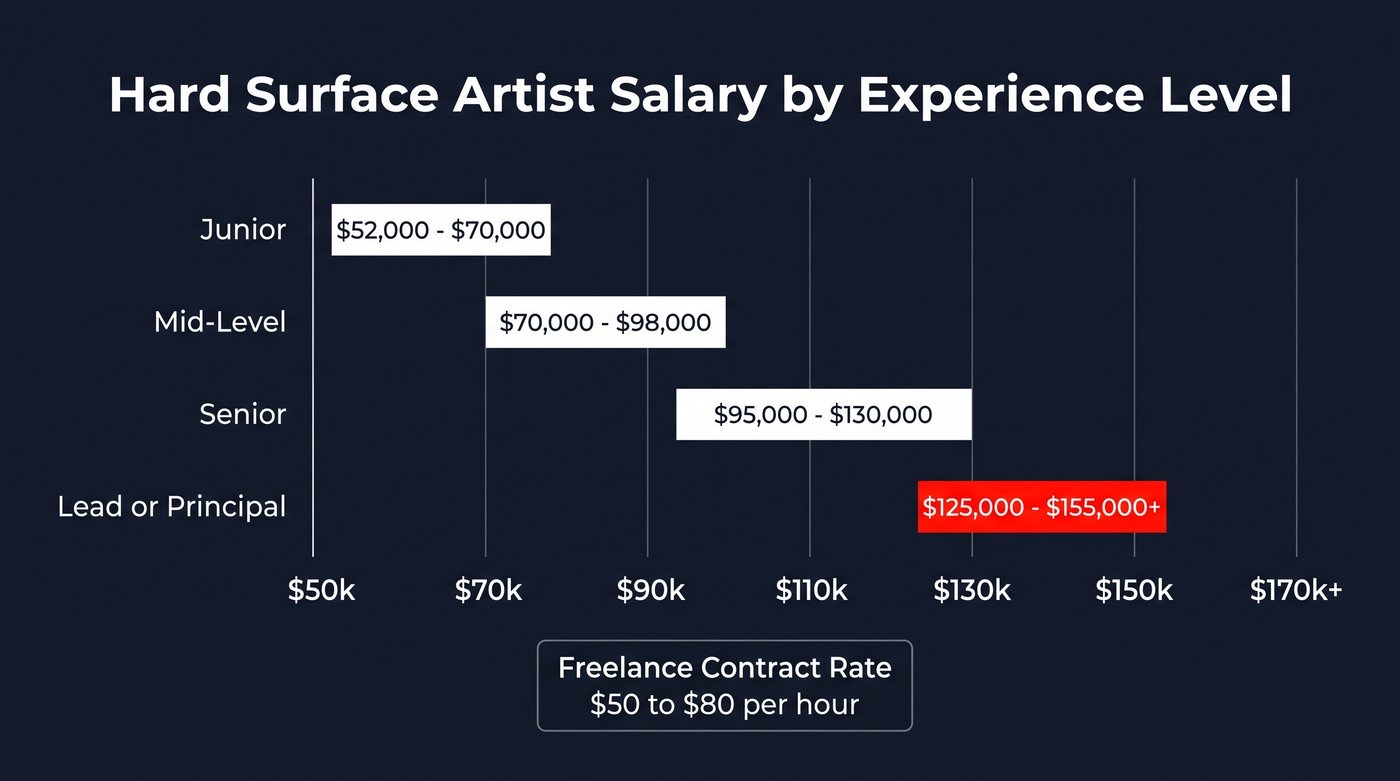
Hard surface artists specialize in modeling man-made, mechanical, and inorganic objects: weapons, vehicles, armor, spacecraft, and industrial environments. According to ArtBlast's 2026 salary data, U.S. in-studio salaries range from $52,000 at junior level up to $155,000+ for lead roles, with freelance contracts for experienced talent often hitting $50 to $80 per hour.
Whether you are just entering the field or pushing toward a six-figure ceiling, understanding these numbers gives you the leverage to negotiate smarter, specialize strategically, and know when it is time to move on.
Key Findings: Hard Surface Artist Salary
- Junior hard surface artists earn $52,000 to $70,000; mid-level earn $70,000 to $98,000.
- Senior artists earn $95,000 to $130,000; leads reach $125,000 to $155,000+.
- Experienced freelancers charge $50 to $80 per hour, roughly $104K to $166K annualized.
- AAA studios and weapons/vehicle specialization pay above the band.
- ZBrush, Substance, and game-ready topology skills command the premium.
Hard Surface Artist Salary by Experience Level (U.S. Game Industry)
The clearest picture of hard surface artist pay comes from tiered, role-specific data, not broad "3D artist" averages that lump generalists and specialists together. Here is what the 2026 market actually looks like for in-studio roles in the U.S. game industry.
| Experience Level | Annual Salary Range | Hourly Equivalent |
|---|---|---|
| Junior | $52,000 – $70,000 | $25 – $34/hr |
| Mid-Level | $70,000 – $98,000 | $34 – $47/hr |
| Senior | $95,000 – $130,000 | $46 – $63/hr |
| Lead / Principal | $125,000 – $155,000+ | $60 – $75+/hr |
| Freelance / Remote Contract | $50 – $80/hr (experienced) | ~$104K – $166K annualized |
ZipRecruiter's June 2026 data places the average hourly pay for full-time 3D hard surface artists at $39.46, with most workers earning between $27.16 and $48.56 per hour. The 25th to 75th percentile annualized band sits at roughly $56,500 to $101,000 per year, consistent with the mid-level tiers above.
Remote and work-from-home postings skew significantly higher. ZipRecruiter's "work from home hard surface artist" category shows an average of $129,541 per year, with top earners reaching $152,000 in 2026. These figures represent senior and lead specialists, not typical entry-level positions.
How Specialization Shapes Your Hard Surface Artist Salary
Not all hard surface work pays the same. Where you focus, and which tools you master, can push your salary well above the standard bands.
Vehicles and Weapons Specialists
ArtBlast notes that weapon and vehicle specialists at AAA studios can push senior salaries beyond the standard $95,000 to $130,000 range. These assets demand technical precision, an understanding of real-world engineering, and the ability to optimize high-poly detail for real-time engines. Studios pay a premium for artists who can deliver hero props that hold up in close-up cinematic shots.
Architecture and Environment Hard Surface
Architecture-focused hard surface artists generally fall within the mid-to-senior bands. The work is high-volume and relies heavily on modularity and Unreal or Unity integration skills. Adding cross-engine proficiency to your toolkit is one of the fastest ways to justify a higher rate in this sub-specialization.
Hard Surface vs. Related Roles
Community salary data from an industry art pipeline chart positions the broader competitive landscape like this:
- Character Artist / Sculptor: Currently the top-earning 3D artist category in game development
- Technical Artist / Rigger: Often outearns hard surface due to scripting and pipeline skills
- Hard Surface Modeler: $57,000 – $76,000 mid-range benchmark, above most 2D and compositing roles
- Environment / Generalist Artist: Typically at or below hard surface modeler ranges
- Lighting Artist / Compositor: Comparable or slightly lower than hard surface at mid level
The takeaway is clear: specialization in hard surface places you above the generalist floor, and niche expertise in vehicles or weapons lifts you toward the top of the art department.
Freelance and Remote Hard Surface Artist Rates
Freelancing offers some of the strongest per-hour rates in the field, particularly for experienced artists working on U.S. remote contracts. Real-world job postings on ZipRecruiter show $50 to $80 per hour for senior hard surface work on remote engagements. Annualized at a full-time equivalent, that is roughly $104,000 to $166,000 per year before taxes and benefits.
The U.S. Department of Labor's H-1B and PERM disclosure filings report a national median of $52,666 for the "hard surface modeler/artist" title specifically. This figure represents employer-reported prevailing wages in visa sponsorship contexts and is a useful floor for understanding minimum competitive pay in formal hiring processes.
VFXengine's global modeler data adds useful cross-country context, reporting a global median of $71,000 with a U.S. average around $85,000 and a U.S. senior average of $128,000. Notably, VFXengine recorded a negative 35.9% shift in median modeler salary from 2024 to 2025, signaling possible rate compression or offshoring pressure at the median. Top-band salaries, however, remain strong.
How to Move From $50K to $120K+ as a Hard Surface Artist
Salary growth in this field is rarely linear. Here is a concrete step-by-step path based on what the data and working artists consistently report.
- Nail a specialization early. Pick vehicles, weapons, or architectural hard surface and build your portfolio around that niche. Generalists hit a ceiling faster. Studios hiring for AAA productions want depth, not breadth.
- Master the full tool stack. Maya or 3ds Max for base modeling, ZBrush for high-poly sculpt, Substance 3D Painter for texturing, and Marmoset Toolbag for presentation are table stakes. Add Unreal Engine real-time pipeline skills to jump into the senior bracket.
- Update your portfolio every six months. Stale portfolios kill salary negotiations. Match your work to the visual standard of the studios you are targeting, not where you were two years ago.
- Change studios to change your salary. Working artists on Reddit's r/Maya community consistently note that job hopping delivers larger pay bumps than internal raises. Moving from a mid to a senior title at a new studio almost always pays more than a promotion in place.
- Transition to remote contract work. Once you have three-plus years of production experience, remote contracting at $50 to $80 per hour dramatically accelerates your earning trajectory compared to a fixed staff salary at a mid-tier studio.
- Add cross-disciplinary skills. CAD-adjacent workflows, basic Python or MEL scripting, and real-time engine optimization skills signal to hiring managers that you are a force multiplier, not just a modeler. These skills increasingly justify senior and principal-level compensation.
Industry Outlook: Is Hard Surface Art a Good Career in 2026?
The U.S. Bureau of Labor Statistics projects arts and design occupations will add approximately 84,900 openings per year from 2024 to 2034, primarily driven by replacement needs rather than explosive new growth. The broader category median sits at $53,180 annually as of May 2024, which underscores just how far above average a specialized hard surface artist at a senior level can climb.
Studios are tightening budgets while simultaneously ramping up 3D content for AA and AAA games, streaming series, and real-time pipelines. That tension creates a sharp divide: generalists face more competition and slower pay growth, while highly specialized hard surface talent with production-ready skills remains in strong demand.
The Reddit community perspective echoes this: salary growth in 3D is exponential with seniority, and principals sometimes earn double what juniors make at the same studio. The field rewards patience, specialization, and strategic career moves over simply logging time.
Conclusion: What the Hard Surface Artist Salary Guide Tells You
This hard surface artist salary guide points to four clear takeaways for digital artists planning their next move:
- U.S. salaries run from $52,000 at entry level to $155,000+ at lead, with remote senior contracts reaching $80 per hour
- Specialization in vehicles, weapons, or complex mechanical assets consistently pushes pay above the mid-range band
- The biggest salary jumps come from changing studios, not waiting for internal promotions
- Adding real-time engine skills and cross-disciplinary workflows is the fastest way to break into six-figure territory
The data is clear: hard surface artistry is a financially viable and upwardly mobile career path for digital artists who specialize, stay current, and advocate for their market value. Use these benchmarks as your negotiation foundation, and do not leave money on the table. For those considering broader career paths in game art, explore 3D artist career progression to understand how hard surface specialization fits into the larger industry landscape.
Frequently Asked Questions
What is the average salary for a hard surface artist in the U.S.?
The average salary for a full-time hard surface artist in the U.S. is approximately $39.46 per hour, or roughly $70,000 to $85,000 per year for mid-level roles in 2026. Senior positions typically earn $95,000 to $130,000 annually, while lead and principal roles can exceed $155,000. Remote and contract roles for experienced artists often pay $50 to $80 per hour.
How much does a junior hard surface artist make?
Junior hard surface artists in the U.S. game industry typically earn between $52,000 and $70,000 per year. Entry-level roles in smaller studios or non-game industries may start closer to $52,666, which aligns with U.S. Department of Labor H-1B prevailing wage filings for the hard surface modeler/artist title. Building a strong niche portfolio speeds up the move into the mid-level pay band.
What is the highest-paying specialization for hard surface artists?
Vehicle and weapons specialists at AAA game studios command the highest pay within the hard surface discipline, often pushing senior salaries beyond the standard $95,000 to $130,000 range. Adding real-time engine skills (Unreal Engine, Unity) and cross-disciplinary knowledge like scripting or CAD-adjacent workflows further increases earning potential and justifies principal-level compensation above $150,000.
How does hard surface artist pay compare to character artists and technical artists?
Within game development art pipelines, character artists currently hold the top earning position among 3D artist roles. Technical artists, who combine artistry with scripting and pipeline skills, also frequently outpay hard surface generalists. Hard surface modelers sit solidly above environment generalists and most 2D roles, with a community-reported mid-range benchmark of $57,000 to $76,000 per year for mid-level positions.
Is freelancing worth it for hard surface artists?
Freelancing is highly attractive for experienced hard surface artists. U.S. remote contract postings show rates of $50 to $80 per hour for senior-level work, which annualizes to roughly $104,000 to $166,000. ZipRecruiter's work-from-home category for hard surface artists averages $129,541 per year. The tradeoff involves managing benefits, taxes, and pipeline inconsistency, but for artists with strong portfolios, freelancing often accelerates income growth significantly.
What tools should a hard surface artist learn to earn more money?
The core tool stack for competitive pay includes Maya or 3ds Max for base modeling, ZBrush for high-poly detail, Substance Painter for texturing, and Marmoset Toolbag for portfolio presentation. To reach senior and lead salary brackets, adding Unreal Engine real-time workflow skills, Modo, and basic scripting (Python or MEL) makes you significantly more valuable. Studios increasingly pay premiums for artists who can bridge art and technical pipeline roles.
Are hard surface artist salaries declining in 2025 and 2026?
There is mixed data on this. VFXengine reported a notable negative 35.9% shift in median modeler salary from 2024 to 2025, suggesting possible rate compression or changes in the sample pool, including offshoring pressure at the median level. However, top-band salaries for senior and lead specialists remain strong through 2026, and ZipRecruiter data shows stable to rising rates for remote and specialized roles. Generalist pay appears more exposed to compression than specialist pay.